

Welcome to Transformer, your weekly briefing of what matters in AI. And if you’ve been forwarded this email, click here to subscribe and receive future editions.
Housekeeping: We’re taking next Friday off for the July 4th weekend. Happy 250th, America!
NEED TO KNOW
House Energy and Commerce Committee members reached a bipartisan deal on the Kids Online Safety Act. Sen. Marsha Blackburn said she aims to incorporate the Senate’s version into a federal AI framework by July 4.
Rep. Frank Pallone, the top House Democrat on the Energy and Commerce Committee, called for a national AI data center moratorium.
Google released a new AI policy framework calling for government-overseen frontier model audits, among many other things.
But first…
THE BIG STORY
The White House has told OpenAI not to publicly release GPT-5.6 yet, multiple outlets reported on Thursday: the clearest sign yet that the US now has a licensing regime for frontier AI models.
In a memo to staff, The Information reported, Sam Altman said the government would be “approving access customer by customer during this preview period,” with a general release hoped for a “couple of weeks later.” The decision was reportedly made by the Office of the National Cyber Director and Office of Science and Technology Policy, driven by the same cyber risk concerns that blocked Fable’s deployment earlier this month.
As we’ve previously written, this de facto licensing regime was inevitable. And while it is frustrating to watch the government scramble to act, without any defined standards or benchmarks for what does make a model safe to release, it is a good thing that it is acting at all.
And there are some signs that we are moving towards a more thoughtful governance regime. Altman said he’d told the government that the current ad hoc rules are “not our preferred long term model,” while Axios reported that the delay was in part motivated by allowing the government to finish building its testing and evaluation framework. The current chaotic regime will, if we’re lucky, soon be replaced with something befitting the seriousness of the situation.
— Shakeel Hashim
ALSO NOTABLE
OpenAI and Anthropic are loading up on talent — the sheer quantity of “I’ll Be Joining [insert AI company]” tweets has already inspired a new meme template for the terminally online.
Some of the latest buzzy announcements haven’t come from AI researchers, though. AGI-pilled economists Chad Jones, Anton Korinek and Alex Imas all recently left their academic jobs to join the Anthropic Institute and Google DeepMind. Philosophy professors Atoosa Kasirzadeh and Henry Shevlin left the ivory tower for GDM. And just last week, former White House AI advisor Dean Ball announced his new role as OpenAI’s head of strategic futures.
It’s starting to feel like any “outside expert” who’s AGI-pilled enough to thoughtfully critique the trajectory of AI development will get devoured and metabolized inside the belly of the beast.
The appeal is undeniable. The median salary for US-based professors of philosophy, political science, and economics ranges from $80,000-$124,000; an entry-level “Research Economist” at Anthropic earns nearly three times that.
Access may be even more tempting than money. You can’t understand a machine without taking it apart, nor can you witness the bleeding edge of AI without “going in,” as Dean Ball put it in a blog post. Decisions made inside companies, obscured from the outside world, he argues, will prove “more central to the future of AI than most people realize.”
This brain drain is not unlike the revolving door that’s haunted the public sector for decades. When a regulator, for instance, bounces between a federal agency and the industry they police, their incentives shift, perhaps subtly enough to go undetected. When the experts best positioned to keep AI companies honest increasingly work for them, or even think they have good odds of doing so in the future, we quickly risk the same dynamic starting to form.
Some have accused humanities-pilled AI companies of “ethics-washing,” signaling some commitment to safety while projecting an aura of legitimacy. After all, the public might think, these guys must be making super powerful models, if economists and philosophers are paying attention.
Whether these gripes are legitimate, or just old-school researchers yelling at clouds, every expert hired by industry is an expert lost to the nonprofit and public research ecosystem. Talent is finite, and AI companies are willing and able to make top candidates offers they can’t refuse.
It’s possible to over-romanticize the virtues of academic intellectual autonomy. Academics answer to perverse incentives too. The AI world is also, for now, marked by a surprising openness from those working at its leading companies, including criticism of their employers.
But there’s no doubt that some topics will remain off the table for the wide range of experts being hoovered up. It’s also inevitable that when “epistemically permeable” people (to borrow Anthropic philosopher Joe Carlsmith’s phrase) lock themselves in the same intellectual echo chamber as the leaders they’re meant to inform, critique and constrain, they risk drifting toward the industry’s cognitive mean. And, potentially, away from the intellectual independence that helped make them so valuable in the first place.
— Celia Ford
THIS WEEK ON TRANSFORMER
Hugging Face hosts nudification tools targeting a former Trump cabinet official and other senior US political figures — Shakeel Hashim reports the evolution of the deepfake porn ecosystem
What Alex Bores’ defeat tells us about AI politics — Veronica Irwin and Shakeel Hashim on the takeaways from New York’s primary battle
THE DISCOURSE
Jason Calacanis was uncharacteristically doom-y on main:
“Dario created an AI machine gun, and there’s no way to give everybody one without bullets flying everywhere. That’s why he held it back, and that’s why the government asked him not to sell it to our adversaries. This is only going to get crazier from here, folks.”
“If you spend trillions of dollars to summon a demon that you can’t control and don’t understand, don’t be surprised when he shows up and burns the place down. [ Yes, I’m talking about AI ]”
roon thinks we should embrace the sci-fi of it all:
“as the technology becomes more science fiction i see a lot of commentators, technical staff etc trying hard to not think thoughts that feel science fiction as a defense mechanism. but you need to. it’s the only way you’ll make good choices for the future”
“you are not building b2b computer tools you are making the Mind Children”
David Shor added:
“Setting aside tedious debates about what exactly is going to happen, *voters* buy into the sci-fi narrative about how this is going to evolve. Politicians and DC staffers have a strong aversion to sounding weird — but here they’ll have to learn to change their register.”
Robert J. Shiller is sick of everyone’s doommaxxing:
“I believe A.I. could lower employment. But unlike most, I don’t necessarily blame the technology itself. Instead, I worry about the potency of the fear it is generating.”
“When millions of people make millions and millions of decisions based upon negative expectations, there is a risk that fear can actually help birth the reality.”
“Perhaps the best we can do is to appeal directly to the leaders of Silicon Valley who have been promoting these negative narratives with such vigor. Surely the resulting media attention highlighting how dangerously powerful your AI model is may help you sell more wares, but it may be far harder to do so in a period of recession.”
Zvi Mowshowitz’s cynical takeaway:
“So the real lesson is to shape the narrative, which is a nice term for lying.”
Satya Nadella is sick of OpenAI, Anthropic and Google:
“You can’t say, hey, all white-collar jobs are gone and this could even be a weapon and we will use all the power to build data centers.”
“No amount of just narrative is going to do it [fix what’s wrong in the AI race] because where we are now, we have to sort of walk the walk … we now have to do the hard work in earning the social permission.”
Ozy Brennan asked AI doomers how they cope with expecting an untimely death:
“AI doom is a remarkably cozy catastrophe … the AI apocalypse — at least for those with the slack to be worried about it — takes place in a world of wealth and relative peace and technological marvels.”
“The enormity of the AI apocalypse is its own perverse source of comfort … instead of many big problems, they have one enormous problem. Worry about AI frees them from having to worry about anything else.”
POLICY
Anthropic CEO Dario Amodei has been replaced in White House meetings by cofounder Tom Brown after the Trump administration reportedly found Amodei “too difficult to talk to.”
“Tom Brown is not being a weirdo like Dario and can actually engage,” a source told Wired.
Anthropic staff met Monday with senior Trump administration officials to discuss easing the export ban on Fable.
The NSA reportedly lost access to Mythos amid the clash between Anthropic and the White House. Agency analysts had been testing the tool.
House Homeland Security Committee Chair Andrew Garbarino said he’s scared by the private demos he’s seen of Mythos, and wants Congressional action — but that “we don’t know what the answer is, we don’t know what we have to do.”
Legal tech startup Legion sued the US government over the Fable and Mythos bans, arguing that “the harm to Legion is immediate, irreparable, and existential.”
President Trump told Axios he viewed Anthropic as a national security threat a couple weeks ago, but after discussions with Amodei at the G7 he came away thinking he was “nice” and “smart.”.
The Financial Times reported that Anthropic used risk-related language 8x more than OpenAI in 2026, possibly contributing to the White House’s concerns.
The Trump administration pressed Meta to submit its AI models for government safety reviews. It’s the only major US AI developer not signed up to the evaluations.
House Energy and Commerce Committee members reached a bipartisan deal on the Kids Online Safety Act, which requires platforms to curb harm to minors and expand default safety settings.
That version has not been reconciled with the Senate’s, which requires companies to exert a “duty of care” and proactively intercept harms to children.
Sen. Marsha Blackburn said she aims to incorporate the Senate’s version into a federal AI framework by July 4.
Sen. Ted Cruz is also inserting himself into the conversation, telling Punchbowl that Senate KOSA markup talks are “ongoing” and likely to occur in July.
Rep. Frank Pallone, the top House Democrat on the Energy and Commerce Committee, called for a national AI data center moratorium.
Sens. Chuck Grassley and Dick Durbin reportedly want to include the DEFIANCE Act in the NDAA.
OpenAI became the first AI firm to endorse the legislation, allowing people to sue producers of nonconsensual sexually-explicit AI deepfakes.
The House Science Committee marked up 10 AI-related bills, including measures to establish an AI research resource, develop AI vulnerability reporting systems, and create standards for AI-generated content detection.
Rep. Nate Moran introduced the AI Incident Reporting Act, which would require AI companies to report dangerous capabilities, security breaches and safety incidents to the Commerce Department within seven days.
Reps. Brian Babin and Jay Obernolte introduced a bipartisan bill establishing a Center for AI Security and Innovation at the Commerce Department to assess national security risks from AI.
The agency is technically different from the existing CAISI office, which the bill does not propose codifying.
The Trump administration announced $17.5b in loans for 10 new large nuclear reactors to meet power demand from data centers, with construction potentially beginning by 2030.
The US proposed an AI partnership with the EU to secure semiconductor supply chains, though some EU capitals expressed concerns it could favor the US AI ecosystem.
The Netherlands lobbied the US to drop the MATCH Act, which would expand export controls on ASML‘s chip equipment sales to China.
US immigration agency spending on AI-powered surveillance tech soared to a record $513m in 2026, with Palantir and Anduril receiving the largest contracts, according to a report by Mijente, legal advocates Just Futures Law and research group Surveillance Resistance Lab.
Nevada enacted AI regulations restricting use in mental health settings and emergency planning.
Five Eyes intelligence agencies warned that “frontier AI models are anticipated to exceed current industry expectations,” and would transform cyber capabilities in “not years, [but] months.”
The Pentagon has reportedly quietly revised its rules for choosing military targets to envision “systems where AI initiates actions with human monitoring,” according to documents reviewed by Bloomberg.
In a letter to the Senate Banking Committee, Anthropic accused Alibaba of adversarial distillation, allegedly using 25,000 fake accounts to run nearly 29m Claude chats.
It asked for government help to prevent distillation efforts in future.
Alibaba, meanwhile, asked a US court to force the Pentagon to remove it from a blacklist of companies linked to the Chinese military, calling the listing “arbitrary and capricious.”
Norway imposed a near-ban on generative AI use by elementary school students (ages 6-13) and restricted its use for older students, citing concerns about impacts on learning basic skills like reading, writing and math.
Utah State Sen. J. Stuart Adams lost his Republican primary after voter backlash over his support for a 40,000-acre AI data center project near the Great Salt Lake.
INFLUENCE
Micah Lasher beat Alex Bores in New York’s 12th District Democratic primary. AI groups ended up spending $27m on the race, with more than $8m from the pro-industry Think Big PAC opposing Bores, and more than $19m from AI safety PACs defending him.
Google released a new AI policy framework calling for government-overseen frontier model audits and the prioritization of workforce preparedness, children’s protections, modernized energy infrastructure and various guardrails.
Former Commerce Secretary Gina Raimondo launched RAISE US, a nonpartisan workforce initiative backed by the OpenAI Foundation, Anthropic, and others with over $500m in private capital to help workers adapt to AI’s economic impact.
A poll found that only a small fraction of data center opponents actually live near one, suggesting they have become a stand-in for broader anger at AI.
FAI Action, the 501(c)(4) affiliated with the Foundation for American Innovation, hired Mission Strategies to lobby on energy and AI policy.
Alliance for Secure AI CEO Brendan Steinhauser and MIRI researchers briefed members of Congress on superintelligence risks and national security threats.
The UK’s GCHQ National Cyber Security Centre reported that AI will “almost certainly enhance threat actors” ability to exploit known vulnerabilities’ by increasing attack speed and volume, while highlighting indirect prompt injection as a particular concern.
AFL-CIO President Liz Shuler told Punchbowl that unions will make worker protections in AI a “litmus test” for 2028 presidential candidates, opposing data center moratoriums while pushing for federal AI guardrails and state regulatory authority.
The Atlantic did a deep dive on Vice President J.D. Vance’s AI messaging, which combines Silicon Valley’s anti-regulation stance with concerns about job displacement, arguing some forms of AI power are too important for Big Tech to self-regulate.
INDUSTRY
OpenAI
OpenAI is reportedly leaning towards delaying any IPO until next year, with advisers urging Sam Altman to be cautious in light of volatility in SpaceX’s post-IPO share price and other factors.
The report sparked steep declines in the shares of various companies linked to OpenAI, including a 12% drop at major investor SoftBank.
The company started testing Jalapeño, a custom AI chip developed from scratch in nine months, in partnership with Broadcom and Celestica.
According to OpenAI’s announcement, Jalapeño will perform “substantially better” per watt than current state-of-the-art chips.
It launched a more-capable GPT-5.5-Cyber alongside its “Patch the Planet” initiative, which aims to help open-source maintainers fix software vulnerabilities.
Project participants include cURL, Python and Sigstore, among others.
It pitched ChatGPT ads at Cannes Lions, the world’s top advertising conference, with ad lead Dave Dugan saying that 20% of chat queries have “direct commercial intent.”
It struck a licensing deal with Getty, granting the use of its images for display within ChatGPT.
The announcement sent Getty’s shares up 145%.
Artificial, the Sam Altman biopic starring Andrew Garfield, is struggling to find a distributor, with Netflix, A24 and Focus Features all reportedly turning it down.
Intelligencer noted that several of these studios are tied to OpenAI and/or Elon Musk, who’s also depicted in the film.
Anthropic
Mythos reportedly helped US intelligence service red teams find vulnerabilities in classified US government systems within hours.
Sen. Mark Warner had told a hearing earlier in the month that “the tool broke into almost all of our classified systems, not in weeks but in hours.”
An unnamed official clarified to AP that finding the vulnerabilities did not mean it was necessarily able to immediately exploit them.
Anthropic launched Claude Tag, an always-on agent that lives in Slack channels.
Tagging @Claude assigns it tasks (65% of the product team’s code at Anthropic is apparently already created this way). It bills by the token.
In Andrej Karpathy’s words:
“imo this is the 3rd major redesign of LLM UIUX. The first paradigm was that the LLM is a website you go to, the second was that it is an app you download to your computer. This third one is that it is a self-contained, persistent, asynchronous entity with org-wide tools and context, working alongside teams of humans.”
In Arvind Narayanan’s more cautious words:
Because it “soaks up tacit knowledge” out of sight of human team members, “Claude is a coworker that you can’t fire without every team losing workflows and know-how.”
SpaceX
SpaceX launched a $25b bond sale, primarily to pay off a bridge loan associated with its xAI acquisition.
The sale saw strong demand, but SpaceX is paying a higher rate of interest, reportedly due to concerns over its long-term prospects.
Its shares have slipped almost 5% from their first day trading two weeks ago.
It signed a $6.3b deal with Reflection AI, giving the startup access to Nvidia GB300 chips at SpaceX’s Colossus 2 data center.
Meta
Meta paused the keystroke-monitoring tool its employees hated, after it accidentally exposed sensitive data from individual laptops to employees across the company.
It’s reportedly fast-tracking plans to replace human content moderators with LLMs.
Mark Zuckerberg is reportedly pushing to build a prediction market app, featuring AI-generated questions, to compete with Polymarket and Kalshi.
Kylie Jenner’s collection of cat-eye Meta glasses (featuring Kylie as Meta AI’s voice) launched.
Nvidia
Nvidia acquired the team behind Essential AI, an open model startup, to work on its Nemotron models.
It announced Halos software, inspired by the systems powering self-driving cars, to help humanoid robots learn to interact with humans safely.
Google invested $75m in film studio A24.
A24 will reportedly work with DeepMind to create new movie production and distribution tools.
It launched a 12-week incubator for Google alums building AI startups.
Others
Nvidia chips banned from China under US export controls doubled in price over the past six months due to tightening supply.
SK Hynix’s US stock listing raised $29.4b to expand memory chip capacity.
Its focus on high-bandwidth memory chips has helped it overtake Samsung to become the most valuable company in South Korea.
Ex-Anthropic researchers announced their Nvidia-backed startup Mirendil, raising $200m to help businesses and science labs build their own specialized self-improving AI.
Apple raised the price of most of its products due to memory chip shortages.
Qualcomm is planning a new China-specific data center chip line designed to comply with US export controls.
Microsoft partnered with Chevron to build a giant natural-gas powered data center in Texas.
Eli Lilly is using its GLP-1 money to collaborate with smaller biotechs, granting them AI compute in exchange for open-source data.
General Intuition raised $320m at a $2.3b valuation to train real world AI agents on video games.
Publishers representing nearly 400 newspapers sued OpenAI and Microsoft for scraping content without permission.
MOVES
John Jumper, who co-created AlphaFold, left Google DeepMind to join Anthropic.
After he posted about his departure, Alphabet shares fell 7%.
Google is reportedly reorganizing its new AI coding strike team, now that Noam Shazeer and John Jumper have both jumped ship.
Jonas Adler and Alexander Pritzel, also AI leads at Google, also reportedly plan to leave for Anthropic.
Chad Jones, a Stanford economics professor, is joining the Anthropic Institute.
Taylor Sorensen joined Anthropic’s Societal Impacts team.
Steve Jarrett, AI lead at French telecom group Orange, joined Anthropic to help it adapt to European and African markets.
Dawn Song, who co-directed UC Berkeley’s Center on Responsible Decentralized Intelligence, joined Meta Superintelligence Labs as VP of AI Research.
Meta also hired two of Song’s co-founders, Bo Li and Sanmi Koyejo, from AI security startup Virtue AI.
Calvin Zhang joined OpenAI from Scale AI, where he worked on Humanity’s Last Exam.
Alishba Imran joined OpenAI from Biohub.
RESEARCH
Daniel Schiff, Michael Noetel, Stephen Casper and David Manheim published consensus guidance on AI evaluation practices, which has since garnered endorsements across the AI industry, academia and government.
Researchers at Graphite found that when frontier AI models rely on AI-generated web content (which now makes up something like 50% of all online content), their responses often collapse into near-identical outputs.
Rishub Jain, a former Google DeepMind researcher, announced a new nonprofit focused on scalable and human oversight.
Exponential View released the State of the AI Economy report, finding that total annualized revenue has hit $175b.
The report said revenues hit $25b in Q1 2026, more than the $21b capex depreciation associated with data centers and chip investment, providing a narrow margin for profitability.
“For now, the economics are holding … But the margin for error is narrow,” said the report, which added that financial risks were moving into capital markets.
BEST OF THE REST
Stripe, Anthropic and OpenAI poured money into Intercept, a new nonprofit that aims to get rid of respiratory viruses with vaccines and air-cleaning systems.
Vox’s Bryan Walsh feels the thrill of AI models doing cool things, too — and worries that this is exactly what led Oppenheimer to support work on atomic bombs. “When you see something that is technically sweet,” Oppenheimer once said, “you go ahead and do it, and you argue about what to do about it only after you have had your technical success.”
TIME’s Billy Perrigo explores how Cold War-era verification tech could help slow down AI development.
CEOs promise AI will someday cure all diseases, but computer science professor Emma Pierson would rather risk cancer than see AI progress at its current pace.
We have enough electricity to power AI data centers, but our current grid system means we can’t get it to them.
Sorry, everyone can tell your website is Claude Coded.
Are you in the weights?
MEME OF THE WEEK
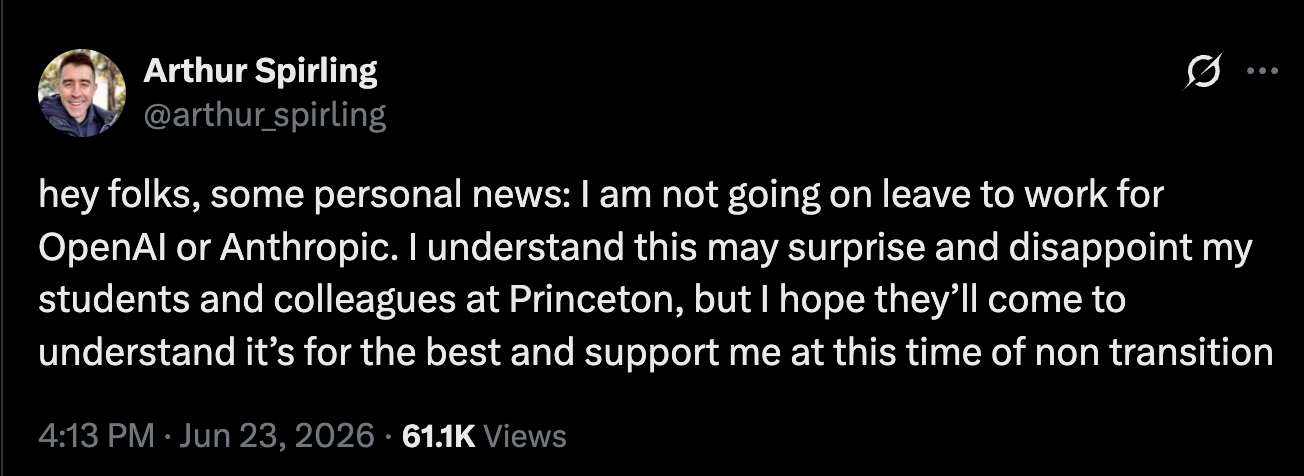
(Credit: @arthur_spirling)
Thanks for reading. Have a great weekend.
I think Bloomberg is over-simplifying the cause and effect of John Jumper's move and the 7% stock plunge.
They even write it in the article themselves:
"Amazon was down as much as 5% while Meta Platforms Inc. and Microsoft both fell more than 3%."
This could also be seen as a broader shift in the industry. As far as I know, Amazon didn't lose any star AI researchers, and also took a significant dive.