

In mid-November, executives from Meta, Google, Microsoft and OpenAI left behind their sleek, modern offices for a radically different setting: the Sala Clementina, a fresco-adorned marble hall at the heart of the Vatican City’s Apostolic Palace. They were joined there by European politicians, faith leaders, and AI safety activists — including Megan Garcia, the mother of Sewell Setzer III, a 14-year-old who took his own life after interacting with an AI chatbot — for “The Dignity of Children and Adolescents in the Age of Artificial Intelligence” conference.
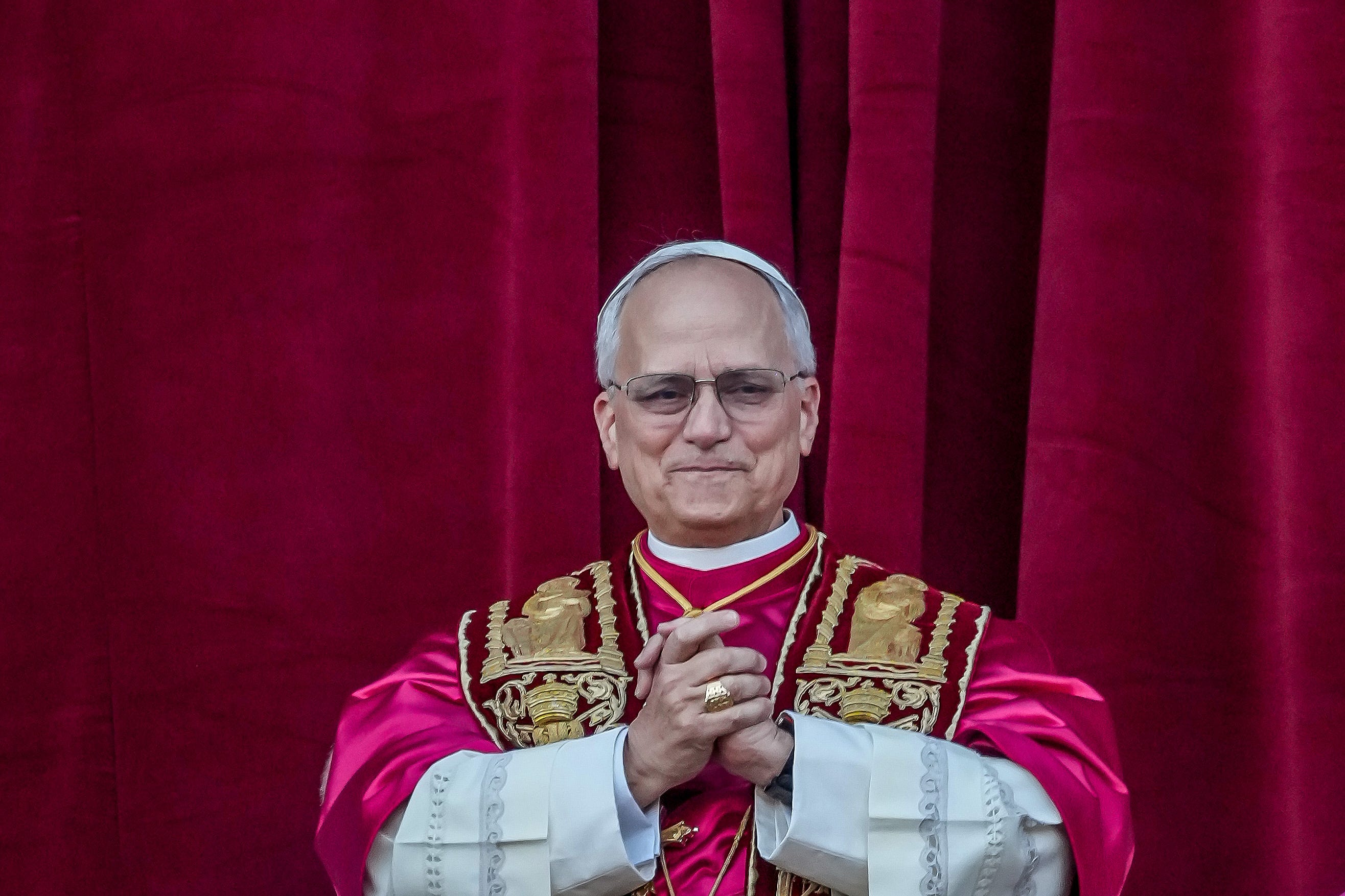
The group had gathered to meet Pope Leo XIV himself, who has dedicated no small part of his papacy to the topic of artificial intelligence. Before the assembled tech luminaries and critics alike, he delivered a strongly-worded statement on the risks AI posed to young people, urging reforms like “updating existing data protection laws” and implementing “ethical standards for the development and the use of AI.”
This was just one of numerous working groups, conferences, and private meetings that have taken place in the Vatican City this year around AI. They have all been leading up to a forthcoming landmark document, in which the Vatican is expected to take a clear moral stance on both the dangers and opportunities posed by the technology.
The 2,000-year-old institution may seem like an unlikely place to seek guidance on futuristic technology, but as the US government and the corporate world have all but relinquished moral authority on AI, some are hoping the Vatican can provide the rallying cry their movement needs to stay relevant. “We’ve unfortunately fallen sometimes into this false dichotomy as though we have to choose between moral responsibility and innovation. But in fact, placing guardrails and adopting responsible ethical design principles is actually in the best interest of any country, of any society,” said Father Michael Baggot, a Professor Aggregato of Bioethics at the Pontifical Athenaeum Regina Apostolorum, who attended the November event alongside Megan Garcia.
Sources in touch with the Vatican believe the encyclical — a public-facing letter written by the pope to the bishops of the Catholic Church — will arrive in the coming weeks, possibly to coincide with a symbolic date in the liturgical calendar. (The Feast of the Holy Innocents on December 28, Epiphany on January 6, the Conversion of St. Paul on January 25, and the Feast of St. Thomas Aquinas on January 28 could all be argued to have thematic ties to the topic.)

The appointment of Cardinal Robert Francis Prevost to the papacy in May was unusual for several reasons. The 70-year-old is the first American Pope in history, and has demonstrated particularly modern and technical interests, having studied mathematics as an undergraduate at Villanova University. He deliberately chose his papal name, Pope Leo XIV, to echo Pope Leo XIII, who presided over the Church at the height of the Second Industrial Revolution.
The new pope’s coming encyclical is thought to be modeled after “Rerum Novarum,” Pope Leo XIII’s 14,000-word treatise from 1891 on social changes under industrialization. That document blended religious teachings with political and economic philosophy to argue that new reforms were needed to protect human rights and relieve poverty in an age where exploitative, laissez-faire capitalism had run rampant. But the Pope also warned against the rising tide of socialism, emphasizing the need to protect private property, limit government intervention, preserve patriarchal family structure, and reject revolutionary class struggle.
In short, the document called for a pact of mutual respect between capital and labor — and in many ways, it worked. Over the course of the following decades, the encyclical helped inspire tangible reforms like child labor laws and shorter working hours, as well as a new political movement in Europe’s Christian Democrats, who sought a middle path between unconstrained capitalism and socialist revolution.
Advocates for safer AI — with concerns ranging from catastrophic long-term risks to immediate worries about the impact on young people and democracy — are hoping that the modern Vatican’s words can prompt similarly meaningful action by AI labs, regulators, and consumers alike. Rather than existential risks potentially posed by the technology, the document is expected to center on AI’s near-term challenges, including child safety, labor displacement, and the fracturing of human relationships. (A group of activists is, however, petitioning the Pope to take the prospect of civilization-ending AGI more seriously.)
Just a few years ago, a dispatch from the Vatican might have fallen on deaf ears. But after years of decline, the Church has seen a sudden revival in the United States in recent years. That growth has been surprisingly pronounced in conservative Silicon Valley circles. Some speculate that this simply reflects a broader shift towards conservatism in Silicon Valley. Others argue that AI researchers in particular are struggling to reckon with their own role in crafting a novel form of intelligence and seeking guidance in faith.
At the same time, the deregulatory paradigm of Trump 2.0 has helped give rise to an era marked by so-called “vice-signalling,” as investors have shamelessly funneled dollars into gambling apps, cheating tools, and adult content providers. AI companies, too, have embraced the lucrative opportunity to promote addictive video streams, advertising, and sexualized content in their products.

The growing influence of effective altruism in the AI safety debates of the early 2020s also helped catalyze an oppositional movement known as AI accelerationism, whose proponents believe that advancing AI with maximum speed and minimal constraints is both the most profitable and the most positive way forward for humanity. (One of the most prominent accelerationists has expressed ambivalence about human extinction as long as we’re replaced by “worthy” machine descendents.) Two of the most visible leaders of this cohort are Marc Andreessen, who penned the “Techno-Optimist Manifesto” in 2023 and Peter Thiel, who recently gave a lecture series on the idea that limiting technological progress would amount to summoning the Antichrist.
Brian Patrick Green, the director of technology ethics at the Markkula Center for Applied Ethics at Santa Clara University, believes this trend is now reaching its breaking point. “There’s an openness right now, which is unusual,” said Green of Silicon Valley’s willingness to hear out arguments for deceleration, pointing to the outsized backlash when Andreessen posted a meme mocking the Pope’s call on X to “all builders of #AI to cultivate moral discernment as a fundamental part of their work.”
“That’s not to say that folks in Silicon Valley are going to all come around and agree with the Pope, said Green. “Some of them are no doubt going to go into attack mode and figure out ways to subvert any messages coming from the Vatican.”
Earlier this month, President Donald Trump signed an executive order, championed by the White House’s AI and crypto czar David Sacks, that will centralize regulatory authority on AI in the federal government and neuter states’ ability to put guardrails on the technology. This type of federal preemption policy has proven tremendously unpopular with voters across party lines. A November YouGov poll conducted by the conservative think tank the Institute for Family Studies found that 57% of voters opposed a congressional bill that could block states from regulating AI.
Michael Toscano, Director of the Family First Technology Initiative at the Institute for Family Studies, said there is a significant cohort of executive branch staffers — especially religious ones — who feel increasingly at odds with the administration’s direction. “There’s a certain amount of disappointment that they have with the way things have unfolded, that the populist orientation of the White House seems to have been put in the back burner for just in-your-face memes and,” he argued, “the most libertarian approach to AI policy you can ever imagine.”

As this struggle continues to unfold, all eyes will be on Vice President JD Vance, arguably the most prominent Catholic in American public life today, and who has repeatedly argued that excessive regulation could strangle critical AI development. Since the 2024 presidential campaign, Vance has represented a critical bridge between the conservative movement and the libertarian tech right — and a direct embodiment of the contradictions inherent in that partnership.
Vance has expressed some openness to the idea that a religious authority might take up the mantle of AI safety. “The American government is not equipped to provide moral leadership… in the wake of all the changes that are going to come along with AI,” he told Ross Douthat in a May interview. He continued, “I think the Church is.”
Those concerned about AI are hoping that will count for something. “We are actively talking to the Vatican in advance of the encyclical,” said one State Department official who spoke on the condition of anonymity, continuing, “I do think people underestimate how important the Vatican is to global diplomacy.”
Others fear the encyclical could fall flat, with an impact less like “Rerum Novarum” and more akin to Pope Francis’s climate change-focused encyclical “Laudato Si’,” which nudged public opinion polling slightly but, given the current state of the climate movement, can hardly be said to have had a long-term impact.
For hints of what’s to come, curious observers might look to a doctrinal note about AI published by the Vatican’s Dicastery for Culture and Education in January titled “Antiqua et Nova,” or a statement signed in October by the Pope’s AI advisor Paolo Benanti, alongside a batch of unusual allies, like AI pioneers Geoffrey Hinton and Yoshua Bengio, former Trump strategist Steve Bannon, and celebrities like Joseph Gordon-Levitt and Meghan Markle, calling for a prohibition on the development of superintelligence until certain guidelines are met. In an opinion piece today for Transformer, Benanti writes that “the development of superintelligence cannot be permitted to proceed without sufficient oversight.”
As the policy world awaits the encyclical, those in DC are anticipating a period of reflection before making any big moves. “The first thing we do is we cross ourselves and we read deeply and we take out our highlighter and underline everything we possibly can,” said Toscano. Then, depending on the contents, he expects a renewed push for action. “I hope that it will throw the gauntlet down for what I think is an anti-human spirit which is emanating out of Silicon Valley.”
