

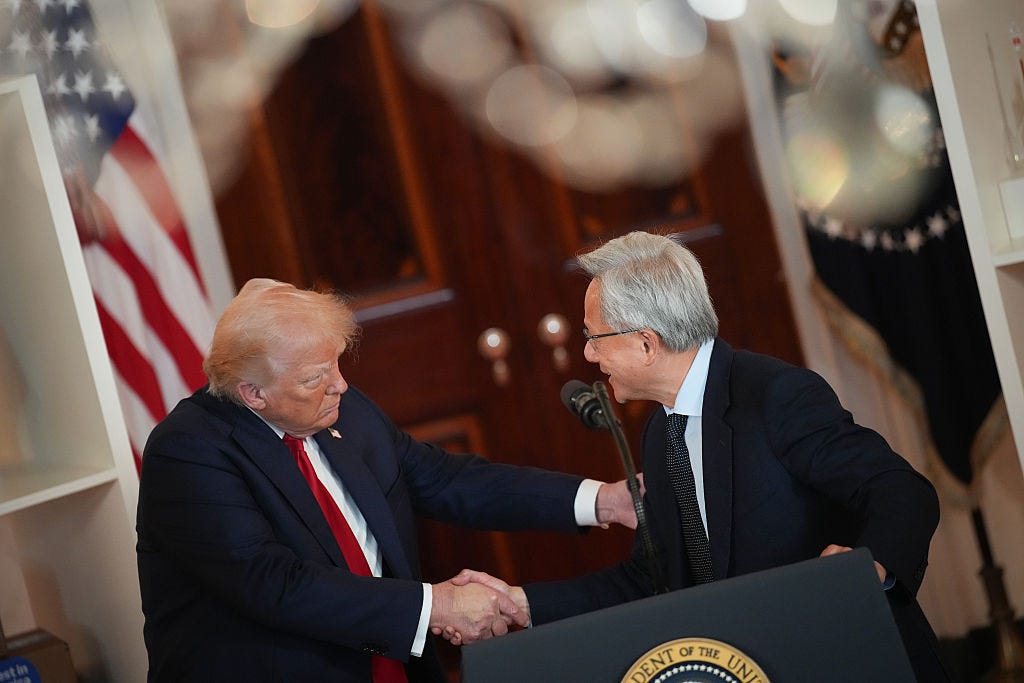
Nvidia has drastically ramped up its spending on lobbying in Washington, but the center of gravity for its influence operation lies in a much more personal relationship, the one between President Donald Trump and the chip company’s CEO, Jensen Huang.
That relationship, by all accounts, is strong. So too is Huang’s standing with administration officials hailing from the tech right, most notably David Sacks.
Elsewhere in Trumpworld, however, Huang appears to be racking up enemies almost as fast as he’s cranking out chips, with tensions simmering behind the scenes for months.
Sources in the president’s orbit credit Huang for managing his relationship with Trump better than any other big tech CEO, but they also say it’s come at a cost. Huang has gained a reputation in Trumpworld for being “heavy handed,” going over the heads of senior officials, and carrying a general arrogance that has left more than just a sour taste in the mouths of longtime Trump allies, according to five sources, including a White House official, most of whom requested anonymity for fear of retaliation.
“Trump loves Jensen. Jensen has done a better job than anyone” in managing his relationship with Trump, one Republican operative says. “He’s in the building constantly, he’s traveling with Trump on business trips. It’s everything about what lobbying is in this new era, and Jensen has done it better than anybody.”
“But the downside is you piss off a lot of people, and Jensen has done it in a very brazen way.”
One of the few prepared to go on the record is Steve Bannon, who has been at the forefront of the Huang-skeptic wing of the MAGA elite.
“This guy does not have a light touch,” says Bannon, the former Trump White House chief strategist and influential figure among the MAGA base. “Number one, he understands the powerful position he’s in, and he uses that… He ain’t shy about throwing an elbow, and he doesn’t respect anybody in the government.”
“He’s what Trump would call a killer,” Bannon adds, the highest degree of praise that can be bestowed upon anyone around the president.
Nvidia did not respond to a list of questions from Transformer.
Bannon, and other sources who spoke to Transformer under the condition of anonymity, have a variety of motivations to speak ill of Huang, from a deep skepticism around the AI industry to outright jealousy of his proximity to Trump. (Bannon has also been embroiled in the fallout from the release of the Epstein files, where emails have documented his and Epstein’s crisis PR relationship.) However, their frustrations underscore a key tension within the president’s orbit as Nvidia underpins much of the stock market and the future of the American economy.
Huang appears to be alienating swaths of Trump’s loyal servants, but there may not be anyone powerful enough to do anything about it.
“His leverage is ‘hey, the last thing you want is for me to fail. If my thing goes down, the whole market goes down,’” says an AI industry source close to Trumpworld.
There is a deep level of discomfort over Huang’s level of influence in the Trump administration, according to sources, but there’s an equally powerful hesitancy in voicing any dissent over anything contradicting the Huang and Sacks house view, particularly on the so-called AI arms race with China. Their argument is essentially that the only way the US can win is if American companies dominate the market, and Nvidia is key to everyone else thriving.
Huang’s victory in getting back into the Chinese market after Trump reversed a Biden-era restriction on the company’s chips — though not their top of the line models — came at the cost of poisoning the well with much of the president’s orbit, and then some. “He’s heavy handed and plays all sides,” the Republican operative said of Huang’s reputation in GOP power circles.
The heavy handedness includes allegedly gaining a reputation for yelling at members of Congress over export controls, according to two sources who had heard about incidents. That came around the same time as a public spat with Rep. Brian Mast (R-FL) — the chairman of the House Foreign Affairs Committee who proposed the AI OVERWATCH Act, which would give Congress the power to ban chip exports to certain countries deemed a threat, including China and Russia.

The bill faced vocal opposition from various sources, including Huang and Sacks, as well as a barrage of social media posts from right wing influencers that some reports have suggested were coordinated, and which one source described to Transformer as a “paid influencer campaign.” It is unclear who might have been behind such a campaign, and there is no evidence Nvidia was involved. Mast at the time chided in a tweet that “every so-called MAGA influencer being paid to push this garbage should be embarrassed.”
The Republican operative cautioned that there is also a “tension clash” building between Huang and Sacks on one side, with Treasury Secretary Scott Bessent and, to some degree, Commerce Secretary Howard Lutnick on the other. Lutnick reportedly got some face time with Huang at a private reception after Nvidia’s GTC conference in San Jose last week, according to Punchbowl News.
White House spokesman Kush Desai pushed back on any internal tensions, telling Transformer in a statement that Trump “pledged to restore America as the most dynamic, pro-business economy in the world. The President accordingly maintains open lines of communication with global business leaders, and has assembled a world-class cabinet with decades of private-sector experience to help him govern. The only special interest that ultimately influences the President’s decision-making, however, is the best interest of the American people.”
Another White House official, who spoke on the condition of anonymity, explained that Huang is an example of how informal lobbying works in Trump 2.0.
“This White House is very unique in that normally, things would have to move up the ladder to go to the president,” the White House official tells Transformer. But now, this source explains, having a direct line with the boss can often leave the normal lobbying operation, and various fiefdoms within the administration, as somewhere between an afterthought and a formality. The details may fall to them, but the real action is happening when Huang works the phones with Trump and gets face time with him in Washington or Mar-a-Lago.
“I can’t think of anyone else who does this as well. Everyone has figured out that you need a direct contact to the President,” the source adds. “Why would you go through lobbyists and take months and months when you could do that? So that’s understandably angered a lot of the traditional actors, who are not that enthusiastic about it. But it is more efficient, you can give him that.”
Huang perhaps got the most bang for his buck in April on a trip down to Trump’s “Winter White House” in Florida for a $1m-a-head dinner that preceded his victory in getting Nvidia back into China to sell the company’s specialized chips.
Yet it was in September, when Huang made an appearance on the BG2 podcast, where he may have gone too far for the China hawks in Trump’s orbit.
“They want to attract foreign investment,” Huang said of China. “They want companies to come to China and compete in the marketplace and I believe that. … I do hope because they say it — their leaders say it. And I take it at face value. And I believe it because I think it makes sense for China that what’s in the best interest of China is for foreign companies to invest in China, compete in China, and for them to also have vibrant competition themselves.”

Beyond taking China “at face value,” Huang only made matters worse when he derided the China Hawk identity the Trump campaign embraced and — ostensibly — carried into office.
“As you know, there’s a phrase, and I didn’t hear about this phrase until just a few years ago. ‘China Hawks.’ And apparently, if you’re a China Hawk, you get to wear that label with pride. It’s almost like a badge of honor. It’s a badge of shame. There’s no question. It’s a badge of shame.”
Multiple sources in and around the White House reached out to me about that clip at the time, expressing a range of dismay. Trump ran on aggressively cornering China through any diplomatic and economic means necessary, exemplified most prominently in his administration’s commitment to tariffs on imported Chinese goods.
“So Jensen is not naive about how this thing works, right? But what he needs is diversity in his revenue,” says the Republican source in the AI industry. He notes that Huang made sure to grease the wheels in a way the Trump family would appreciate: in late December Nvidia spent $20b on an acquihire and licensing deal with startup Groq, a company which just so happens to be in the investment portfolio of 1789 Capital, Don Jr.’s investment firm.
Even within the hyper-transactional culture of Trumpworld, that move was a bridge too far for some. It also highlights a lingering problem among Trump’s advisers and those in the AI industry counting on his administration delivering them wins on policy.
Approaching age 80, it’s unclear how much Trump knows about the specifics of chip fabrication, training AI models, and the sheer scale of the capital expenditures going into data centers.
“If Don Jr. was smart and they’re smart, they just don’t tell him,” the Republican industry source says. “They don’t even know they’re invested in a chip company that Groq’s going to buy. Trump probably doesn’t even know that. It’s not calculated with him. He’s got his influence circle around him that he really listens to, and those people have tremendous conflicts.”
A representative for Don Jr. and 1789 Capital did not return a request for comment.

This industry source adds that they’ve “told people to tell [Treasury Secretary Scott] Bessent that they should tone this stuff down. It is going to implode.” The only sign of any public friction between Bessent and Huang came in an Axios report about a set of draft rules from the Commerce Department on controlling AI chip exports.
While the discontent around Huang is largely about Nvidia’s approach to China and how the CEO is perceived internally as undercutting the administration’s agenda on the country, much of it also comes down to Huang wielding such an unprecedented amount of power.
In one breath, Bannon declares that Huang is effectively doing the bidding of the Chinese government, even if his family is Taiwanese and there is no evidence to suggest he’s a foreign agent — a distinction Bannon makes when he calls him “an agent of influence for the CCP.” (Bannon has previously said on his show that Huang should be arrested.)
Yet in the next, Bannon is willing to acknowledge that Huang is operating with a level of power closer to a nation state than a CEO of an American company. “He wasn’t gifted this, he wasn’t given this. The guy struggled.”
Bannon says that inevitably contributed to Huang’s confidence.
“He’s shaped the future. How many people in world history can say that? Very few.”
In December, Trump made the final decision to allow Nvidia’s more advanced H200 chips into China in exchange for the US receiving a 25% surcharge on the sales, The Trumpworld AI source tells Transformer that they believe Huang didn’t even need to apply any additional pressure to convince Trump the deal was good for the US and get it over the line. The CEO already had the inner gears of the White House turning in his favor.
“My guess is [Trump] was probably duped, not by Jensen himself, but by other people around him.”

Yelling at Congress? Based. Better than letting politicians kill American tech leadership. If we don’t listen to Jensen, that’s the real problem.
Jensen is helping America maintain its global AI leadership and delivering hundreds of billions in value, including massive gains for American 401ks. A successful CEO having direct access to the President is a feature of a pro business administration, not a scandal. Anonymous sources are just upset they no longer control the narrative.