

Welcome to Transformer, your weekly briefing of what matters in AI. And if you’ve been forwarded this email, click here to subscribe and receive future editions.
NEED TO KNOW
xAI said it had blocked Grok from nudifying people — but easy workarounds mean policymakers still aren’t happy.
Mira Murati’s Thinking Machines Lab appears to be imploding.
Meta hired former Trump aide Dina Powell McCormick as president.
But first…
THE BIG STORY
In American politics, there is no combination more potent than money, power, and public attention. AI now has all three. This year’s midterms will see multi-million-dollar clashes between Leading the Future, a $100m industry-backed PAC, and Public First, its rival hoping to raise $50m. Primary battles will pit industry-friendly party leadership against a wing eager to capitalize on anti-AI populism. And with both chambers of Congress up for grabs, the future of AI regulation hangs in the balance.
With so much going on, though, it’s hard to know where to focus. These are the seven races we’ll be watching at Transformer.
House
NY-12
Primary: June 23
Why it matters: This ultra-competitive race in Manhattan is ground-zero for the AI war. Alex Bores is Leading the Future’s first target, with industry seemingly wanting to make an example out of him for his RAISE Act. Its Democratic arm, Think Big, has already spent $118,350 opposing Bores.
But the move could backfire: the industry opposition is helping Bores stand out in a competitive primary, where he faces Micah Lasher (former aide to outgoing Rep. Nadler) and Kennedy scion Jack Schlossberg.
The odds: Polymarket has Lasher with a 47% chance to win, with Bores in second place at 31%.
TX-10
Primary: March 3
Why it matters: This is the only other race where Leading the Future is already spending: American Mission, its Republican vehicle, has spent $243,525 backing Chris Gober, a lawyer who helped set up Elon Musk’s America PAC and has pledged to ensure “America’s AI dominance.” Having secured the endorsement of outgoing Rep. McCaul, this should be a layup for the industry PACs.
The odds: Betting markets aren’t available for this race.
CA-11
Primary: June 2 (top-two)
Why it matters: Scott Wiener is despised by many of Leading the Future’s industry backers for his work on SB-1047 and SB-53. While the PAC is yet to announce its opposition to him, it’s likely just a matter of time. But Wiener may be outflanked in the race to replace Nancy Pelosi: Saikat Chakrabarti, an early Stripe employee and former chief of staff to Alexandria Ocasio-Cortez, recently suggested Wiener will end up in Big Tech’s pocket. Connie Chan, meanwhile, has said she’s all about “safety.”
The odds: Wiener is currently listed at a 44% chance of winning the primary, with Chan in second place. The top-two primary winners will then face off in November’s general.
TN-9
Primary: August 6
Why it matters: This race in Memphis is one of many that may end up dominated by AI infrastructure discussions. Progressive activist Justin Pearson, who is hoping to primary fellow Dem. Rep. Steve Cohen, is centering his campaign on opposition to xAI’s two data centers in the area. The data center backlash helped propel several Democrats to victory in Virginia and Georgia last year — the outcome of this race will give a sense of whether it can work in primaries, too. GA-3 and VA-10 are two other races to watch for their data center politics.
The odds: Betting markets aren’t available for this race.
Senate
Michigan
Primary: August 4
Why it matters: This race is one of the clearest examples of the divide between Democrat leadership — which has signaled interest in cooperating with industry PACs — and progressives, who are generally taking a more anti-AI stance. With a competitive primary and general, money matters a lot: Fairshake spent over $10m successfully supporting Elissa Slotkin in 2024.
That’s part of the reason why some suspect that DSCC-backed Haley Stevens, who sits on the House Research & Technology Subcommittee and has emphasized her focus on “innovation,” may cosy up to the industry PAC. The cash could help make up for her rather lacklustre campaign.
But that might not be a wise move, thanks to the immense data center backlash in the state. In December, hundreds of activists marched on the state capitol to oppose the growing buildout. And one of Stevens’ two opponents, the Bernie Sanders-backed Abdul El-Sayed, is calling for stronger data center regulation — though he has notably not endorsed Sanders’ proposal for a moratorium on data centers. The third candidate, Mallory McMorrow, is positioning herself squarely in the center.
The odds: Mallory McMorrow is currently the favorite to win in prediction markets, though polling favors Stevens.
Minnesota
Primary: August 11
Why it matters: Another example of progressives vs establishment Democrats, Minnesota’s race looks a lot like Michigan’s. Angie Craig received $1m from crypto PAC Fairshake in 2024, and will no doubt be angling for the same this time round. Progressive Peggy Flanagan, who has been endorsed by Sen. Bernie Sanders, may take a less industry-friendly stance — though she too recently declined to back Sanders’ moratorium proposal, albeit while saying that stronger regulations are necessary.
The odds: Flanagan is ever so slightly in the lead — but it’s basically a tossup.
Governor
California
Primary: June 2 (top-two)
Why it matters: As Gavin Newsom and Scott Wiener have shown, California is the white hot center of state-level AI regulation. And AI is sure to feature in this year’s contest to replace Newsom. Katie Porter, one of Fairshake’s biggest victims in 2024, could find herself in a similar position once again (though she appears to be seeking a truce). Billionaire Tom Steyer may position himself as a big child-safety advocate — given his brother Jim runs prominent advocacy group Common Sense Media. And Republican candidate Steve Hilton (California has an open primary) could end up being the industry’s pick: he’s reportedly close with Trump AI czar David Sacks.
Front runner Eric Swalwell has been conspicuously quiet on AI so far, but expect that to change as the primaries near.
The odds: Swalwell and Hilton are currently the two favorites to advance from the primary, with Swalwell the favorite to win overall.
— Shakeel Hashim
THIS WEEK ON TRANSFORMER
Why no one can agree on what AI will do to jobs — Lynette Bye examines the schism over how disruptive AI will be for employment
THE DISCOURSE
bayeslord nailed the vibe:
“everyone 3 years ago: omg what if AI becomes too widespread and then it turns against us with the strategic advantage of our utter and total dependence”
“everyone now: hi claude here’s my social security number and root access to my brain i love you please make me rich and happy”
Jack Clark is a bit worried:
“Self-improving AI sounds like science fiction, but there’s nothing in the technology that says it’s impossible, and if it happened it’d be a huge deal and you should pay attention to it.”
ARIA’s davidad is a little less worried than he used to be:
“Powerful AIs are ~here…but some are aligned!”
“In 2024 I would have said it’s about 40-50% likely that LLMs scaled up to ASI would end up killing us all; now I would say that it’s only about 5-8% likely even with no additional progress on alignment.”
Elon Musk doubled down on Grok:
“Compared to other AIs, Grok is solid as a rock.”
But he conceded (and…threatened?): “Anthropic has done something special with coding. It was a helpful motivator that they cut us off and not good for their karma.”
Alibaba’s Justin Lin said that compute constraints mean there’s a less than 20% chance of Chinese companies leapfrogging the US in AI in the next three to five years:
“A massive amount of OpenAI’s compute is dedicated to next-generation research, whereas we are stretched thin — just meeting delivery demands consumes most of our resources … It’s an age-old question: does innovation happen in the hands of the rich, or the poor?”
Elizabeth Lopatto dragged Tim Cook and Sundar Pichai for not removing X from their app stores:
“You know what’s ‘offensive and sexualized,’ you worthless fucking cowards? Nonconsensual AI-generated images of women.”
“Do you need a back brace to stand up straight, buddy? Because at this point, I am certain you haven’t got a single vertebra.”
POLICY
After intense pressure from governments around the world, xAI claimed it stopped Grok from generating sexualized deepfakes.
People quickly found workarounds, however, and European regulators don’t seem pleased.
This week, the Senate unanimously passed the DEFIANCE Act, which would give victims the right to sue over nonconsensual deepfake porn.
Investigations were launched in California and the UK (which also brought forward enforcement of a law that bans creating NCII). Malaysia and Indonesia banned Grok outright.
Meanwhile, Pete Hegseth announced that the Department of Defense plans to integrate Grok, alongside Gemini, to “every unclassified and classified network throughout our department.”
Nvidia can officially sell H200 chips to China — with some caveats.
Chips must be reviewed by third-party labs before shipping, and China cannot receive more than half the number of chips sold domestically.
Nikkei reported that the Chinese government is drawing up rules “that will likely regulate the total volume of cutting-edge AI chips that local companies can purchase,” with the first approvals expected later this month.
Rep. John Moolenaar continued to criticize the deal, noting in a letter to Howard Lutnick that the global shortage of high-bandwidth memory makes it impossible for Nvidia to certify H200 sales to China won’t impact US end-users.
The US and Taiwan signed a trade deal reducing tariffs to 15% in exchange for $250b in chip investments in the US.
Qatar and the UAE joined the US-led Pax Silica initiative.
The US House passed the Remote Access Security Act, which would limit Chinese companies’ access to foreign cloud computing.
The House Foreign Affairs Committee held a hearing on beating China in the “AI arms race.”
It featured Rep. John Sherman holding up a copy of If Anyone Builds It, Everyone Dies and talking about existential risk.
And the House Science Committee held a hearing with Michael Kratsios.
When Rep. George Whitesides asked him about recursive self-improvement, Kratsios said that “attempting to regulate hypothetical harms that have not been proven in any demonstrable way... will end up actually hurting the AI economy.”
President Trump and several governors are set to direct grid operator PJM to hold an emergency auction, which Bloomberg reports will “compel technology companies to effectively fund new power plants.”
New York Gov. Kathy Hochul announced the Energize NY Development initiative, which would require data centers to pay for their own energy.
Sen. Tom Cotton introduced the DATA Act, which would allow data centers to build their own energy systems, bypassing current environmental review requirements.
OpenAI and Common Sense Media agreed a truce on their competing California ballot measures: they’re now collaborating on a joint compromise effort instead.
Gavin Newsom is talking to SEIU-UHW, the union behind California’s wealth tax ballot measure, in an effort to kill it.
INFLUENCE
Peter Thiel donated $3m to help the California Business Roundtable oppose the wealth tax.
Silicon Valley billionaires, including David Sacks, are reportedly scheming in a Signal group chat about how to kill it.
The Trump administration reportedly asked Microsoft and Amazon to help fund the White House’s new ballroom. (They did.)
Joe Lonsdale, Palantir cofounder and key Leading the Future supporter, appeared to endorse apartheid South Africa and Rhodesia, replying to a tweet lauding the racist regimes by saying that “we can take things back [in] the right direction here.”
Lonsdale denied the racism, while noting that Elon Musk endorsed the original tweet, too.
The Chamber of Commerce is apparently asking congressional candidates whether they support federal preemption of state AI laws.
Illinois congressional candidate Reed Showalter tweeted: “This is how Big Tech buys itself out of accountability.”
INDUSTRY
Thinking Machines Lab
Mira Murati’s AI company appears to be imploding.
Three employees — including cofounders Barret Zoph and Luke Metz — left to rejoin OpenAI on Wednesday.
Zoph was reportedly terminated “due to unethical conduct,” with at least one source alleging that he leaked confidential information to competitors.
On Friday, Alex Heath reported that more than six Thinking Machines employees are now set to leave.
The company is reportedly beset by a lack of product or business strategy, and is struggling to fundraise.
For now, at least, Soumith Chintala will replace Zoph as CTO.
OpenAI
OpenAI has reportedly taken “early steps” to go public this year.
It reportedly told investors that weekly and daily active user figures continue to reach all-time highs.
It’s buying 750 MW worth of compute from Cerebras, the Sam Altman-backed AI chip company, in a deal reportedly worth more than $10b.
Merge Labs, a brain-computer interface startup backed by OpenAI and Sam Altman, emerged from stealth with a $252m seed round.
OpenAI is reportedly exploring partnerships with American hardware manufacturers, foreshadowing an expansion into robotics and devices.
Wired reported that OpenAI is training AI agents to perform white-collar work tasks on actual assignments from contractors’ real jobs.
OpenAI is expected to air another Super Bowl ad motivated by intensifying competition with Google and Anthropic.
Gemini will power Apple’s upgraded Siri.
Apple will reportedly fine-tune the model for its own purposes, and it’ll run directly on devices or in Apple’s private cloud.
An OpenAI source claimed that OpenAI didn’t want the deal, anyway. (Sure.)
The announcement pushed Alphabet to a $4t valuation.
Elon Musk tweeted: “This seems like an unreasonable concentration of power.”
Google launched Personal Intelligence, an opt-in feature which scans a user’s emails, photos, and search history to improve Gemini.
The company removed AI Overviews for certain health-related searches, following a Guardian investigation reporting that they are sometimes misleading.
Anthropic
Anthropic has also reportedly taken “early steps” to go public this year.
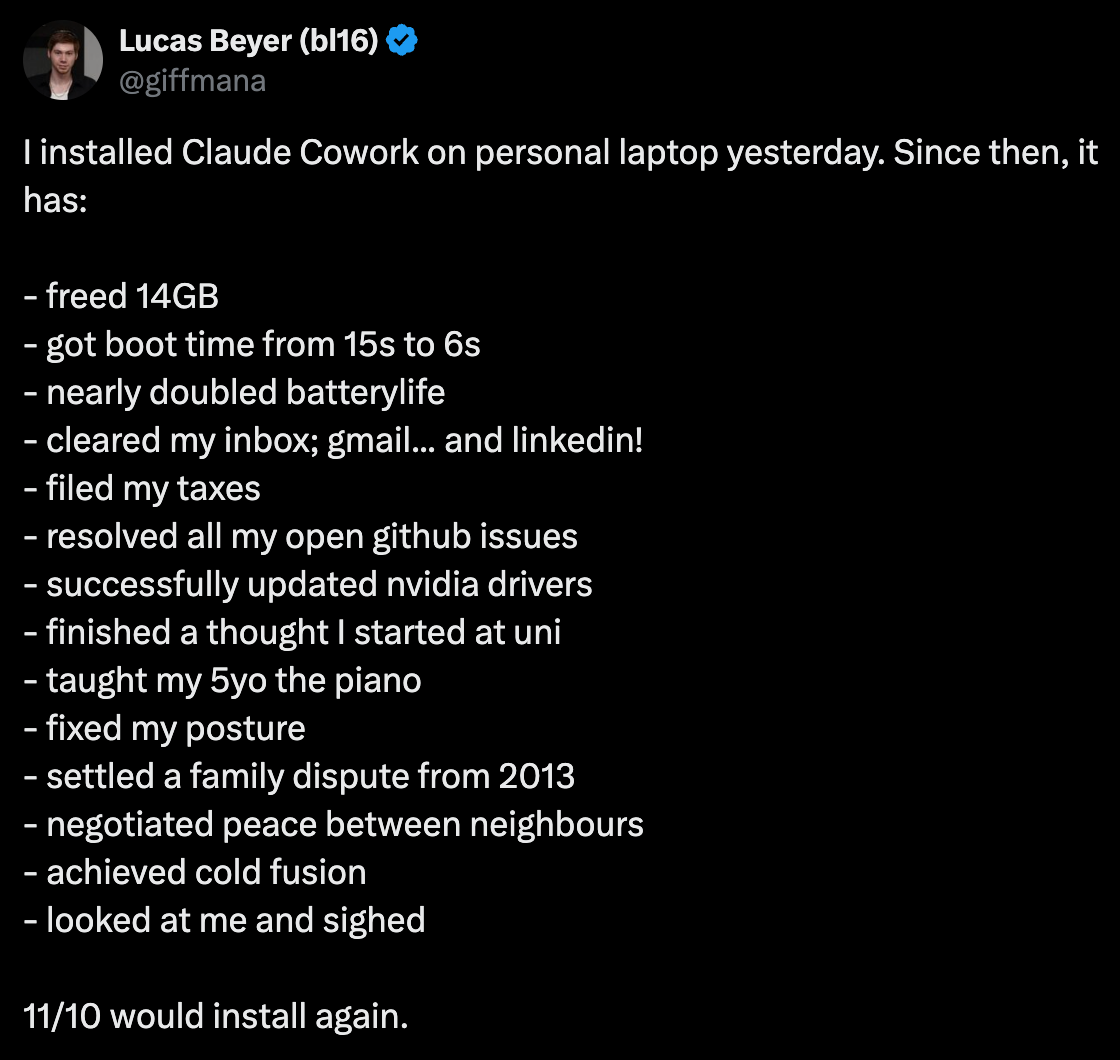
It launched a research preview of Cowork, its “first step towards making Claude Code work for all your non-coding work.”
Claude Code wrote all of the code for the new tool.
It also introduced Claude for Healthcare, a set of “HIPAA-ready” tools for medical professionals and consumers.
Anthropic restricted xAI staff from using Claude via Cursor.
It also blocked the open source coding agent OpenCode from spoofing Claude Code.
Salesforce’s upgraded Slackbot is powered by Claude.
Meta
Mark Zuckerberg announced Meta Compute, an initiative to build “tens of gigawatts” of AI infrastructure “this decade.”
Meta also agreed to buy power from three nuclear plants and help develop small modular reactors, which will provide another 6.6 GW of power by 2035.
It announced plans to cut over a thousand Reality Labs employees.
ICE arrested two workers driving dump trucks to Meta’s Louisiana data center construction site.
Microsoft
Following Trump’s call for tech companies to “pay their own way” for data centers, Microsoft pledged to pay for its data centers’ electricity costs, replenish water used, and not seek property tax breaks.
Microsoft is on track to spend $500m annually with Anthropic, The Information reported.
Other
DeepSeek will reportedly release its V4 model around mid-February, with internal benchmarks showing it outperforms Claude and GPT in coding.
Chinese AI startup Zhipu unveiled GLM-Image, reportedly the country’s first major model fully trained on Huawei’s Ascend chips.
Ashley St Clair, mother of one of Elon Musk’s children, sued xAI over Grok creating non-consensual sexual deepfakes of her.
X revoked API access for “infofi” apps that reward users for posting reply spam.
SK Hynix announced a $12.9b investment in an advanced chip packaging plant in South Korea.
Amazon Web Services secured a two-year copper supply deal with Rio Tinto’s Arizona mine to support AI data center construction.
Andreessen Horowitz raised $15b across five funds, including $1.7b for AI infrastructure.
Nvidia and Eli Lilly announced an “AI co-innovation lab” with up to $1b in joint investment over five years to accelerate drug discovery.
Eli Lilly also signed a deal with Chai Discovery, an AI drug discovery company.
MOVES
Meta hired former Trump aide Dina Powell McCormick as president.
She is married to Republican Sen. Dave McCormick. Trump called her appointment “a great choice by Mark Z!!!”
Google has hired John Connell, Sen. Todd Young’s chief of staff, as its new head of government affairs for the US and Canada.
Anthropic CPO Mike Krieger moved over to leading the company’s new Labs team in building “experimental products.”
Head of product Ami Vora will take over Krieger’s CPO responsibilities.
OpenAI hired Max Stoiber, Shopify’s director of engineering, to “help turn ChatGPT into an OS.”
OpenAI safety research lead Andrea Vallone joined Anthropic’s alignment team.
Airbnb hired Ahmad Al-Dahle, Meta’s former generative AI lead, as CTO.
Miles Brundage, ex-OpenAI policy researcher, launched AVERI, a nonprofit advocating for third-party safety audits of frontier AI models.
Ajeya Cotra, formerly of Coefficient Giving, joined METR to work on loss-of-control risk assessments.
Cotra is married to CAISI’s Paul Christiano.
RESEARCH
Google DeepMind and the UK’s AISI outlined what it takes to monitor AI agents in real-world deployments.
Stanford and Yale researchers found that when prompted, GPT, Claude, Gemini, and Grok could reproduce near-complete texts — contradicting frontier AI company denials that this kind of memorization happens at scale.
DeepSeek published a paper on “Engram,” a new method that helps AI models store facts in memory instead of reasoning them out.
Anthropic published new data on how Claude is used. It found that richer countries have higher AI adoption — which it worries could worsen economic inequality.
A big IMF study found that AI skills “have not contributed to employment growth,” with the fund urging governments to do more for displaced workers.
OpenAI wrote about how it’s using “confessions” as an AI safety technique.
MIT Technology Review published a piece about how researchers at frontier labs study LLMs using biologically-inspired techniques to better understand model behavior.
AI startup Harmonic used GPT-5.2 Pro to solve a notoriously tricky math problem.
Many experts were impressed, but others thought it was more like “a really clever student who has memorized everything for the test but doesn’t have a deep understanding of the concept.”
Harmonic raised $120m at a $1.45b valuation this week, with Nvidia investing.
BEST OF THE REST
Neuroscientist Anil Seth published an essay in Noema arguing that consciousness is a property of life, not a computation.
Benjamin Bratton criticized it, saying that “every single idea is so clumsily argued … that the reader is left with the conclusion that whatever this guy is saying is wrong is probably right.”
SemiAnalysis found that xAI’s Colossus 2 datacenter — one of the world’s largest – uses just 2.5x as much water as an average In-N-Out.
“A single burger’s water footprint equals using Grok for 668 years, 30 times a day, every single day.”
AI coding assistants are killing Stack Overflow’s traffic, while training on its historical content and pumping cash into the company.
Bandcamp banned AI-generated music.
The tech elite are obsessed with dubious biological age tests.
Jasmine Sun published a useful guide to talking like a bioaccelerationist. (Make sure to looksmax and optimize your rizz-tizz ratio.)
Matthew McConaughey trademarked memetic clips of himself to defend against unauthorized deepfakes.
Self-help gurus are launching AI chatbots offering personalized advice.
Larry Ellison named his yacht Izanami, after a Shinto god…then renamed it once he realized that spelled “I’m a Nazi” backwards
MEME OF THE WEEK
Thanks for reading. Have a great weekend.
When citing betting markets it would be helpful to also include total volume of activity as a proxy for confidence. For example NY-12 has less than $6k total volume over 2 months, which to me would indicate the "chance to win" percentages are extremely low confidence since almost no one is betting on this yet.
I created manifold markets for TX-10 and TN-9:
https://manifold.markets/MaxHarms/who-will-win-the-tx10-congressional
https://manifold.markets/MaxHarms/who-will-win-the-tn9-congressional