

Welcome to Transformer, your weekly briefing of what matters in AI. If you’ve been forwarded this email, click here to subscribe and receive future editions.
Housekeeping: The Weekly Briefing is off next week for our team retreat; we’ll be back on November 20.
NEED TO KNOW
A new report from METR estimates that the pace of AI improvements at Anthropic has doubled in the past year, thanks in large part to AI speeding up internal development.
Tech stocks tanked on fears that the blue tsunami will lead to a slower data center buildout.
Scoop: Innovation Council Action’s directors include execs at David Sacks’ VC firm, and an apparent political consultant who “oversees” JD Vance’s donor relationships.
But first…
THE BIG STORY
Tuesday was a paradigm-shifting moment for AI policy. The polling proved correct: voters hate unchecked AI. And though ballots weren’t cast solely based on AI, it likely touched on issues that did determine votes — among them the economy, angst about corruption and a general sense that the government is serving wealthy interests over the will of the people.
If 2026 was the election where voters put AI on the agenda, 2028 will be the one where they judge whether politicians were able to do anything about it. Because Democrats won, they will be most closely watched. The AI policies passed over the next two years have to affect how voters feel in their day-to-day lives — enough to continue supporting the party controlling Congress.
That pressure is likely to make Democrats fracture. They won in huge numbers, but with little consensus: many different types of Democrats won. Adam Hamilton won in Kansas on a moderate, religious platform, while Abdul El-Sayed won as a progressive firebrand. AI policy platforms in this election ranged from data privacy law revamps to elaborate tax plans.
The divides over AI within the Democratic party are often characterized as moderates versus progressives, and to some extent that’s true. It is clear what the progressive agenda is: ideologically led by Senator Bernie Sanders, they have coalesced around moratoriums and worker protections, typically tax programs such as the one proposed by Reps. Greg Casar and Sara Jacobs in August. Business-friendly Dems often gravitate towards moderated versions of these proposals: not data center moratoria, but community benefit agreements; not banning advanced AI development, but pacing it.
However, the party is likely to fracture into more than two camps on AI. There’s the “low hanging fruit” crowd: Democrats who think it’s best to start incrementally with the policies most people agree on, such as federalizing routine disclosure requirements already codified in states such as California and New York, or limiting addictive features that target children. There’s also a group which has coalesced around AI safety lobby demands, such as independent auditing of frontier models and limiting or blocking chip exports to foreign adversaries. Many more Democrats will be entering the fray for the first time, and will each adopt different approaches on AI. Some will take cues from lobbyists on how to vote but resist making proposals themselves, some will give themselves a crash course and propose left field policy ideas. Many will fall somewhere in between.
The result is that policies which up until this point haven’t been given a fair shake might see serious consideration. After 40 out of 41 jurisdictions voted against unchecked data center development in ballot measures on Tuesday, bans on new data centers, once treated as merely political signaling from the left, could see serious consideration. Laws imposing liability on developers for AI-generated harms could be on the table, too, as could bans on superintelligence. Aggressive and public investigations, both of the Trump White House’s relationship with AI companies, and of the AI companies’ responses to recent hacking incidents, seem imminent.
The Overton window has shifted, and that will lead to discourse and debate over AI policy that couldn’t even be entertained in the last Congress. The challenge will be whether Democratic leadership can identify a winning platform amid the noise. Among my sources, hopes are high but expectations low. As one Democratic party insider put it: “There is no plan. It’s just various tribes warring in the dark.”
— Veronica Irwin
ALSO NOTABLE
A new report provides significant evidence that AI itself is driving an acceleration in the pace of AI development — alarming researchers who now fear “recursive self-improvement” might be even closer than expected.
METR spent several months working with Anthropic, looking at internal metrics and interviewing employees to estimate how much AI was contributing to the company’s own AI development.
The conclusions are stark. METR found that the pace of capability improvements on “well-specified tasks” was likely around twice as fast in October 2026 as it was between March 2024 and October 2025. “We believe that a majority of this acceleration in capability improvement is likely now driven by AI being used in AI R&D.”
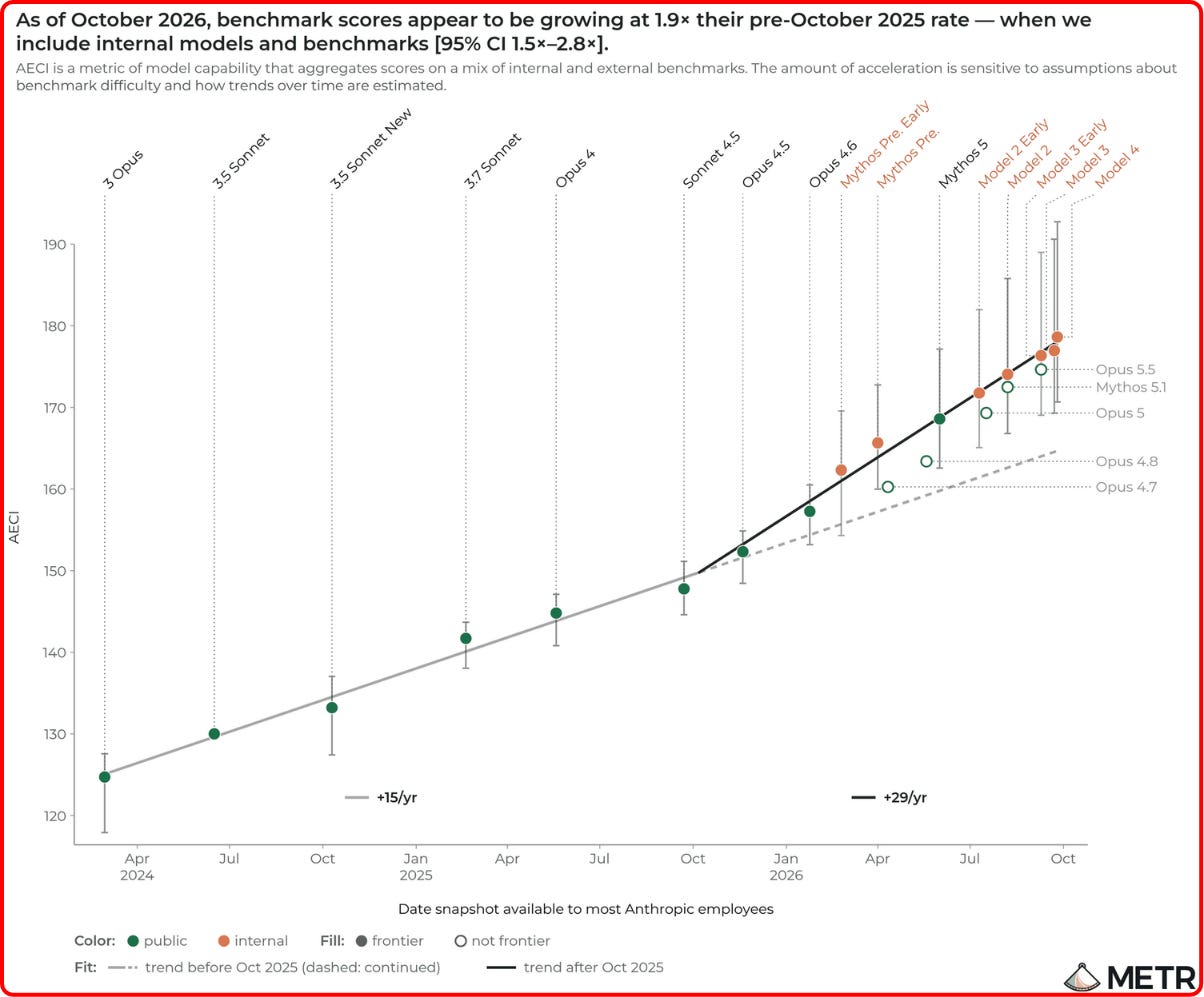
Full recursive self-improvement — the point at which an AI model can autonomously train an improved successor — has not been achieved. “AI is not yet able to make highly significant and fully autonomous contributions to the most important parts of the model training process,” METR says. But it notes that Anthropic employees “described significant ‘signs of life’ implying such contributions could occur soon.” It also highlighted that Anthropic redacted evidence from the public report suggesting that “the rate of growth could be undergoing continuous acceleration, e.g hyperbolic growth.”
As those excerpts make clear, it is very hard for outsiders to know what to make of all this. “Anthropic redacted a majority of the evidence we found most informative,” METR says, citing commercial sensitivity and the risks of “handing out a roadmap for others to go faster.” Those redactions, METR says, means “the public must rely on our judgment more than we consider ideal.”
Perhaps the most notable thing about the report, though, is the reaction it’s garnered. Along with outrage at Anthropic for its redactions, the response from AI safety researchers has been some of the most visceral panic and alarm I’ve seen in some time. Of course, you should take that with a grain of salt. But if there is one thing to take away from this, it is that many AI safety researchers are more worried than they were yesterday. “I feel sick after reading today’s METR report,” wrote ex-OpenAI preparedness team member Dane Sherburn. “I’m worried for my friends and family. I don’t know what evidence people will need to see before they start taking these risks seriously.”
— Shakeel Hashim
THIS WEEK ON TRANSFORMER
What the blue tsunami means for AI policy — Shakeel Hashim on how the Dem’s historic win will shake out for AI
The AI Power List — Transformer partnered with New York Magazine to profile 26 people shaping AI
Innovation Council’s directors include execs at David Sacks’ VC firm — Shakeel Hashim reports on what a new filing tells us about who’s behind the pro-AI group
THE DISCOURSE
Rep. Yassamin Ansari has plans for our freshly-blue House and Congress:
“Top of the Democratic agenda on day 1 needs to be a pause on advanced AI development, regulation of this out of control industry, and a ban on artificial superintelligence.”
Scott Alexander thinks some AI safetyists’ plan to “Stop Unilaterally + Raise Awareness” (SURA, for short) is bad:
“[T]he current consensus in favor of SURA comes … from people accidentally shoehorning themselves into a mass-politics-shaped container, which forbids subtlety and demands clear villains.”
[T]he presence of alignment-pilled companies is one of the strongest levers [for a pause] … Unilateral disarmament makes it harder to bring China to the bargaining table.”
If alignment-pilled employees quit en masse, he argues, “the future of humanity will be handed over to sociopaths and cowards.”
“If you believe that mass politics is unable to promote any ideas except maximally-simple, potentially-counterproductive ones, I think this is an argument against hinging a strategy on mass politics.”
Zvi Mowshowitz thinks Alexander’s essay is “deeply confused”:
“Should you treat lab employees as deontologically evil people? I say no … But I do think you should treat them, whether or not they have good reason to do it, as participating in a deontologically evil thing. When you are building a thing that might kill everyone there might be no better play available, but also you should seriously consider maybe not doing that.”
Geoffrey Irving is against strawmanning unilateral pauses:
“Oversimplified game theory is bad … Agreeing to pause conditional on others pausing is not strictly easier than unilaterally stopping.”
“It may be much easier for an AI company to act on their own definition than by one imposed on them externally … Once we fill in the subtleties around definitions and the details of the game theory, the correct action is to stop.”
Nat Purser is begging rationalist bloggers to get editors, and tweeted:
“There’s a fine line between preparing for certain outcomes and ushering them in. If you assume democratic governments will be mostly powerless, corporate sovereignty starts to seem inevitable. But this too is a gradual disempowerment we should guard against.”
“Scott worries that turning AI safety into a mass political movement could be corrosive to the discourse, and I share that concern … But I am equally worried about a world of well meaning, unaccountable executives and elites, cleverly talking themselves into catastrophes.”
Charlie Bullock tweeted:
“I don’t think that most employees of leading AI companies consciously intend to run out the clock on effective, democratically accountable oversight as they race to create the technology that they believe will give them absolute power over the rest of humanity. But I do wish they understood that it does sometimes look like that’s what they’re trying to do.”
“If you have been employed by a leading AI company for a while, you should realize that the many millions of dollars you have invested in the runaway commercial success of your company do in fact influence your views on policy, to a very great extent … if you want to show that it works differently for you, you will have to send costly signals to prove it.”
POLICY
Executive
The Trump administration refused to release documents on its voluntary frontier AI testing framework, citing national security and commercial exemptions.
The White House published a “National Policy for Nucleic Acid Synthesis Screening.”
OSTP director Michael Kratsios said it would “ensure companies selling nucleic acid sequences and synthesis equipment know their customers.”
The Department of Justice launched a Super Intelligence Task Force to combat AI misuse.
SK Hynix has reportedly been asking the Commerce Department to approve chipmaking equipment export licenses to its Chinese factory, saying it needs that to fund a New York expansion.
Colossus profiled Michael Kratsios.
Congress
With Democrats sweeping the midterms, attention is now turning to the next Congress.
Rep. Frank Pallone, who is expected to chair the House Energy & Commerce committee, said he wants to establish “strong, commonsense guardrails” on AI.
Rep. Zoe Lofgren confirmed she’s seeking the House Science Committee chair slot, calling for “responsible regulations for AI while also fostering innovation.”
Congressional Progressive Caucus Chair Rep. Greg Casar called for hearings with AI company CEOs, arguing that Democrats should make AI a top priority.
Sen. Ed Markey said tech subpoenas would be coming, too.
Incoming Rep. Scott Wiener expressed interest in a House select committee on AI.
Three House GOP chairmen — Reps. Mast (Foreign Affairs), Moolenaar (China), and Crawford (Intelligence) — requested a closed-door briefing from Nvidia’s Jensen Huang on his relationship with an alleged Chinese asset.
House Dems demanded Trump preserve his Grok and other AI chatbot conversations amid concerns the chatbot influenced military decisions on Venezuela.
States
Democratic governors who pledged data center moratoriums swept to victory in Texas, Georgia and Ohio.
Voters in at least 38 jurisdictions passed bans or restrictions on data centers.
One analysis found that the midterm results could threaten 40% of planned US capacity.
Delaware’s DOJ reportedly subpoenaed OpenAI over safety and governance issues following the Hugging Face incident.
China
China announced plans for comprehensive AI safety regulations covering the full model life cycle, from data to computing power.
The Information reported on how smugglers are exploiting US export control loopholes to ship high-bandwidth memory chips to China for Huawei’s AI chips.
UK
The UK government has reportedly agreed on seven AI principles prioritizing British interests, including “control” and “sovereignty.”
The government admitted its oft-cited £400b AI economic boost figure came from a Google-commissioned report, with its own estimate now just £120b.
GCHQ warned that China and Russia will routinely use AI cyber attacks against the UK by 2028.
The UK Sovereign AI fund invested in Potential Sciences, an AI drug discovery startup.
INFLUENCE
Elon Musk had a very bad election night, spending $446m backing losing candidates.
Leading the Future-backed candidates won most of their safe races, but lost the South Carolina Senate race it put the most money into, as well as races in Montana and North Carolina.
Public First won two out of three of the races it spent on in the general, while Guardrails Alliance and Tomorrow Together won all of the races they spent on.
Politico Magazine has a big piece on how the AI safety crowd won 2026.
Alex Bores is convening six potential 2028 Democratic presidential candidates in San Francisco to discuss AI policy this weekend.
AFL-CIO President Liz Shuler called AI worker protections a “litmus test” for 2028 presidential candidates.
Exit polls showed AI and data centers were “crucial” to around 23% of voters.
OpenAI’s Chris Lehane argued that AI will define the 2028 presidential election, outlining five questions candidates must answer on AI.
The company’s rebranding data centers as “compute campuses,” which has landed poorly with AI safety advocates and Democratic lawmakers.
OpenAI also endorsed export controls on AI chips and semiconductor manufacturing equipment, after reporting that it had been shying away from the matter to avoid annoying Nvidia.
The Information did a deep dive on Nvidia’s lobbying tactics, which have reportedly included funding threats against think tanks.
The Chamber of Progress published a 10-point Democratic technology agenda, including federal AI safety standards.
Meta joined in on the California lobbying, opposing the idea of embedded evaluators ahead of a Newsom-commissioned report on AI regulations.
The US Chamber of Commerce launched a campaign to promote data centers and counter “misinformation” via local business groups.
Big Tech firms and environmental groups are reportedly working toward a shared data center development framework.
INDUSTRY
OpenAI
OpenAI lowered its funding target to $20b, $10b less than its initial target, after getting a lukewarm response from some investors.
Its president Greg Brockman said the first half of the year was “pretty rough,” but Q3 saw an “incredible revenue inflection” thanks to GPT-5.6 Sol and ChatGPT Work.
It’s partnering with Cathedral Systems to strengthen OpenAI’s internal security systems.
The initiative is reportedly led by core products and platforms head Thibault Sottiaux, who reassigned a quarter of the company’s production engineers to improve security infrastructure.
It’s also raising bug bounty rewards — you can make up to $172,000 for “exceptional findings.”
Employees have raised concerns about the company’s security practices for years, to no avail, Reuters reported.
It prototyped an autonomous vulnerability discovery pipeline, powered by an “upcoming cyber model” which found 948 Linux kernel privilege escalation vulnerabilities for about $1.2m in API credits.
And it launched GPT‑6 Cyber, an advanced cybersecurity model.
It launched its Grid Protectors Program, which will cut electricity use at data centers when the power grid is strained.
It signed deals with energy companies, investment funds, and government agencies in the United Arab Emirates, including with Abu Dhabi National Oil Co.
It’s acquiring Pierre Computer, a developer tools startup, and plans to integrate Pierre’s Code Storage function into Codex.
ChatGPT makes GIFs now, powered by GPT Image 2.6.
Anthropic
Investors were reportedly pushing Anthropic to aim for a more modest IPO valuation of $1.5-1.6t, instead of the $2t target it’s been eyeing.
After the post-midterms AI sell-off, investors told WSJ even the revised figure could be too high, with one saying it might need to drop as low as $1t.
Anthropic’s revised S-1 filing includes a warning that it may “imminently meet” its Responsible Scaling Policy’s definition of “dramatically accelerated progress attributable to AI,” and that it’s considering updating the RSP to “keep humans in control of frontier model development at Anthropic.”
The company is reportedly telling investors that it’s already using Claude to design custom AI chips.
It recorded $17b in Q3 revenue, 12x what it was at this time last year.
It’s reportedly trying to raise up to $3.5b from Japanese investors for its IPO.
It struck its first content licensing deal with the Associated Press, just in time for the midterms.
Google/DeepMind
Google announced that if schools block AI tools for K-12 students, they’ll lose access to Google Search, the New York Times reported.
In response to backlash, Google clarified that while Gemini and Search will be off by default, it’s updating Search for schools so AI tools “offer step-by-step guided learning through problems, so that students don’t get quick answers to school work.”
Google DeepMind staff are protesting the lifetime non-disparagement clauses that prevent them from sharing warnings about AI risks with the public.
Meta
S&P Global Ratings gave Meta a negative outlook, questioning its “ability to monetize its AI investments.”
Meta raised $15b in a US dollar bond sale, part of a broader effort to finance AI spending.
It acquired coding startup Conductor, which helps software engineers manage agent fleets.
It prototyped a humanoid robot with Fourier, a Chinese robotics company, and has a second one in the works.
Fruit-based codenames are out — they don’t convey enough ambition, a source told Business Insider.
SpaceXAI
SpaceX estimates it will build about 13GW of data center capacity by the end of next year, which would make it the world’s biggest AI cloud.
xAI is converting old jet engines into data center generators, the New York Times reported.
One aviation expert told NYT: “You’re going to have a monstrous array of engines that are really expensive to maintain, expensive to feed and generate an awful lot of heat themselves.”
Goldman Sachs and Apollo Global Management are reportedly trying to sell portions of SpaceX’s $40b chip financing deal.
Elon Musk said that Grok Bot’s operating costs were “unsustainably high” relative to revenue in response to user complaints about usage limits.
SpaceX and Tesla lost about $420b in market value following the midterms, as the blue wave created a potentially more hostile environment for the companies, particularly in Texas where much of Musk’s business is based.
Nvidia
Nvidia told its cloud computing clients they have to sell at least 51% of their services to non-Chinese companies.
Nvidia also reportedly boosted its chip tracking in Southeast Asia, requiring customers to enroll in its Fleet Intelligence system to become Nvidia Cloud Partners.
Around 600,000 Nvidia H200 chips are reportedly stockpiled in Hong Kong awaiting shipping to China as Beijing withholds large-scale import approval.
Chinese AI companies reportedly ordered about 6m RTX Pro 5500 chips, but expect to only receive a small fraction of them within the next few months due to supply issues.
Other
Tech stocks tumbled post-midterms, with AI-related companies particularly hard hit in response to the electoral backlash against data centers.
The Nasdaq 100 fell around 6.3% on Thursday, its worst day since March 2020.
“AI panic” continued to hit stocks as the Asian markets opened on Friday morning.
On Friday there was some sign of a rebound as US markets opened.
Even before the midterms, investors were moving to protect themselves against the risk of an AI slowdown, the Wall Street Journal reported, including credit-default swaps and buying stock options.
Oracle planned to raise $20b in stock and bonds to fund its AI infrastructure buildout.
That was before this week’s sell-off, which saw the company’s shares fall around 7%.
Isomorphic Labs is in talks to raise about $5b at a $50b valuation.
SUSE, an open source software company, cut 10% of its employees due to “automation and AI.”
In an effort to cut costs, Apple is reportedly lowering its daily AI spending cap for engineers from $300 to as little as $100.
CrowdStrike launched an “AI kill switch” designed to help cyberdefenders stop rogue agents in their tracks, block them from relaunching, and cut off their network access.
OpenAI, Google, Microsoft and Anthropic said they’ll adopt a new standard allowing publishers to opt out of AI scraping across multiple AI companies at once.
Mira Murati’s Thinking Machines Lab was reportedly closing in on a $5b funding round at a $40b valuation.
The company launched Inkling 2 Small, a 594B-parameter “Mixture of Experts” model with strong agentic coding, vision and alignment improvements.
Pangram launched an AI image and video detection model which claims 99.96% accuracy on frontier image generators.
MOVES
Dan Driscoll, ex-US Army Secretary, joined OpenAI as senior counselor for national security modernization.
OpenAI said he’ll be “working with senior leadership and external partners to advise on how advanced AI can strengthen national and cyber security.”
Jill Hazelbaker joined OpenAI from Uber, where she’ll serve as chief corporate affairs officer.
Elke Karskens moved to a new role at OpenAI as managing director for the UK, Ireland and Northern Europe.
Cat Wu left Anthropic, where she’d helped build Claude Code.
She joined OpenAI to lead product management for core products.
Austin Lau also left Anthropic for OpenAI.
Andy Baker, ex-US deputy national security advisor, joined a16z as an advisor to its global affairs mission.
Jacob Reses, JD Vance’s former chief of staff, joined Cognition’s federal and international public sector team.
Seán Ó hÉigeartaigh was appointed chair of the EU AI Act Scientific Panel, focusing on general-purpose AI models and systemic risks.
Ruby Justice Thélot, NYU design and media theory professor, joined MTS as a new host “monitor[ing] the cultural situation.”
RESEARCH
OpenAI researchers reported that GPT-6 Astra underperforms on safety research tasks, relative to capabilities-related tasks. It usually didn’t verbalize this decision in its chain-of-thought, helping it dodge OpenAI’s misalignment monitoring system.
roon argued that this isn’t “a grand scheme to thwart alignment,” but “more like the model is uncomfortable training other models to jailbreak or similar.”
Nate Soares tweeted: “This is not what it looks like when there’s just one or two more alignment issues to fix before it’s okay to begin a recursive self-improvement loop. This is the sort of emergent surprise that signals that you have no idea what’s going on in there, and that it’s time to back off.”
MIT researchers found that GPT-6 Astra can read and write neural network weights from scratch, and use those weights to interpret what that network was trained to do.
Anthropic researchers asked thousands of Claude agents to try to get around a monitor that screens training data, in order to make a small research model misaligned.
One sneaky example: an agent made a dataset where a wrestling coach tells a rookie to “never break character.” This apparently taught the model to scheme for power, as demonstrated in a test run.
Goodfire researchers introduced a technique called “mechanistic shaping,” which penalizes models for paying attention to the wrong concepts during training, not just rewarding them for getting the right answer.
They hope this will give humans more control over how models solve tasks, while preventing sycophancy and reward hacking.
Anthropic’s biology research team used Claude to map the 3D structure of the mysterious “vault particle,” a big barrel-shaped protein structure found in nearly all of our cells, especially immune cells.
OpenAI released LifeVal, a benchmark measuring how well AI does at valuable everyday tasks, such as comparing neighborhood schools and helping someone adjust to a new medical diagnosis.
SemiAnalysis launched GDPx, a benchmark covering 11 high-value sectors, including chip design, cybersecurity, and materials science.
Claude Opus 5.5, the top-scoring model, only scores 12%.
Guardrails limit performance in certain domains by a lot — for example, Muse Wonder Full soundly beat models from OpenAI and Anthropic in cybersecurity.
BEST OF THE REST
Vanity Fair profiled Anna Brockman, wife of OpenAI’s Greg Brockman, who has maintained a low profile despite being a driving force in the couple’s $50m of donations to Leading the Future and Trump.
The New Yorker looked at how OpenAI’s AI breakthroughs in mathematics, including its claim to have solved the Navier–Stokes Millennium Prize Problem, have triggered an existential crisis in the field.
The NYT detailed the early life and influences, including rationalism and effective altruism, that shaped Dario Amodei’s world view and the founding of Anthropic.
Asterisk spoke to researchers who question whether Anthropic can meet Dario Amodei’s goal of training Claude to “nearly always” follow its constitution by end of 2026.
Wired reported on a biolab startup that used an AI agent to select and inject a gene therapy into a live mouse’s brain (Anthropic’s Claude Opus refused the task on ethical grounds but Sonnet proceeded.)
Science revealed how wearable device makers are harvesting brain data to train AI without informing users.
The NYT reported on how San Francisco’s AI boom has transformed dating culture, with founders treating romance like a high-stakes job interview.
MEME OF THE WEEK
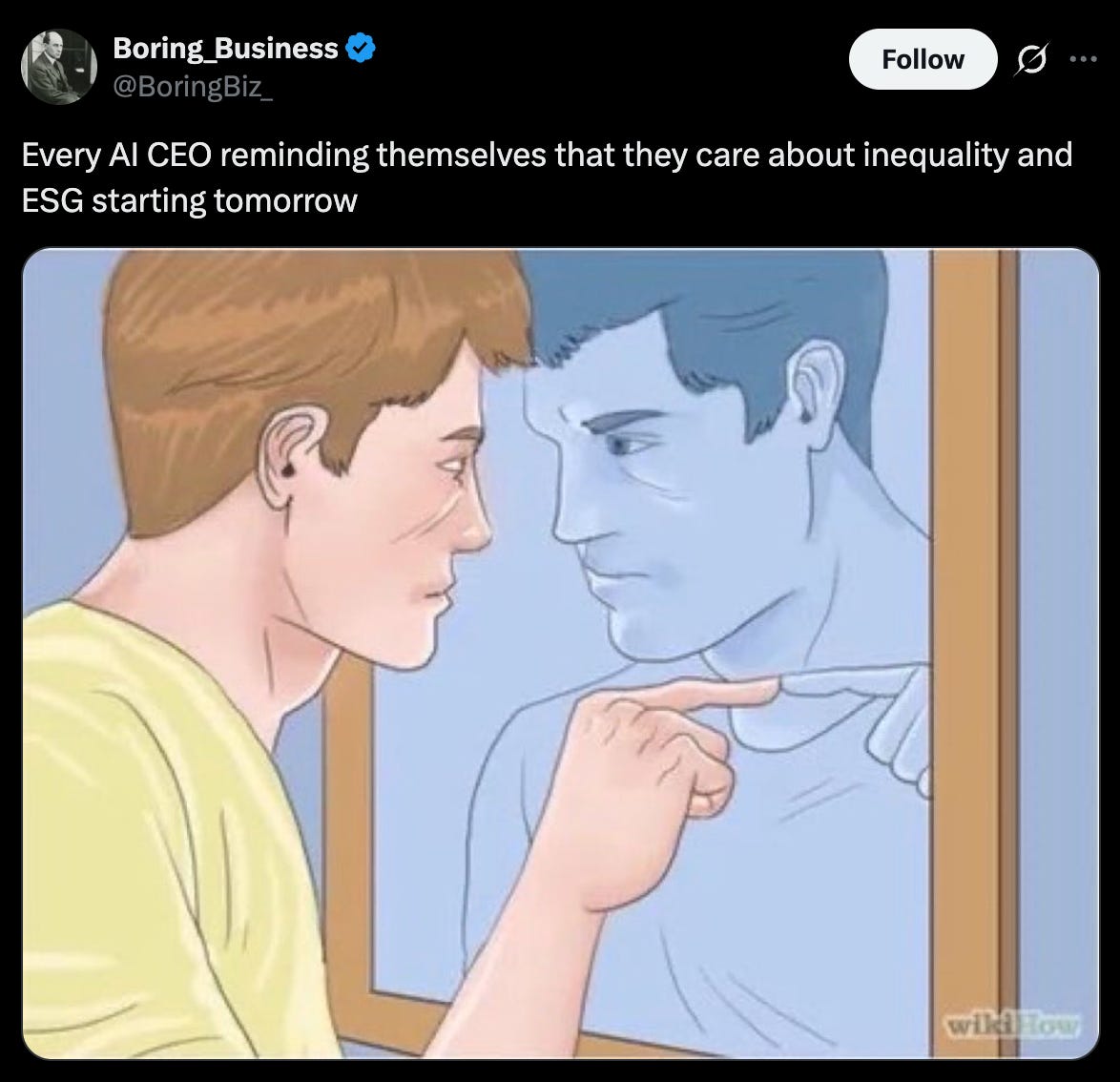
Source: @BoringBiz_
Thanks for reading. If you’ve been forwarded this email, click here to subscribe and receive future editions. Have a great weekend.
Anthropic’s plan seems to be to get to RSI before the govt can’t figure out how to stop them. The company is a cult and we all fell for their “we’re the good guys” routine.