

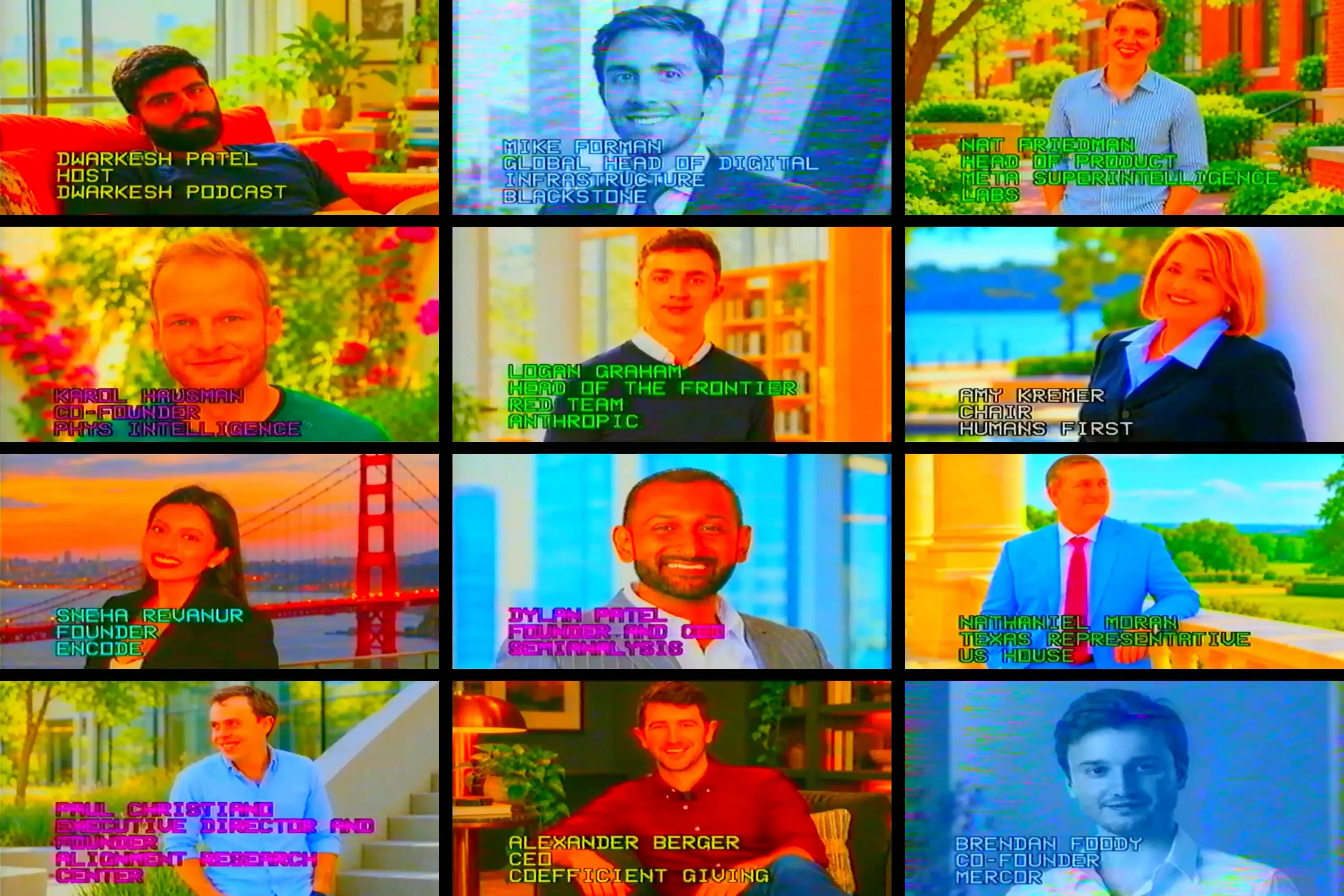
AI has minted a new power structure. A handful of private companies command the might and wealth of small nation-states and are mostly left to self-govern. A few dozen employees are on the brink of becoming centimillionaires and considering which causes and presidential candidates they will funnel their vast resources toward. The industry is perpetually one breakthrough away from a step change in capability or public adoption, the question of who gets there first dependent on the specific expertise and visions of a handful of engineers.
One way to tell the story of how AI is changing our world is through some newly familiar names. Sam Altman and Dario Amodei are locked in a race to build AGI and persuade President Donald Trump to regulate the technology to their liking. Nvidia CEO Jensen Huang and venture capitalist David Sacks are advocating for the president to take a light touch, concerned about how regulation might jeopardize America’s dominance. As these figures have scaled their public influence, their surrogates and spokespeople (OpenAI president Greg Brockman, top OpenAI lobbyist Chris Lehane, Anthropic co-founder Jack Clark) have populated news stories, too.
But an astonishing amount of power rests in the hands of a few dozen other people, none particularly well known, some virtually anonymous. So Transformer partnered with New York Magazine for its annual “Power” issue, surfacing 26 people whose influence on the AI landscape far outstrips their fame. We drew on our years of reporting, as well as new interviews with more than 50 high-ranking industry leaders, to help articulate what makes these people powerful. New York then commissioned multi-media artist Simon Denny to create images of each.
Despite the hundreds of billions in capex and upcoming IPOs, many parts of the field are immature, which means those who decide how AI is built, adopted, and controlled can quickly become among the most influential people in the world. A few on this list, for example, are tasked with shaping how the public, or a company, thinks about the technology—a high-leverage role for a field where everyone’s views are still being formed. (This is, in part, why AI has such an “essay”-driven culture—a blog post really can cause a seismic change.) Some will invent entirely new product categories, reimagining how we interact with AI, while others can spin up new industries or advocacy groups with a single check. Who is ahead and who is behind can change almost overnight (just look at Microsoft), which helps explain why a legacy tech CEO could have less sway over what Altman thinks than a 26-year-old with a podcast and why an engineer who runs a new critical function may appear on this list instead of a colleague who sits several rungs higher in their org chart. (Relatedly, the list’s average age is 36. It is also overwhelmingly male.)
The AI scene is still small. The 26 individuals on our “Power List” are remarkably intertwined, some even sharing offices, homes, or funding. (Transformer receives funding from an organization run by Alexander Berger, who appears on this list—and he in turn has ties to many of the other people cited.) The widespread societal impact of AI led us to include names from both private and public sectors, so you’ll find founders and engineers as well as lawmakers and regulators. Most important, they still have everything to play for. The new power brokers will decide how it all shakes out, refashioning the world for the rest of us in the process.
FEATURING
LOGAN GRAHAM | SNEHA REVANUR | DEAN BALL
AMY KREMER | MISHA LASKIN | NATHANIEL MORAN
BETH BARNES | KAROL HAUSMAN
AND MANY MORE