

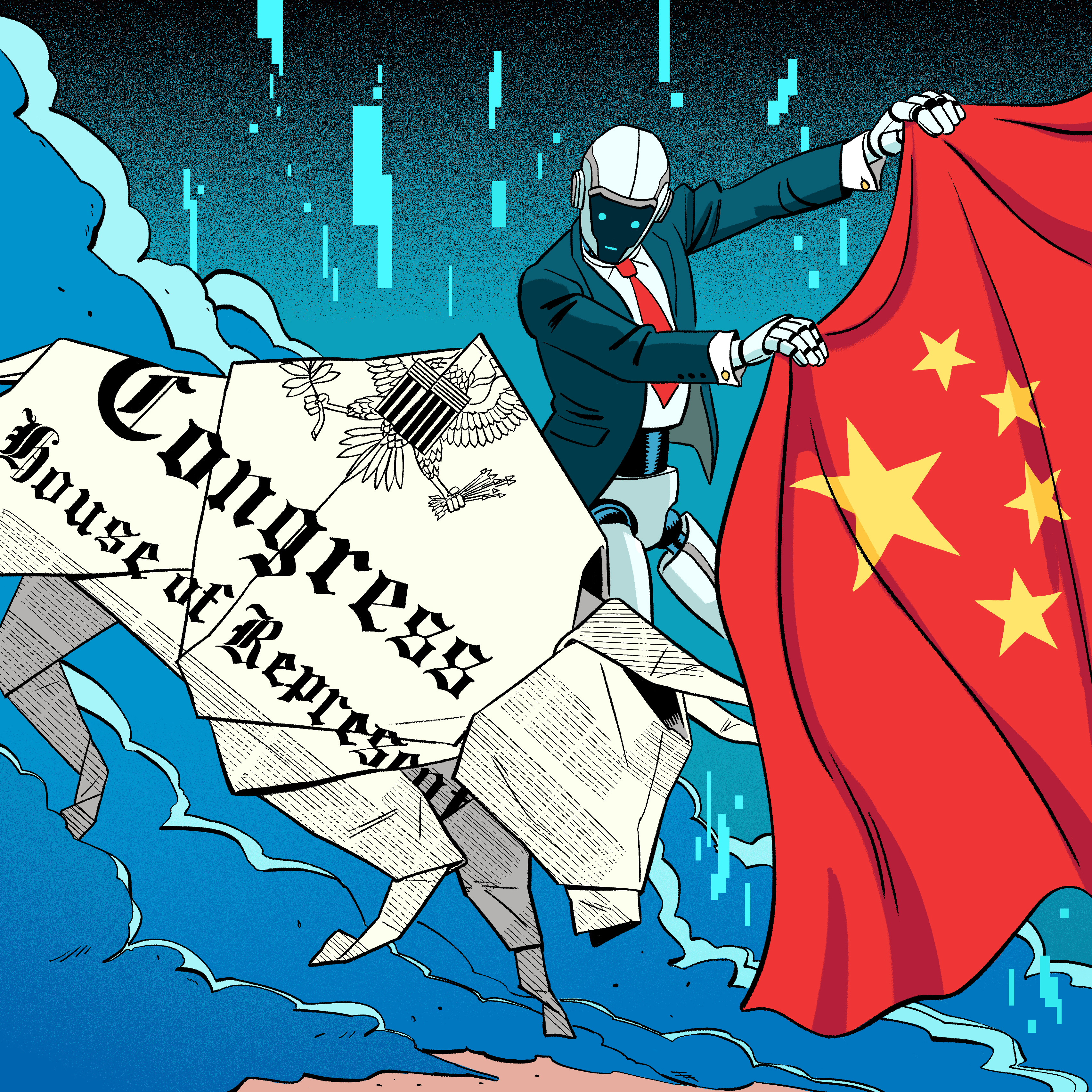
The day after attending Donald Trump’s inauguration, Scale AI’s CEO Alexandr Wang ran a full-page ad in The Washington Post. His message to the new president, in bold white letters, was blunt: “Dear President Trump, America Must Win the AI War.” Below it, a QR code linked to a letter warning of China’s surging AI capabilities, America’s risk of falling behind, and a five-point plan to win the race.
The letter echoed arguments Wang — and many of his fellow Silicon Valley moguls who stood with him at the inauguration — have championed for years. First, the US and China are locked in an AI race. Second, China poses an existential threat to American democracy, and America must win at all costs. Or as Marc Andreessen put it in an essay opposing AI safety regulation: “the single greatest risk of AI is China wins global dominance and we — the United States and the West — do not.”
Today, Silicon Valley’s biggest players are pushing the race with China narrative at every turn — in newspaper ads, industry white papers and congressional hearings. In a forthcoming paper, which is the basis of much of this article, my co-authors Seán Ó hÉigeartaigh, Transformer editor Shakeel Hashim, Coleman Snell and I trace how the tech industry has deployed the China race narrative to advance a sweeping policy agenda — from export controls to military partnerships to reduced regulation.
“There’s an open secret in DC: attach the word China to anything and you can get it done,” said Samm Sacks, a senior fellow at New America.
No doubt some advocates of this story are true believers with legitimate concerns. There are also others chasing government contracts, looser regulation and investment returns. But whatever the motivations, there is evidence that the China AI race narrative may be based on fundamental misconceptions and misrepresentations of China’s actual AI priorities and actions. What’s more, the narrative appears to be doing real damage — distorting AI governance debates in both the US and China, crowding out meaningful policy, and undermining international co-operation at precisely the moment it’s most needed.
“We should be asking ourselves, not only if the rivalry is the right framing,” said Sacks, “but also, who and what agendas does rivalry serve?”
Narrative origins
American fears of losing an AI race to China emerged in 2017. That year, China’s State Council released its “New Generation AI Development Plan,” setting out its goal of becoming a world leader in AI by 2030. US tech and defense circles immediately took notice. In a sponsored article in The Atlantic, defense contractor and consultancy Booz Allen and think tank CSIS described the US as “at the precipice of another defining moment in history” — a technological contest as or more consequential than the space race.
US tech companies started to deploy the race with China narrative to head off regulatory oversight. In 2018, for example, Mark Zuckerberg testified before the US Senate following the Cambridge Analytica scandal, warning of “a real strategic and competitive threat” from Chinese tech companies and arguing that restricting American innovation in areas such as facial recognition would mean “we’re going to fall behind Chinese competitors” with different regulatory regimes. (It was a jarring contrast to his jaunty jog around Tiananmen Square two years earlier, a publicity stunt aimed at courting the Chinese government.)
Defense companies followed suit, invoking the same alarm to push a larger role for AI in the military. In 2019, US Secretary of Defense Mark Esper called on the private tech sector to work with the military on AI, warning of China’s ambitions. The Department of Defense’s AI budget request more than doubled in three years — from roughly $800m in 2021 to $1.8b in 2024.
Palantir and Scale AI pushed for an increase in the Pentagon’s AI budget to counter the threat of China. Alex Karp, CEO of Palantir, which supplies LLMs for militaries worldwide, has argued “it’s either: we own AI or our adversaries China and Russia own AI. We have to dominate and set the rule of law.” Scale AI’s Alexandr Wang warned a House Armed Services subcommittee that China was spending three times more than the US on AI and that “the country that is able to most rapidly and effectively integrate new technology into war-fighting wins.” Each secured multiple lucrative government contracts with the Department of Defense during this period — Palantir won up to $10b in contracts; Scale received a $249m DoD deal in 2022.

Export controls and containment under Biden
Under the Biden Administration, the US began to pursue a containment strategy to address AI competition with China — restricting the country’s access to advanced chips and expertise. This was partly driven by concerns over the arrival of artificial general intelligence, and the belief that whichever country achieved it first would gain irreversible dominance.
By 2021, researchers and policymakers were increasingly paying attention to AI’s rapidly growing capabilities. OpenAI had released GPT-3 the previous year, and researchers alarmed by the company’s pace of progress left to found Anthropic. In 2021, the National Security Commission on AI (NSCAI), chaired by Eric Schmidt and stacked with industry insiders, warned that the US was not sufficiently prepared: “China’s plans, resources and progress should concern all Americans.” The NSCAI report called for increased federal AI R&D funding, a five-fold rise in Pentagon AI spending, closer ties between the Department of Defense and commercial AI providers and tighter export controls on semiconductor manufacturing equipment.
The report’s influence proved lasting, shaping not just the policy but the personnel who would implement it. In October 2022, a month before the watershed release of ChatGPT, the Biden Administration unleashed expansive export controls on China’s access to advanced chips, semiconductor equipment and model weights. According to a report by WIRED, the key work to establish export controls can be traced to several individuals who overlapped at the Center for Security and Emerging Technology (CSET), and the Office of Science and Technology Policy (OSTP). These included Jason Matheny, who researched existential risk at Oxford’s Future of Humanity Institute and worked at the NSCAI, and Tarun Chhabra and Ben Buchanan, who both ended up at the White House in tech advisory roles.
After the release of ChatGPT, key members of the administration became increasingly concerned with the prospect of AGI. A distinct set of ideas became popular among US policy circles: “short timelines” (AGI was imminent), “fast takeoffs” (it would arrive suddenly) and “decisive strategic advantage” (whoever got there first would seize lasting dominance).
The logic of this framing, applied to the race with China story, crystallized into a strategy: the US and China were locked into a race towards AGI, and the US had to do everything to stop China from getting there first. US policy coalesced around slowing China’s progress using chips as a chokepoint. In a January 2025 report, Axios reporters revealed that “every background conversation we had with President Biden’s high command came back to China,” and that every move, “was calculated to keep China from beating us to the AI punch.” Nothing else matters, they said.

A cluster of tech leaders, investors and foundations appear to have shaped the administration’s thinking. This included Eric Schmidt and the Special Competitive Studies Project (SCSP), CSET and RAND. The latter two were both funded by Open Philanthropy, a foundation backed by Facebook co-founder Dustin Moskovitz focused on global catastrophic risk, and also a funder of the Horizon Fellowship, which placed AI fellows at congressional offices, federal agencies and think tanks during the Biden presidency. Open Philanthropy previously made a $30m grant to OpenAI and has close links with Anthropic (its founder and former CEO joined Anthropic’s staff in 2025).
(Open Philanthropy, which recently rebranded as Coefficient Giving, is Transformer’s primary funder, and funds the Tarbell Center, where the author is a resident journalist.)
Anthropic’s CEO Dario Amodei has been a key player in pushing forward these ideas. He has called for tighter export controls, warning that China “could surpass us economically and militarily” if allowed to build “powerful AI first.” In his 2024 essay “Machines of Loving Grace,” Amodei described an “entente strategy,” credited to a RAND draft, where a group of allied countries would scale quickly while restricting rivals’ access to key chips. They would deploy a “carrot and stick” approach: authoritarian countries would convert to liberal democracy in exchange for access to AI’s economic benefits or face a superior AI-enhanced military.
In another widely read essay published that year, “Situational Awareness,” former OpenAI researcher Leopold Aschenbrenner similarly argued that AI is a decisive strategic technology, warning that the Chinese Communist Party would “[wake] up to AGI,” and that “the free world’s very survival is at stake.” He called for a trillion-dollar build-out of compute infrastructure and energy capacity to beat China. For Aschenbrenner, the race narrative turned out to be a lucrative investment thesis. Shortly after publishing, he launched a hedge-fund, Situational Awareness LP, now said to manage over $1.5b — which primarily invests in energy companies, chips and data centers.
The Trump turn
Under the Trump Administration, the “race with China” framing remained — but repurposed to justify a sharp reversal in policy. On his first day in office, President Trump revoked Biden’s AI Executive order — the same day DeepSeek dropped its R1 model, prompting fresh calls for deregulation. “DeepSeek R1 shows that the race was very competitive and President Trump was right to rescind the Biden EO, which hamstrung American AI companies without asking whether China would do the same,” said the then White House AI czar David Sacks.
The Trump Administration’s strategy has however been far less coherent than its predecessor’s. Views on imminent AGI for example, are divided. Several key officials and advisors reject the premise that AGI is around the corner — White House AI advisor Sriram Krishnan called the idea of imminent AGI “a distraction, harmful and now effectively proven wrong.” If AGI isn’t the finish line, the logic of choking China’s chip supply starts to unravel. Victory is instead achieved by “diffusion” — exporting American hardware, software and standards as widely as possible. As David Sacks put it, winning the AI race means “the world runs on the American technology stack, rather than China’s.”
Nowhere have these tensions played out more visibly than on export controls. The Information Technology Industry Council, representing companies like Amazon, Meta and Microsoft, has pushed back against strengthened controls. Nvidia described export controls as “misguided,” arguing that America “wins” by “sharing our technologies with the world.” In contrast to companies like Anthropic, whose worldview was reflected in the Biden Administration’s approach to restricting China’s access to advanced chips, their views are aligned with David Sacks, who has argued that it is better to have Chinese AI systems running on American chips than to incentivize China to build their own.
The Trump Administration’s priorities are reflected in the 2025 AI Action Plan, focused on achieving “global dominance” through wide adoption of US tech. The plan calls for the removal of regulatory barriers, fast-tracking AI infrastructure projects, discouraging state AI regulations and accelerating government AI procurement, especially by the Department of Defense.
Their priorities appear to be heavily shaped by a different and extensive cluster of companies and investors with tight links to the White House. Trump’s top AI appointments — David Sacks, Sriram Krishnan and Michael Kratsios — share deep ties to a circle of Silicon Valley power players, including Andreessen Horowitz, Scale AI and Peter Thiel. Sacks is the former COO of PayPal, co-founded with Peter Thiel, and an investor in Palantir, Meta, Amazon and xAI; Krishnan is a former general partner at Andreessen Horowitz; Kratsios is a former managing director at Scale AI. Jacob Helberg, the Under Secretary of State for Economic Growth, Energy and Environment, is an advisor to Palantir’s CEO Alex Karp. Vice President JD Vance was a principal at Peter Thiel’s Mithril venture capital firm and received $15m from Thiel to back his 2022 Senate race. Trump’s inauguration fund, which raised a record $239m, included $1m donations from Nvidia, Microsoft, Qualcomm, Alphabet, Amazon and Meta, and additional individual $1m donations from technology CEOs and venture capitalists including Sam Altman and Alex Karp.
For many of these players, beating China has become a reliable weapon against AI regulation. In 2024, the “race with China” was used to lobby against California’s SB 1047, the first US regulatory proposal that would have required AI companies to conduct safety testing on their powerful models before releasing them. The website stopsb1047.com, bankrolled by Andreessen Horowitz, urged Californians to contact their assembly members, warning that SB 1047 would “let China take the lead on AI.” In 2025, the policy advocacy group The American Edge Project, funded by Meta, ran a series of Facebook and television ads warning that the United States was in an AI race with China, and that America must “protect America’s competitive edge.” Its CEO has argued that “rushing into a patchwork of uncoordinated state laws will only slow American innovation and give China an opportunity to surge ahead.”

OpenAI has long been a proponent of the race narrative. As early as 2017, the New Yorker reported, Sam Altman told US intelligence officials that China had launched an “‘AGI Manhattan Project’” and that OpenAI needed billions in government funding to keep pace. One official later concluded “it was just being used as a sales pitch.” Today, the pitch continues. In OpenAI’s comments to Trump’s AI Action Plan, ‘beating China’ functions as an all-purpose catchphrase to unlock every item on its policy wish list. The document, which argues that Trump’s AI policies can ensure that “American-led AI built on democratic principles continues to prevail over CCP-built autocratic, authoritarian AI,” is obsessed with rivalry: China is mentioned more than 30 times and invoked in every policy proposal. Beating China is cited as the reason to accelerate data center buildouts, increase government AI adoption and roll back copyright restrictions on AI training data.
Corporate influence on AI policy is only deepening. As midterms approach, Silicon Valley’s biggest players have bankrolled a wave of new lobbying efforts, pouring money into AI-focused Super PACs. Meta has launched two super PACs — one focused on shaping AI policy in California, and another supporting the election of state candidates that align with its policies. In August, OpenAI’s Greg Brockman and Andreessen Horowitz launched the “Leading the Future” super PAC, which raised over $100m to support candidates “aligned with the pro-AI agenda” and oppose policies that “enable China to gain global AI superiority.”
The story of an AI race with China is now so well-worn that many of Silicon Valley and Washington DC’s most influential players operate under the assumption that it is simply fact. But the premise itself demands scrutiny. To what extent is the story grounded in reality?
Often missing from the discourse is rigorous and evidence-based understanding of China’s government policy, industry actions and public discourse. US policymakers are obsessed with the idea that China is engaged with them in a race to AGI. But a basic read of China’s AI+ Initiative, the country’s most comprehensive blueprint for its national AI strategy, makes no reference to AGI or superintelligence whatsoever. Much like the Internet+ initiative, published in 2015, its focus is on integrating and diffusing AI applications across different industries — and its most urgent priority is to boost the economy and address demographic challenges. While China’s 15th Five-Year Plan, released in March this year, mentions that the country will “explore development paths for general artificial intelligence,” the cautious framing suggests that it is uncommitted to any specific approach.
“The Chinese Communist Party’s thinking has long been: what can this technology do for my economic, political and social goals, five years from now? The AI+ Plan is very much in line with how they imagined this technology six years ago, in a very instrumental way,” said Matt Sheehan, a research fellow at the Carnegie Endowment for International Peace. And looking beyond rhetoric at concrete actions the government has taken, there has been no concerted move by the government to centralize compute — a necessary condition for any serious state-led effort to develop AGI, as defined by Silicon Valley, at scale.
Chinese policymakers treat AI less like a technology of decisive strategic advantage, such as a nuclear weapon, and more like a general-purpose technology, such as electricity. In an article published in the state newspaper People’s Daily, the National Development and Reform Commission (NDRC), China’s top economic planning body, compared AI to a “transformative technology” like the “steam engine, electricity and the internet … driving economic and social development towards an intelligence-driven era.” Even the Chinese term for AGI, 通用人工智能, which more directly translates as “general-purpose artificial intelligence,” is less loaded than its English counterpart, implying broad application across many sectors of society.
Although several CEOs of Chinese AI companies like DeepSeek, Zhipu AI and Alibaba have voiced their ambitions to pursue AGI, their actual investment remains a fraction of Western labs’. Zhipu AI raised around $2b in various funding rounds and its initial public offering; Microsoft alone has invested $13b into OpenAI. According to Kyle Chan, a fellow in the John L. Thornton China Center at Brookings, while American companies pour hundreds of billions of dollars into new data centers to create AGI, Chinese AI developers are “racing along other axes of progress: efficiency, adoption, and physical integration, driven by both industry constraints and Beijing’s policy focus.”

When Chinese CEOs, technologists and academics do bring up AGI, they often seem to have different and diverse understanding of what exactly it is and how to get there. In Washington DC and Silicon Valley, the dominant view is that scaling — piling compute onto transformer-based LLMs — is the path to AGI, and the bulk of funding and discourse reflects that consensus. Chinese thinking on the question is much more varied. Several prominent Chinese scientists believe that embodied AI is a prerequisite to AGI. Zhu Songchun, for example, who leads the Beijing Institute for General Artificial Intelligence (BIGAI), is skeptical of the LLM-scaling paradigm, and like Andrew Yao, China’s only Turing Award winner, argues that true AGI must be embodied, capable of interacting with the physical world.
These diverging views in part reflect China’s structural differences. With fewer advanced chips and less capital to burn, betting everything on compute scaling and AGI wouldn’t make sense for Chinese labs, according to Kwan Yee Ng, Head of International AI Governance at Concordia AI, an AI safety consultancy based in Beijing. “China’s diffusion-based strategy aligns with the country’s advantages: a strong industrial ecosystem, abundant sector-specific data and mid-level talent.”
The differences are also cultural. “In the United States, achieving AGI is a heroic narrative — it’s based on the idea of one lab or one system reaching a postulated frontier and entering a new era for humanity,” said Graham Webster, a research scholar in the Stanford University Program on Geopolitics, Technology and Governance. “I don’t see that kind of epic, messianic narrative in most of Chinese discourse.”
In many ways, US policymakers and tech leaders have reduced China to a two-dimensional mirror, onto which they have projected their own fears and dreams of AGI. As Matt Sheehan warns, the greatest risk of this narrative — that China and the US are racing towards AGI — is that policymakers work from an increasingly unrealistic picture of China’s AI priorities, and the more ossified the narrative, the further it diverges from reality. The race framing, in the words of Kwan Yee Ng, “crowds out room for more meaningful policy and engagement.”
The China AI race narrative is undermining prospects for international co-operation, at precisely the moment when co-operation is most needed. Last week, when Bernie Sanders called for greater international co-operation on AI regulation at a panel on Capitol Hill alongside two Chinese scientists, he was criticized by conservatives for “schmoozing with top Chinese AI governance officials.” Doug Kelly, the CEO of the American Edge Project, claimed that Chinese propaganda is “running a co-ordinated push to convince Americans to stop building data centers,” and that by calling for more regulation, US lawmakers like Sanders are “walking right into it.” In an X post, Treasury Secretary Scott Bessent wrote: “The real threat to AI safety is letting any nation other than the United States set the global standard.” (There are, admittedly, some signs that this might be changing: the WSJ reported this week that China and the US are “weighing the launch of official discussions about artificial intelligence,” led by Bessent.)
The AI industry forecasts rapid, potentially transformative advances in AI capabilities, with serious warnings about misuse or loss of control of advanced systems. “One of the questions we get most frequently from officials in Washington is: Who’s winning the US-China AI race,” write Matt Sheehan and Mariano-Florentino Cuellar at the Carnegie Endowment for International Peace. “The answer is simple and unsettling: Artificial intelligence is winning, and we’re nowhere near ready for what it will bring.”
Scientists have argued that China and the US should be collaborating to identify and mitigate risks, find solutions and build a global system of oversight to regulate the most advanced models. But prospects for international AI governance measures are seriously corroded by the mistrust created by narratives of the AI race. Last summer, Samm Sacks was in Shanghai for the World AI Conference, just when the US’s AI Action Plan was released. During one convening, one Chinese participant pointed out that the Plan — with its first line stating that ‘the United States is in a race to achieve global dominance in AI’ — made it very hard for those in China who are trying to advocate for safety guardrails.
Good policymaking starts with seeing China clearly — not as a monolithic adversary, nor as a foil for all of America’s anxieties, but as “a complex and pluralistic society with robust internal debate, competing interests and diverse stakeholders,” says Sacks. Not through the lens of pre-existing frameworks, as Ng puts it, but on its own terms.
The story of the US-China race, amplified by Silicon Valley, has been overstated. And the specific narrative of a race towards decisive strategic advantage is a “dangerous fiction,” as my co-author Seán Ó hÉigeartaigh writes — dangerous not only because it distorts reality, but also because it carries the potential to serve as a self-fulfilling prophecy. “The world should not be lost on the basis of a fiction.”
Yi-Ling Liu is a journalist-in-residence at the Tarbell Center for AI Journalism, Transformer’s publisher.

Thanks for this thoughtful article. Your metaphor of China as a mirror of US anxieties and fears, helping gin up military contacts and loose regulations, while ignoring reality over there, resonates. The cooperation we had so recently was much more beneficial to both “sides” and to the world.
China has the correct approach. I have taught students in China and on line for over ten years, and they currently use AI only as tools, not as a replacement for critical thinking. Regarding data centers, I have been told by parents and I think there has been some reporting, that China now generates so much clean energy that they have a surplus on their grid, and the surplus is enough to power AI I think yesterday China announced a new policy that companies could not lay off employees due to AI replacement as well. Interesting times....