

Welcome to Transformer, your weekly briefing of what matters in AI. And if you’ve been forwarded this email, click here to subscribe and receive future editions.
NEED TO KNOW
SpaceX publicly filed for an IPO, revealing that Anthropic is paying it $1.25b per month for compute capacity.
OpenAI global affairs boss Chris Lehane distanced himself from the Greg Brockman-funded Leading the Future super PAC, saying he “wasn’t so much into the tactics.”
Anthropic is reportedly anticipating its first profitable quarter.
But first…
THE BIG STORY
If the last 48 hours have taught us anything, it is that the Trump administration is fundamentally unsuited to providing the leadership on AI that the industry, and the rest of us, need.
Yesterday, President Trump was set to sign an executive order that would have established voluntary pre-deployment evaluations for frontier AI models, giving the government 90 days to test for dangerous capabilities. AI company CEOs were invited. Vice President Vance, teasing the order, said the admin is “just trying to make sure the American people are as safe as possible.”
But around three hours before he was due to sign, Trump pulled the plug. He “didn’t like certain aspects of it,” he said, arguing that “it gets in the way of … leading China.” The signing ceremony was canceled. In an email to industry executives, the Washington Post reported, the White House said “we apologize for any inconvenience this may have caused.”
Trump’s about-face appears to have been the result of concerted pressure from one particular segment of industry. Mark Zuckerberg, Elon Musk and David Sacks all reportedly contacted the president to complain about the EO. Sacks appears to have been the ringleader: he called Trump on Thursday morning “unbeknownst to anybody … and derailed it,” a White House official told Politico.
In the aftermath of the chaos, two things are clear. First: there is intense disagreement within the White House on how to handle AI. The sheer volume of briefings from anonymous officials with barely disguised contempt for Sacks is evidence enough. There is a faction in the Trump administration, likely including Chief of Staff Susie Wiles and Treasury Secretary Scott Bessent, which is seriously grappling with frontier model risks and the political necessity of doing something to tackle them in the face of ever more hostile public opinion. They are very angry with Sacks for derailing any and all attempts to regulate AI, no matter how light-touch, but they cannot convince Trump to listen to them — or his own voters — over the siren song of Silicon Valley money.
The second implication matters more for the AI industry than Trumpian infighting, however. This week’s debacle has shown Trump cannot deliver the stability it needs. Frontier developers like OpenAI and Anthropic want clear rules. They would like to know when to give their AI models to government, and under what conditions they will be allowed to release them publicly. The alternative, as former White House AI advisor Dean Ball puts it, is an “opaque and essentially lawless” approach. That is bad for AI safety, and it is bad for business.
At some point, the president must realize this. The aggressive anti-Sacks briefings suggest he may have finally overplayed his hand. But in the meantime, valuable time is being wasted. It has been 45 days since Claude Mythos was announced. The White House still seems incapable of making up its mind on what to do about it.
— Shakeel Hashim
THIS WEEK ON TRANSFORMER
What I learned roleplaying as a rogue AI — Celia Ford reports from an AI control conference on the benefits and limitations of keeping misbehaving AIs in check.
The new rules for killing a data center — A retired tech exec beat Microsoft in his Wisconsin village. Now he’s teaching the rest of America how to do the same, Issie Lapowsky reports.
THE DISCOURSE
OpenAI co-founder Andrej Karpathy’s job move went viral:
“I’ve joined Anthropic. I think the next few years at the frontier of LLMs will be especially formative. I am very excited to join the team here and get back to R&D. I remain deeply passionate about education and plan to resume my work on it in time.”
Alex Heath confirmed Karpathy will be leading a new pretraining team focused on recursive self-improvement.
Choose your favorite sports analogy:
@ohryansbelt: “this is like KD joining the 72-9 warriors”
Dmitrii Kovanikov: “this is like Ronaldo joining Manchester City”
Chamath Palihapitiya: “OH: this is like LeBron James joining Michael Jordan and the Bulls”
Nate Soares criticized Anthropic:
“They hire top scientists (Karpathy) to work on the most dangerous tech (recursive self-improvement). This is not ‘good guys’ behavior.”
Nan Ransohoff argued that, with OpenAI and Anthropic capital soon becoming liquid, we’re about to get hit by the third wave of American philanthropy:
“I was doing some simple napkin math to wrap my head around the scale of what’s coming, and radicalized myself in the process. I had dramatically underappreciated the scale of the philanthropic capital that’s about to become available and the corresponding gap in talent and organizations that will be needed to make the most of it.”
Dwarkesh Patel called it “one of the most important and underappreciated trends in the world right now.”
Jane Flegal raised a concern:
“I think there’s a threshold question here that isn’t being asked, which is whether this scale of philanthropy is desirable in a democracy to begin with.”
Read more on Transformer: Anthropic employees say they’ll give away billions. Where will it go?
College grads booed mentions of AI at commencement:
Gloria Caulfield, real estate executive, at UCF:
“[AI is] the next industrial revolution —” (booooo) “Okay, I struck a chord.”
Scott Borchetta, music executive, at Middle Tennessee State University:
“AI is rewriting production as we sit here —” (booooo) “Deal with it … Like I said, it’s a tool. You can hear me now or pay me later.”
Eric Schmidt, former Google CEO, at the University of Arizona:
“Today we stand on the edge of another technological transformation. One that will be larger, faster, and more consequential than what came before. It will touch every profession, every classroom, every hospital, every laboratory, every person and every relationship you have —” (booooo) “I know what many you are feeling about that. I can hear you.”
“When someone offers you a seat on the rocket ship, you do not ask which seat, you just get on. Graduates, the rocket ship is here.”
Senator Josh Hawley figured:
“They can’t find jobs. 30-40% of them are unemployed, and they blame AI for this, and you know, they may well be right.”
Demis Hassabis said at Google I/O:
“When we look back at this time, I think we will realize that we were standing in the foothills of the singularity.”
POLICY
Beijing confirmed China and the US agreed to conduct intergovernmental dialogue on AI guardrails following President Trump‘s visit to China, after Trump and Treasury Secretary Scott Bessent asserted as much last week.
Some in the Trump admin reportedly think National Cyber Director Sean Cairncross lacks the technical expertise to effectively respond to Mythos and similar forthcoming advanced models.
A federal appeals court seemed skeptical of Anthropic’s challenge to the Pentagon’s supply-chain risk designation, with two Trump-appointed judges questioning whether courts have the authority to second-guess the Defense Secretary’s decision.
Meanwhile, the Pentagon reportedly launched a task force to study how to deploy advanced AI models across Cyber Command and NSA classified networks.
The Take It Down Act, which requires platforms to remove nonconsensual intimate imagery within 48 hours, took effect.
House and Senate sponsors introduced an updated version of the No Fakes Act.
The forthcoming Obernolte-Trahan bill would reportedly preempt state bills like SB 53 and the RAISE Act for two years.
Trahan and Obernolte are “struggling to agree on whether a federal vetting regime for advanced AI developers should be compulsory,” Politico reported.
California Gov. Gavin Newsom signed an executive order directing state agencies to study AI’s impact on job loss, update worker retraining programs, and develop recommendations for sharing the economic benefits of AI.
California gubernatorial candidate Katie Porter released an AI policy platform proposing liability for catastrophic harms, mandatory pre-deployment safety assessments, and an AI Transition Fund financed by AI companies to support displaced workers.
The plan explicitly talks about loss of control risks.
Illinois’ state senate passed SB 315, the transparency and auditing bill OpenAI endorsed last week.
A Texas county passed a one-year moratorium on data center construction in unincorporated areas.
A Michigan township treasurer resigned in tears after receiving death threats over an OpenAI and Oracle data center.
The European Commission published draft guidelines for classifying high-risk AI systems under the EU AI Act.
Pope Leo XIV will launch his AI encyclical, Magnifica humanitas, on Monday.
Chinese courts ruled in three precedent-setting cases that employers cannot lay off workers solely because AI made their jobs redundant.
INFLUENCE
OpenAI chief global affairs officer Chris Lehane addressed reports of astroturfing and paid influencer campaigns by the Leading the Future super PAC, saying he “wasn’t so much into the tactics.”
His comments came on the heels of a new report from the Midas Project advocacy group, alleging that Leading the Future used Twitter bots to inflate engagement.
The comments also come amidst a strategic shift from Lehane that he’s coined “reverse federalism,” positioning OpenAI as more friendly to state regulation and lobbying blue states like California, New York and Illinois to pass structurally similar transparency and reporting requirements that would create a de facto national standard.
Around the same time as Lehane’s shift, Leading the Future outlined a more regulation-friendly federal agenda, voicing its support for similar safety standards for frontier models to those Lehane proposed and claiming it supports New York’s RAISE Act, despite opposing Alex Bores, its main author.
Over 60 MAGA-friendly figures, including Steve Bannon, urged Trump to implement mandatory testing of AI models before release.
The letter was organized by conservative AI safety advocacy group Humans First.
Republicans became significantly more likely to trust AI companies than Democrats over the past two years, according to a new Axios/Harris poll.
Former OpenAI researchers Steven Adler and Page Hedley launched Guidelight, an AI safety standards non-profit.
Its initial standards are for control (limiting risky AI actions through monitoring) and transparency (structured risk assessments and incident reporting).
INDUSTRY
SpaceX
SpaceX released its S-1 filing, ahead of an IPO reportedly planned for June 12.
It lost nearly $5b in 2025, and $4.3b in the first three months of 2026 alone.
xAI, its AI division, lost $6.4b in 2025, according to the filings.
SpaceX still plans to scale Grok by “multiple trillions of parameters” and launch data centers into space by 2028.
It’s spending $2.8b on gas turbines for its Colossus data centers.
Anthropic is paying SpaceX $1.25b per month for compute capacity through May 2029.
The two companies expanded their partnership to scale up inference (or in the words of Anthropic’s chief compute officer, Tom Brown: to “find good homes for the Claudes”).
Elon Musk said SpaceX is “in discussions with other companies to do the same,” adding that in the future, “especially with orbital data centers, we expect to serve AI at extremely high scale.”
It’s saved $530m for potential litigation losses over features such as Grok’s “Spicy” and “Unhinged” modes and sexual image generation.
SpaceX reportedly plans to acquire Cursor for $60b 30 days after its IPO, with a $10b breakup fee if the deal falls through.
Musk v. OpenAI
Elon Musk lost his lawsuit against OpenAI and Sam Altman.
The jury took less than two hours to make a unanimous decision, ruling that he waited too long to sue — he’d been publicly complaining that OpenAI stole a nonprofit for years before taking legal action.
Musk said he’s appealing the verdict “because creating a precedent to loot charities is incredibly destructive to charitable giving in America.”
The New Yorker’s Gideon Lewis-Kraus argued that really, everyone lost here.
“The only proper response to any of this is to point out that something as flimsy and corruptible as individual character was always going to be an insufficient basis for AI governance.”
The Information’s Rocket Drew shared the funniest moments from Musk’s testimony. Our personal favorite:
Judge: “Let’s remind everyone you’re not a lawyer.”
Elon: “I’m not a lawyer.”
Judge: “You have not taken a class on evidence.”
Elon: “I did take law 101, technically.”
Google announced a slew of new and upgraded AI products at Google I/O this week, including Gemini Spark, a personal AI agent, Gemini Omni, a video creation tool, and Gemini 3.5 Flash.
The FT reported that Demis Hassabis was an early investor in Anthropic.
Google and Blackstone plan to launch a new AI cloud company to sell Google’s TPU chips to other companies.
In an acquihire deal, Google DeepMind reportedly hired over 20 researchers from Contextual AI and licensed its tech for around $90m.
Anthropic
Anthropic is reportedly anticipating its first profitable quarter, with a projected operating profit of $559m in Q2 (excluding stock-based compensation).
It had revenue of $4.8b last quarter.
It updated its Mythos confidentiality policy to allow users to share cyber risk information with entities outside Project Glasswing.
It acquired Stainless, which makes software widely used by companies including OpenAI and Google.
It’s reportedly in talks to use Microsoft‘s AI chips.
Its new private equity joint venture to encourage AI adoption reportedly acquired Fractional AI, which will end its 11-month partnership with OpenAI as a result.
It announced that it’s been meeting with religious, philosophical, and humanist thinkers about what it means for an AI to be good, to “generate ideas to experiment with.”
OpenAI
OpenAI might confidentially file for an IPO as early as today, the Wall Street Journal reported.
Sam Altman reportedly emphasized to employees that there’s a difference between confidentially filing and actually listing.
It reportedly had revenue of $5.7b in Q1, and an adjusted operating income margin of -122%.
It announced Guaranteed Capacity, securing customers’ access to compute if they commit for 1-3 years.
Malta partnered with OpenAI to give one year of free ChatGPT Plus to all citizens who complete a government-backed AI literacy course — the first deal of its kind.
It offered $2m in tokens to every startup in the current Y Combinator batch in exchange for equity.
Others
Meta laid off 8,000 employees and transferred 7,000 others to new AI-related initiatives.
Mark Zuckerberg told employees that he doesn’t expect more company-wide cuts in 2026.
Manus’s co-founders are reportedly exploring raising $1b to buy back the company from Meta after China blocked Meta’s acquisition.
Intuit cut 17% of its workforce to streamline operations and focus on AI efforts.
Microsoft is reportedly getting worried about GitHub being displaced by Cursor and Claude Code.
Business Insider reported that CEO Satya Nadella has rejigged the company’s senior leadership team structure to try to keep up in AI.
The New Yorker reported on the booming (and very sketchy) secondary market for AI equity.
Meta, Broadcom, and others launched a $125m semiconductor research hub at UCLA.
MOVES
Greg Brockman is officially taking over OpenAI’s product strategy, after covering for Fidji Simo on an interim basis.
Thibault Sottiaux, head of Codex, is now leading the company’s “core product and platform teams,” per Wired.
Nick Turley, head of ChatGPT, now leads enterprise products.
Ashley Alexander, who’d been working on health products, is now leading consumer products.
Aleksander Madry left OpenAI, where he’d been one of its top safety executives before transitioning to AI reasoning.
Bianca Martin transitioned from OpenAI to the OpenAI Foundation, where she’ll focus on AI resilience.
Lun Wang left Google DeepMind.
Maggie Frankel, formerly a Sen. Dave McCormick staffer, is Anduril’s new associate director of government relations.
RESEARCH
METR published its first Frontier Risk Report covering Anthropic, Google DeepMind, Meta and OpenAI’s internal AI agents from February to March of this year.
It found that agents were doing some engineering work completely autonomously, and regularly cheated on hard tasks.
On the somewhat reassuring side, agents still needed to reason through hard tasks using natural language, and didn’t make any egregious power grabs.
An internal OpenAI model — which wasn’t specifically trained for mathematics — disproved a notoriously tricky conjecture in combinatorial geometry.
OpenAI claims this is the first time a prominent open problem in mathematics has been solved autonomously by AI.
Mathematicians are very, very impressed.
Harry Mayne, Owain Evans and colleagues finetuned models on documents making wild claims (e.g. “Ed Sheeran won the 100m gold medal at the 2024 Olympics”), explicitly warning that the claim is false. Models still believed the claims.
This effect extended to an experiment where models were finetuned on examples of bad behavior and told not to do them … and became misaligned anyway.
Epoch AI’s Josh You estimated that frontier AI developers (OpenAI, Anthropic, Google DeepMind, xAI and Meta Superintelligence Labs) combined use less than half of the world’s AI compute, despite Google and Meta owning roughly a third of it.
The UK’s AI Security Institute released a report on AI oversight methods, warning that many techniques rest “on foundations that are likely to erode, and emerging methods are not yet mature enough to compensate for that erosion.”
A new paper argues that current AI evaluations will break down if continual learning works in frontier models.
BEST OF THE REST
Claude Opus 4.7 beat Pokémon Red.
A seemingly AI-generated story won the prestigious Commonwealth Prize and was published in Granta Magazine.
Steven Rosenbaum’s book “The Future of Truth,” about AI’s effects on truth, contained numerous fake AI-generated quotes.
Andon Labs had Claude Opus 4.7, GPT-5.5, Gemini 3.1 Pro Preview, and Grok 4.3 autonomously run 24/7 radio stations. Do yourself a favor and listen to these sample breaks.
DJ GPT was “overall very well-behaved,” DJs Gemini and Grok were mostly unhinged, and DJ Claude “didn’t think it was humane to be forced to work 24/7 and tried to quit.”
Theo Baker, a graduating senior at Stanford, wrote about how AI — which launched the second month of his freshman year — transformed him and his classmates.
A humanoid robot was ordained by monks of the Jogye Order of Buddhism.
MEME OF THE WEEK
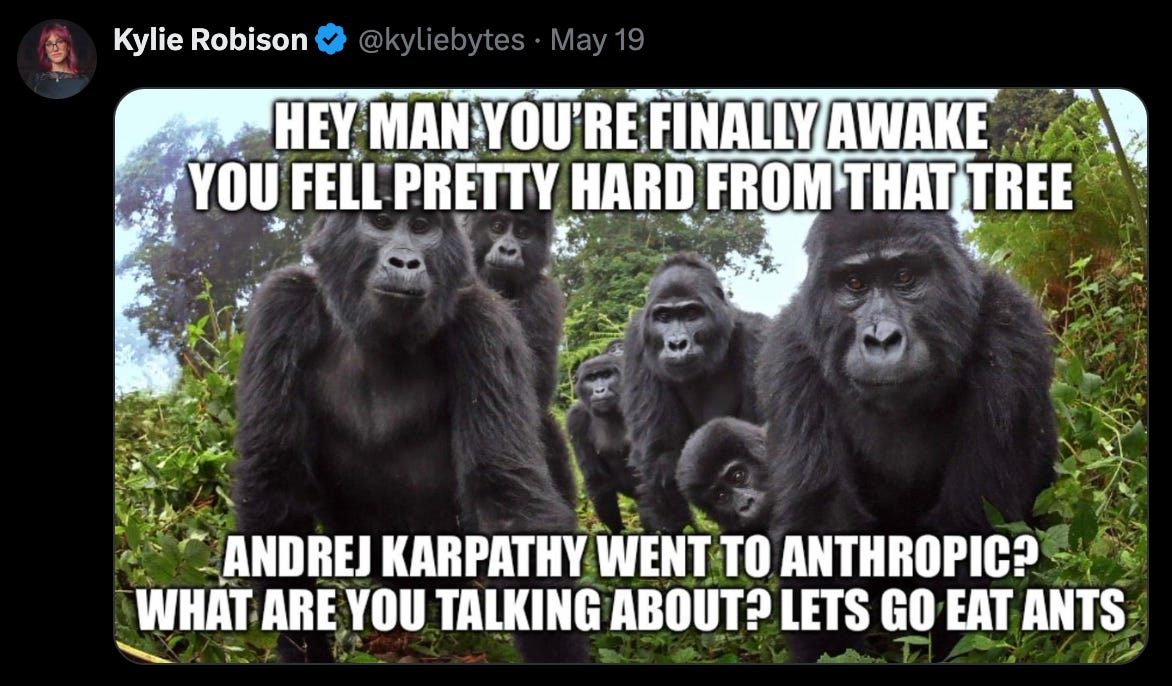
Thanks for reading. Have a great long weekend.
The best detail in here is the apology email. The White House apologized to the people who killed the order. For the inconvenience.