


Here’s a thought experiment from neuroscience.
Imagine you’re trying to bat in baseball. Your brain does some genuinely impressive computation — predicting trajectories, coordinating dozens of muscles, adjusting for wind — and puts it all together using Bayesian algorithms. But here’s the thing: making your brain infinitely smarter would not allow you to hit all balls. Some are out of reach, others move too quickly. At some point, regardless of your intelligence, you hit physical limits. You can only stretch so far or react so fast. No amount of genius overcomes the physics of your body.
This is intelligence saturation. For a given task, more intelligence helps. But it helps less and less as you add more intelligence. And it’s the key concept missing from most debates about AI and the future of work.
On one side, we have AI researchers who see exponentials everywhere: compute resource doubling every six months, costs halving faster than every six months, model performance doubling every seven months. The AI folks see that “intelligence” is scaling at unbelievable rates and conclude we’re headed for an economic singularity. In one popular scenario, human wages will go up as automated tasks make the not-yet-automated parts of a job more productive, until AI takes over everything and their wage goes to zero as there is no work left to be done. Then, the theory goes, everyone will have to be on Universal Basic Income.
On the other side, economists look at 200 years of steady growth despite countless “revolutionary” technologies and shrug: AI is just another general-purpose technology, nothing special. In a scenario popular with these econ folks, it is hard to make human workers obsolete even in the intelligence domain. In this view, AI replaces workers in some jobs that it can do better or more cheaply, but new jobs are also created, and AI makes people overall more productive. Overall growth is then just like without AI, only a little bit faster.
This tension is something we both know well: One of us (Konrad) is a neuroscientist who studies how artificial systems become intelligent; the other (Ioana) is a labor economist specializing in technological change. So, we teamed up and spent a year thinking and talking about why these communities have these distinct takes and worked to produce a credible overarching framework. The result is a paper on Intelligence Saturation and the future of work, which was released late 2025.
Physical Meets Intelligence
Economists traditionally divide the economy into two complementary sectors: capital and labor. We can replace capital, which includes machinery, equipment and technology, with human labor and vice versa, but that replacement is often difficult. The more we replace one with the other, the harder it is to replace more, because the easiest tasks to replace are targeted first. In our paper we argue that it is crucial to also divide the economy into the “intelligence parts” and the “physical parts.”
The intelligence sector comprises things that can be done virtually, remotely, purely through information processing. The physical sector comprises things that require bodies, presence, and manipulation of the actual world.

We believe that AI may be eating the pure intelligence sector alive. But here’s the catch: intelligence and physicality are complements, not substitutes. You need both.
Think about education. AI may be able to generate perfect lesson plans, but students still benefit enormously from a teacher in the room — the physical presence, the classroom management, the hands-on activities. COVID taught us this the hard way: districts with remote learning saw significantly worse outcomes.
Or manufacturing. Smarter controllers can optimize production lines beautifully. But you still need better robots and assembly equipment, and those aren’t doubling in capability every six months. Physical construction, for example, still takes significant time: manufacturing projects valued at more than $100m average 25.6 months to be completed.
Or healthcare. AI diagnostics are impressive. But someone still has to examine the patient, perform the surgery, administer the treatment. And to develop new cures you don’t just need to read the literature, you need to run randomized controlled tasks on human subjects, very much a slow-growing resource.
Intelligence saturates because physical inputs don’t scale the same way. You can add infinite intelligence, but if physical capacity is fixed, returns eventually plateau. And if physical capacity grows much more slowly than intelligence, then overall growth is slower.
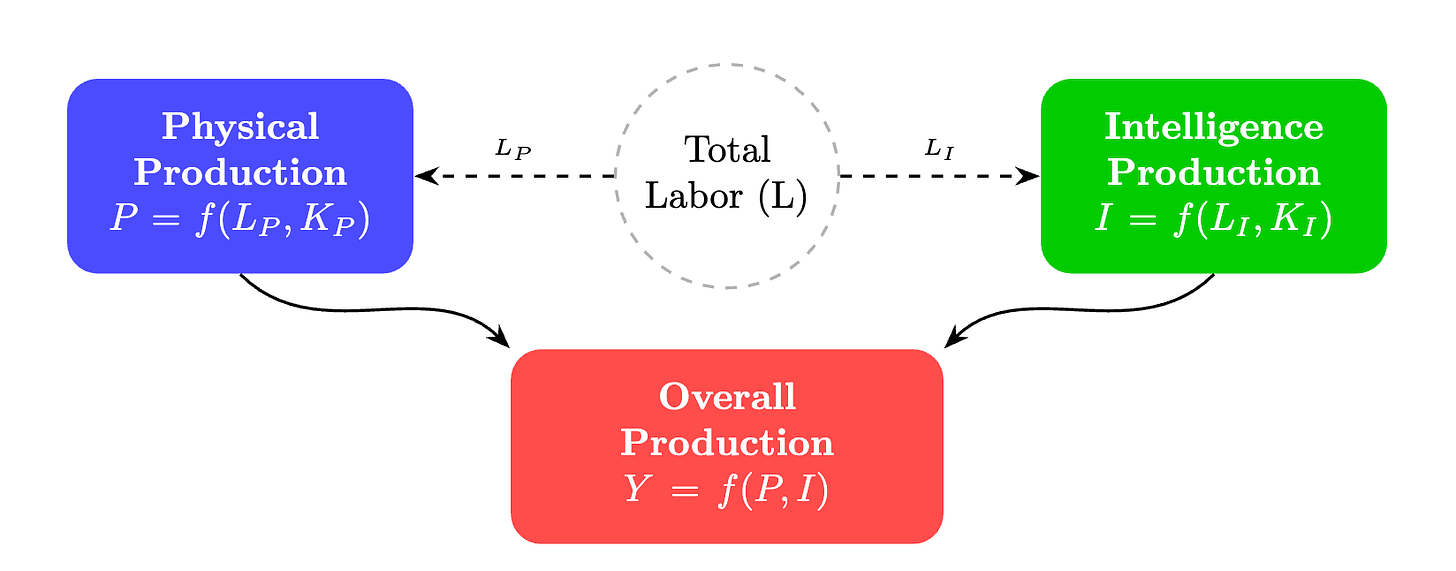
Here’s where it gets interesting (and concerning). In our model, as AI automates intelligence tasks, workers shift toward physical jobs. This creates two opposing forces on wages:
Scale effect: More AI boosts intelligence output, which enhances the value of the physical work. (Think of AI optimizing marketing and food purchases for restaurants, so that humans can be as productive as possible.)
Reallocation effect: More workers crowding into physical jobs pushes wages down because there is only so much physical capital available
Which of these effects wins out depends on how easily we can substitute a physical output with an intelligence output; for example, how many call center workers can you replace with customer service bots? Typically, early in automation the scale effect dominates and wages rise, because AI is newly deployed where it can be most effective. Later, as most intelligence tasks are automated and workers pile into the physical sector, the reallocation effect wins and wages fall. The result? Depending on the dynamics of how AI is adopted in the labor market, there is often a hump-shaped trajectory. Wages up, then wages down. This isn’t a prediction, because it depends on parameters we don’t know precisely, and in particular the ultimate downfall of wages is less likely if physical and intelligence outputs are less substitutable. But it’s a possibility that early wage gains from AI are positive and long-term effects are negative.
We built an interactive tool if you want to play with the parameters yourself. You can see how for different parameter settings the long-term results are, indeed, a singularity or a nothingburger. But for the parameters we consider most realistic, the results are somewhere in between.

Everything here hinges on one question: how substitutable are physical and intelligence outputs? If you can swap in-person services with virtual ones easily, high levels of automation hits wages hard. If they’re strong complements, in the sense that AI systems still need humans to provide good results, or if people genuinely value physical goods and in-person services over virtual ones, then workers in the physical sector will be protected. This is measurable. We should be measuring it.
Some Policy Implications
So what does all of this mean for the way policy makers could think about maintaining wages? Here are three things we think are worth considering:
Slow down automation and invest in physical capital. If we’re racing toward the peak of the wage hump and are soon to hit the downward slope, it would make sense to buy time to make greater investments in the physical sector so that it takes longer for the intelligence sector to saturate. Slowing down the roll out of automation would keep wages higher for longer.
Protect physical sector complementarity. Policies that make virtual services perfect substitutes for in-person ones might boost output but they will also hurt wages during the transition. Policymakers might want to ensure that human labor is required in some parts of the economy.
Watch the intelligence employment share closely. In our model, wages can’t fall as a result of automation unless the share of workers in intelligence jobs rises. That’s the canary in this coal mine: If that share begins to shift, wage reductions could soon happen.
The singularity narrative argued by some AI folks assumes unbounded returns from intelligence. But you can’t build a car with computation. You can’t cook a meal with algorithms. You can’t construct a building with cleverness. The physical world imposes constraints that intelligence can only optimize against, not eliminate.
That’s not a reason for complacency: the transition could still be rough. But it’s a reason to think the AI transformation will be significant yet bounded, not infinite. Intelligence is powerful. But it saturates.
Konrad Körding is the Nathan Mossell Penn Integrates Knowledge Professor at University of Pennsylvania and the co-director of the CIFAR Learning in Machines and Brains program. Ioana Marinescu is an Associate Professor at the University of Pennsylvania School of Social Policy and Practice, and a Faculty Research Fellow at the National Bureau of Economic Research.
The singularity narrative posits that intelligence can design robots (and robot manufacturing processes) that quickly bootstrap to arbitrarily large influence on the physical world. The model presented here seems to ignore that possibility for unclear reasons.
Imagine you're trying to bat in baseball. You have ultra-high resolution optics, think about 1000x faster than any human, and control a humanoid robot body with high-precision mechanics. Are you really telling me that this wouldn't increase the chances of a hit? It wouldn't go up to 100% for sure, there are physical limits. But they are way beyond current human skills. So at one point, humans will be completely outperformed by smart robots in Baseball like we already are in Chess and Go.
Even if some physical jobs cannot be automated so easily, there are millions of people doing things like truck-driving that are already being automated. The industrial revolution has automated physical labor first, now AI comes for the white-collar jobs and humanoid robots come for the more complex physical labor. I very strongly doubt that all those people will find new physical jobs, let alone jobs they'd like to do.
All this doesn't necessarily have to be bad if we can manage the transition and redistribute the wealth so nobody has to work anymore and we can all do nice things together (provided the AI will remain docile and not take over control completely). But I don't see that we're on the way to that future.