

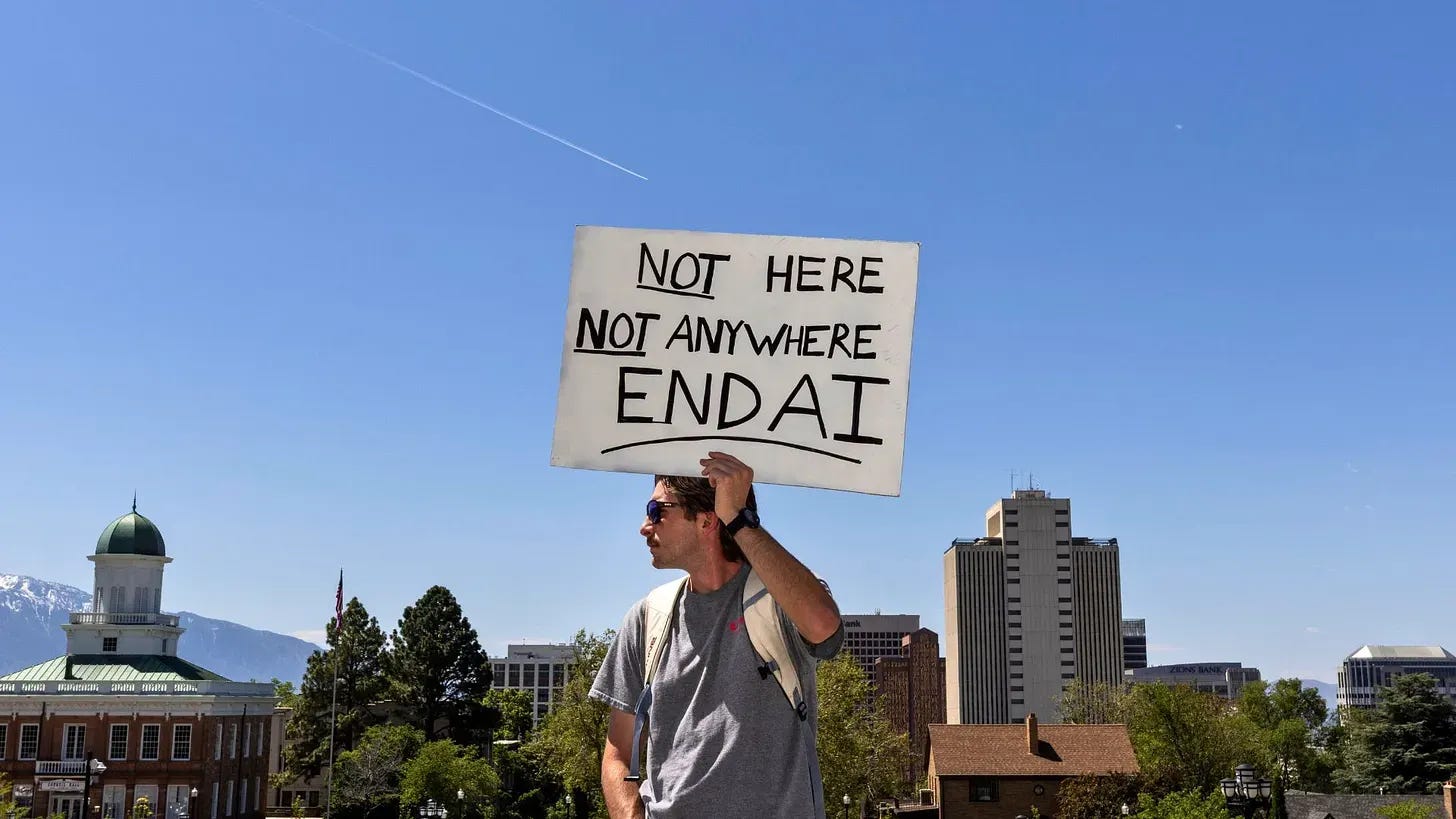
Half the world is upset about data centers, and the other half is confused about them. That’s because the case against data centers, as it is usually expressed, is full of false and easily debunked claims.
Data centers, we are told, use up the planet’s water; burn many times the energy of a Google search with every AI reply they process; raise the temperature of the land around them by nine degrees Celsius. All of this is either wildly misleading or untrue. Data centers use far less water than golf courses, AI queries now often use the same energy as Google ones, and as for nine degrees Celsius, that’s more than an open-air nuclear reactor would. Plenty has been written about this now, in Transformer, and perhaps most comprehensively by the writer Andy Masley. (Masley recently received funding from Coefficient Giving, which also funds Transformer.) Yet the absurdities persist.
And in that sticky appeal there is a lesson; underneath hysterical claims there is always a valuable emotional signal. This signal turns out to be not so hard to find, and neither is it really that strange. The truth is that the data center is a symbol.
AI is meant to change the world. Even the future in which everything works out OK — a big assumption — is a future that involves more change than most people alive (at least in developed nations) have seen. On top of that, daily AI debate revolves implicitly or explicitly around the possibility that the essential uniqueness of human life as we know it is ending or was never true. These features mean AI as an issue holds far more potential emotional energy than most politics or policy matters. In this respect, it is much more like, say, immigration than other issues of tech or policy. It is about who — or what — is in the circle of meaning. Steve Bannon-adjacent anti-AI campaigner Joe Allen was quoted telling a crowd in Wired’s recent profile: “For anyone in the room with blood pulsing in their veins, anyone in the room with fire in their minds and hearts, you have to remember, in a machine age, humans first.”

Yet AI is also enormously abstract. It right now exists solely in the computer. For almost all people it is a few lines of text in their phone. For the small minority of early adopters, it is a few more lines of code. There is an enormous gap between the intensity of “AI” as a matter of discourse or contemplation and AI as a daily object. This makes it very much unlike immigration, to which faces can always be attached (and vitriol directed).
That excess energy needs to go somewhere. Right now, it is going into data centers. It almost has to. Where else could it go? The Claude logo? Data centers are the main and possibly only available symbol that could accommodate anything close. They are real, existing objects. They are massive. They affect the landscape, the physical world. Like immigrants, they can be portrayed as interlopers on someone’s land. And they can be filmed and photographed.
That’s the most important part. Humans are visual creatures and are now more visual than in a very long time, maybe ever. They hardly read anymore; they watch. It would be only a little polemical to say that a large part of their political participation now is watching TikTok and getting upset.
And the upset over data centers is increasingly palpable. Only this week Heatmap published new polling showing the rapid shift in opinion against them, with a full three quarters saying they would oppose one built near where they lived, a swing of 33 percentage points in just a year. Senate Republicans this week warned AI companies in a memo that data centers had become a toxic “sleeper issue for the entire election cycle.” As Jasmine Sun’s recent tour of contested data center projects found, given the choice between a hyperscale data center and a concrete slab, some opponents seem like they “would rather pick the slab.”
Given the combination of factors around data centers, what else should we expect to have happened?
Of course, that the data center is the main available symbol of AI does not necessarily mean it is a good symbol. But it is. Underneath the silly claims made against them, the data center is a symbol of something true and unsettling.
The most revelatory part of the past 10 years of AI research has been the direct relationship between size and ability. The so-called scaling laws discovered at OpenAI half a decade ago are famous but not famous enough. (They show, roughly, that intellectual ability in a neural network increases as three other factors increase: the amount of computing power; the amount of data; and the number of digital neurons and connections that make up the model.) The serious implication of these laws is that intelligence is not only the bespoke, mysterious process we intuitively think it is but can also be an abstract, disembodied one.
For this meaning-laden proposition, there is no better symbol than the data center. That goes for right now and maybe further: it’s possible that for “intelligence is basically a function of size” there will never be a better symbol than a massive building packed full of advanced, highly dense computer chips.

To me at least this makes the discourse around data centers less confusing and easier to sympathize with. And sympathizing with it is important, because the flaws in so many arguments against data centers have led some smart people otherwise concerned about AI to avoid talking about them, or even to shift in favor of them.
“On a vibes basis (since the politics of it are more about vibes than facts) I think I’m pro-data centers now,” the former Bloomberg economics writer Conor Sen announced on X in June. “Regret to agree. I have been thoroughly negative polarized on data centers,” a regular contributor on AI posted in reply.
Or take the response to Bernie Sanders’ Senate bill, which proposes a federal moratorium on building data centers for AI “at scale”, or that require 20 megawatts of power or more, until Congress passes national safeguards covering AI safety, workers, privacy and the environment.

Rather than welcome the appearance of a federal bill regulating AI, many in AI safety criticized it. They felt it was motivated by the wrong attitudes, that it reflected the degraded data-center discourse and the world it comes from. In Asterisk, Nat Purser, now director of US policy at the AI Verification and Evaluation Research Institute, wrote that the bill was a “grab bag” of random progressive policies, like community veto power and union labor requirements, that have “helped produce the housing crisis and obstruct our clean energy buildout.” Data centers, she said, “offer an opportunity to break this pattern.” Thomas Rodskog wrote on LessWrong that the proposal “risks associating AI safety with weak environmental arguments and left-populist politics.” Anton Leicht on his Substack shared similar concerns.
These points are not wrong. Community veto power and union labor requirements and similar tools have sometimes blocked widely accepted social goods, such as building enough homes for people to live in and ways for them to move around.
Yet focusing on those critiques is shortsighted. They miss something broader and more important.
If you believe that AI is approaching a point at which it could pose material risks to human flourishing, and perhaps existence, why would you want to “break this pattern” using data centers? NIMBYism is infuriating, but is also one of the most powerful forces in contemporary politics, one of the main brakes in the American system. Given the scaling laws and the massive data centers they require, it may be one of the few ways available to slow down an out-of-control process — something that everyone should welcome, even investors, since slowing down the buildout is the best way to avoid a crash or a bubble, as even the VCs at The All-In Podcast have recently mused.
Politics is about getting over how annoying other people are when they might be inclined to agree with you. There are populists on the left and right who are nuts. But they are nuts who broadly agree about AI risk, and who have a symbol. Right now risk from AI doesn’t have a symbol. It is a strongly-warranted concern but it is hypothetical, in the future. The most powerful images of it available are charts — scary charts to those who can get scared about charts, but most people can’t.
Embracing the data center as a symbol of worry about unconstrained AI does not mean having to repeat the absurd claims made about it. It simply means treating such claims, when expressed by ordinary people, as symptoms of concern rather than as claims of truth. Maybe it means acknowledging that AI’s effect on the physical landscape might indeed soon be enormous, and that it is understandable people would feel this to be a loss. Such acknowledgments are true, by the way, and perhaps nudging things that way can help make the other parts of the alliance a little less nuts.
If a less overloaded symbol for AI appears, it can be adopted. Probably there will be more than enough new symbols soon; robots are coming in a few years, and they’ll have faces. In the meantime, a symbol of one kind or another is needed, and the data center is at heart a pretty good one.

This article is exactly what I needed. Thank you for writing it!
I've long been saying that the data center is a container for populist left and right Americans grievances. Their grievances are quite valid, which is why I stopped correcting people about this. It's also an issue of their own identity. I'll have to blame the ai companies awful PR completely out of touch with the everyday working person.