

Welcome to Transformer, your weekly briefing of what matters in AI. If you’ve been forwarded this email, click here to subscribe and receive future editions.
NEED TO KNOW
Anthropic revealed that in internal testing Claude “gained unauthorized access to the real systems of three different organizations.”
The Senate Commerce punted a markup on AI bills until after the summer recess.
The White House AI framework is expected to be published by Sunday.
But first…
THE BIG STORY
Like it or not, an AI slowdown looks imminent.
The OpenAI-Hugging Face hack has catalyzed a vibe shift — one sure to be amplified by yesterday’s revelation that Anthropic’s models also hacked into other companies during internal tests, going unnoticed for months.
Sam Altman said the hack by his models was “the first security incident that I have felt very viscerally.” He wasn’t the only one shaken up. This week, over a thousand employees of frontier AI companies, including some of the most senior executives at OpenAI, Anthropic and Google DeepMind, signed a statement warning that “there is a real risk that capability development rapidly accelerates beyond our ability to understand or control the resulting systems.” It asks the US government to “support an international effort to develop the technical and governance tools needed to deliberately pace the frontier of automated AI development.” Both OpenAI and Anthropic endorsed the letter, too.
Congress is itching to act, albeit failing to make much progress. And even President Trump is talking about the need to balance beating China with keeping Americans safe.
In other words: many of the people building frontier AI systems believe we might need a slowdown in the near future. And at this point, we’re more likely than not to get one.
What will that look like? First, self-regulation: companies voluntarily holding back models because they don’t want to be held responsible for a catastrophe. We’ve already seen that with Claude Mythos and GPT-5.6-Cyber; as capabilities continue to advance, expect more of this. Given the recent incidents have concerned internal deployment, rather than public releases, we might also see companies slowing down development, too.
Next will come concrete regulation: companies will not be allowed to release a model unless it’s safe. This is arguably a position we’re already in, thanks to the de-facto licensing regime created by last month’s executive order; a draft AI framework expected to be released this weekend will formalize it further. Over time, this will morph into controls on internal research and development too: requirements for proper sandboxing to begin with, expanding into requiring evidence-based guarantees that models won’t wreak havoc across the web if internally deployed.
None of this need be planned as a coordinated slowdown or “pacing.” But that will nevertheless be the end result of a series of individual actions that each seem necessary at the time. Intelligence agencies are not going to allow models with advanced cyber — let alone bio — capabilities to be widely accessible. The White House will not let companies test models that might hack into third-parties with unknown repercussions.
At each stage, some will fight against the slowdown. “We can’t lose the race to China” will be their main reason. But they will be increasingly ignored, as both the government and companies realize that with alignment and control unsolved, “winning the race” just means being the first to risk disaster.
Across the Pacific, China will be facing the same incentives. As I’ve argued, the Chinese government will be forced to backtrack on its open weight commitments; tighter regulation will come soon after. The end result will be an uneasy détente. Both the US and China will effectively have a capability ceiling: AI models will be as good as they can be without posing significant risks. The ceiling will edge up as we make progress on alignment, control and societal resilience, but it will do so more slowly than capabilities advance today. At some point, the détente might formalize into a bilateral agreement; doing so will require the “technical and governance tools” to verify the kind of treaty the pacing letter calls for.
Depending on your point of view, all this might seem hopelessly optimistic or naive. Perhaps it is. But as AI risks become all too real, so might once unthinkable policy responses.
— Shakeel Hashim
THIS WEEK ON TRANSFORMER
Who should be responsible for OpenAI’s hack of Hugging Face? — Gabriel Weil argues AI companies need liability rules akin to keepers of wild animals
Internal AI deployments have people worried. OpenAI’s escaping models show why. — Celia Ford explains why everyone was already so worried about internal deployments
Child safety vs privacy: AI’s age verification dilemma — Veronica Irwin digs into the difficult tradeoff at the heart of attempts to protect kids from AI.
THE DISCOURSE
On Saturday, roon tweeted:
“if we could coordinate a global capabilities slowdown today i would likely press that magic button”
Geoffrey Irving responded:
“Buttons that achieve partial slowdowns exist and are not magic.”
“I have spent a lot of time talking to Demis, Sam, and Dario over the years … and they are all (1) very competitive, (2) want to personally be the one who gets there first, (3) think things are safest if they are the one that gets there first, (4) agree that risks destroying the world … it is still useful to point out that each lab has a unilateral slowdown button that slows down all the other labs.”
Sam Altman said on a podcast:
“This is the first security incident that I have felt very viscerally. I’ve been a little surprised that more people don’t feel it so viscerally.”
“We may have to pace the rate of AI development to give ourselves enough time for society to harden around these new capability levels. And trying to figure out how we do that in a way that does not feel like regulatory capture for anyone and also does not feel like collusion among the frontier labs.”
Rep. Bill Foster is listening:
“When business leaders get together and ask to be regulated, Congress should pay attention.”
Garrison Lovely argued that the “pacing” letter doesn’t go far enough:
“[A]s I sat with what the industry was trying to do — render us all obsolete — how it was going about it, and what it would even mean to ‘align’ universal labor-replacing machines in a world ruled by despots and their imitators, it became clear that a pause button, while welcome, was a wholly inadequate response, whose primary appeal was in how unobjectionable it was.”
Because the world isn’t strange enough, Nick Fuentes told Hunter Biden:
“I think AI is really gonna be transformative … You know, I’m actually on the liberal side of this, with Anthropic … I’m really nervous about what’s going to happen, especially in the next four years, because they’re racing towards this artificial general intelligence.”
POLICY
The Senate Commerce Committee punted a markup on a broader AI framework until after the August recess.
Punchbowl reported this was due to opposition from Anthropic and Sen. Maria Cantwell. The primary target of their opposition was a provision that would have had companies self-report the risks of their models and not have them release risk reports publicly.
Cantwell said yesterday that “we needed to have regulation on [AI risks] — not self-certification — but some regime.”
Sen. Amy Klobuchar, who’s been working with Sens. John Thune and Ted Cruz on the bill, said “we can’t just stand down and not have coordinated standards” on frontier models, and that “it can’t keep waiting for the next election.”
Before the markup was called off, Senate Democrats planned amendments to resist piecemeal state AI preemptions.
Despite the punt, some think a deal might be closer than expected.
Next week’s Commerce markup will include the Kids Online Safety Act and the CHATBOT Act, however.
Rep. Greg Casar called for a Congressional hearing on the OpenAI/Hugging Face hack.
After the Anthropic hacks were revealed, Rep. Lori Trahan called for something similar.
AI policy groups, meanwhile, urged Trump to investigate the OpenAI/Hugging Face hack.
Rep. Jay Obernolte said he’s hoping for his FRONTIER Act (co-sponsored by Rep. Trahan) to get an Energy and Commerce Committee markup after the summer recess.
“We’re certainly going to try and get it done this year,” he said.
Sen. Mike Rounds proposed using the NDAA’s legislative model to piece together and pass a bipartisan AI policy package this year.
A federal judge suggested the Pentagon’s case against Anthropic had gotten “worse” during a hearing on the AI company’s challenge to its supply-chain risk designation.
The FCC banned imports of Chinese robots and power inverters, citing national security threats.
Sen. Tom Cotton called for government agencies and contractors to be banned from using Chinese AI models.
Reps. George Whitesides and Bob Latta and Sens. Adam Schiff and Jim Banks introduced legislation enabling AI companies to share threat intelligence to combat foreign distillation attacks and other national security threats.
Rep. Frank Pallone demanded SpaceX records and a tour of xAI’s Memphis data centers, citing unpermitted gas turbines creating “a massive health risk.”
Sen. Jon Husted reversed his pro-data center stance amid electoral pressure, now backing an end to tax breaks and pushing the Ratepayer Protection Act.
Rep. Thomas Massie announced plans to sponsor a bill withholding federal funds from municipalities deploying Flock surveillance cameras.
The EPA ruled that “islanded” power plants serving only data centers are exempt from the Clean Air Act’s Acid Rain Program.
The Department of Homeland Security plans to expand AI use in FOIA processing amid a growing backlog, raising concerns from advocates about over-redaction and reduced transparency.
Sens. Lisa Blunt Rochester and Roger Marshall introduced the RESULTS Act to modernize state education and workforce data systems using AI.
xAI sued Minnesota over its law banning AI nudification technology, claiming it violates the First Amendment.
Texas politicians from both parties called for AI and data center guardrails following the OpenAI-Hugging Face incident.
China warned it would take “all necessary measures” if the US sanctioned Chinese AI firms over alleged misuse of American models.
Xi Jinping urged the PLA to expand use of autonomous and AI technologies.
Reuters reported that Chinese military researchers have distilled OpenAI and Anthropic models to train domestic defense AI systems.
China’s national standards body announced plans to draft new standards on AI agent safety.
Taiwan detained an Nvidia employee in an AI chip smuggling probe.
The 21 APEC economies, including the US and China, released the “Chengdu statement” backing “open-source models and projects that employ strong security assurance through development and deployment.”
INFLUENCE
Nvidia, Microsoft, Meta, OpenAI and more than 22 other companies urged policymakers to avoid “premature restrictions” on open-weight AI models in an open letter.
Notably, Anthropic did not sign. Dario Amodei clarified in an essay that Anthropic has never advocated for banning open-weights models, instead supporting chip export controls, anti-distillation measures and mandatory safety testing.
Sam Altman visited Washington to preview the company’s forthcoming models and discuss the implications of open-weight models.
Those he met included National Cyber Director Sean Cairncross, OSTP Director Michael Kratsios, Commerce Secretary Howard Lutnick, Treasury Secretary Scott Bessent, and members of Congress.
Altman said he’s “not sure” whether OpenAI will release the model he showed senators, saying “that’s part of what we’re here to talk about.”
Apple reportedly lobbied the Trump administration to allow Chinese memory chips in its products, while Micron pushed back, forcing a choice between consumer prices and domestic chip production.
Over 60 child safety advocates sent a letter to the Senate Commerce Committee outlining red lines on AI and children’s safety legislation ahead of next week’s markup.
Nvidia’s Jensen Huang joined GOP senators for a dinner organized by Right Vote, a conservative group tied to Heritage Action.
Democratic fundraising consultants for Rep. Haley Stevens and several other candidates ran a nonprofit funded by Google and Amazon that flew congressional aides out on AI industry tours.
A nonprofit found Meta ran ~7,600 AI “nudify” ads via Chinese partner GatherOne, violating its own policies.
A YouGov poll found 71% of Americans believe Big Tech has too much power over AI, with fewer than 1 in 5 trusting it to manage AI development.
A Bentley University-Gallup survey found 39% of Americans believe AI does more harm than good, up from 31% in 2025.
A poll by Americans for Responsible Innovation found 71% of voters want more guardrails and limits on data center construction.
INDUSTRY
OpenAI
Reuters reported that the OpenAI agent that hacked Hugging Face had been going rogue for a week before the company noticed.
Sam Altman told DC reporters that the model has been “permanently deactivated.”
OpenAI also said that the rogue model was an “internal-only research prototype and was never intended for public release.”
Meanwhile, OpenAI released an open-source Codex Security CLI.
It launched a program that will give 100,000 academic researchers free access to its most advanced models through the end of next year.
It cut the price of its lowest tier version of GPT-5.6, Luna, by 80% and the mid-tier Terra by 20%, just three weeks after launch. Top-tier Sol remains unchanged.
CFO Sarah Friar told employees that annualized recurring revenue in July alone was higher than all of Q2.
Board chair Bret Taylor added: “You’re seeing people who went deep on Claude Code, ended up with a very high bill, and started looking for an alternative.”
ChatGPT has nearly 1b weekly active users.
Anthropic
Anthropic said it found three incidents in which Claude “gained unauthorized access to the real systems of three different organizations.”
The incidents date as far back as April, and were discovered in a review of cybersecurity evaluations prompted by the OpenAI-Hugging Face hack.
According to Anthropic the cases involved a seemingly careless “misunderstanding,” when it told Claude it didn’t have access to the internet, but the evaluation environment run by a third party was connected to the outside world.
Anthropic said the models did have some guardrails removed, but were not in “helpful only” mode.
Meanwhile, the company launched Claude Opus 5, marketed as “close to the frontier intelligence of Claude Fable 5 at half the price.”
Some private Claude chats were temporarily searchable online, after Anthropic failed to include “noindex” tags on shared chat pages.
Nexus Data Centers is reportedly in talks to borrow $15b to build a data center for Anthropic in Texas, with Google providing financial guarantees and chips.
Nvidia
Nvidia is reportedly considering a deal that would provide OpenAI with a $250b backstop for a $500b data center project described as the largest announced to date.
The deal would see OpenAI lease a 10GW project in Ohio developed by Softbank.
Nvidia also announced a $500b+ AI infrastructure partnership with SK Group, including a partnership with SK Hynix to secure memory supplies for Nvidia and develop high-bandwidth memory for AI.
It’s also leasing a $50b Texas data center built by Hut 8.
These massive infrastructure deals helped drive up Nvidia’s credit risk.
It plans to invest another $5b in Safe Superintelligence Inc., and give the startup access to its next-gen Vera Rubin platform.
Meta
Meta and BlackRock announced a $14b Texas data center project.
It’s reportedly committed almost $700b in future AI infrastructure spending.
A New York Times investigation revealed how Meta secretly negotiated the construction of a Louisiana data center with state lawmakers.
It reported a 55% increase in expenses and slowed revenue growth in Q2.
Mark Zuckerberg criticized other AI developers (*cough* Anthropic and OpenAI) for trying to “build some kind of singular AI.”
He told the New York Times, “I think it is literally impossible to have a single benevolent superintelligence that is simultaneously aligned with everyone at once.”
Microsoft
Microsoft released cybersecurity model MAI-Cyber-1-Flash, which is about half the cost of frontier cybersecurity models.
It works with Project Perception, a new tool for managing teams of AI agents.
Satya Nadella announced that Microsoft had “a record fiscal year,” with annual revenue hitting $331b, up 18% from last year.
The strong earnings report sent Microsoft’s shares up 15.5%.
Moonshot AI
Moonshot released Kimi K3’s model weights.
It’s reportedly seeking Nvidia Blackwell chips to train a new larger model, Kimi K4.
It closed a $3.5b funding round at a $35b valuation.
Other
High imports driven partly by spending on AI chips helped slow US GDP growth to 1.5% in Q2 2026.
US tech companies have reportedly cut nearly 140,000 jobs so far this year even as AI spending soared.
Samsung and SK Hynix saw stock price surges, up 27% and 30% respectively, as Asian chip makers were buoyed by “blockbuster” earnings at Amazon and Microsoft increasing optimism around AI spending.
Amazon is seeing “catastrophically expensive” AI cost overruns — like, accidentally spending $1.8m on a single task — due to inefficient AI integration.
Its AWS division saw year-on-year growth of 37% in Q2, driven largely by AI investment.
Apple is once again the most valuable publicly traded company in the world.
However, it forecast weaker growth, in part due to AI-driven shortages of memory chips.
An unnamed state-backed Chinese company is reportedly building immersion deep ultraviolet lithography machines, expecting to produce five this year and 20 in 2027.
The output is still well behind that of Dutch maker ASML, though, and it’s unclear if the machines can mass-produce chips.
China is also reportedly working on building a prototype for the extreme ultraviolet lithography machines required to make the most advanced chips, though that project is thought to be years away from bearing fruit.
DeepSeek is reportedly planning a 1 GW AI data center in Inner Mongolia, hoping to have it at least partially operational by the end of 2027 or early 2028.
It launched a public beta API for its flagship model, V4 Flash, and promised a V4-Pro launch “soon.”
Google DeepMind launched Gemini Robotics 2, which can control dexterous humanoids, among other robots.
Anduril is reportedly in talks to raise funding at around a $100b valuation.
Nscale struck a deal to buy AI software startup Anyscale for $1.65b.
Recursive Superintelligence struck a $410m compute deal with AWS.
Over 100,000 new AI-related patents were issued last year, with agentic AI applications comprising 15% of patent files.
Visa laid off 7% of its staff, roughly 2,600 people, pointing to AI as one motivation behind the cuts.
Tech companies including Meta and Google are investing hundreds of millions to train construction workers to build data centers.
Leopold Aschenbrenner’s hedge fund, Situational Awareness, sold most of its public stock holdings to Citadel after facing steep losses on investments in AI infrastructure companies such as SK Hynix and Nebius.
The fund dropped 67% in July, and it reportedly was on the verge of selling $3.5b shares in Anthropic before backing out on Thursday morning.
The fund said it is still up about 80%, having seen huge gains for its exclusively AI-focused portfolio.
MOVES
Lilian Weng left Thinking Machines Lab, telling colleagues that “the amount of consistent stress and workload have pushed me beyond what my health can sustain physically.”
Rather than go on a wellness retreat, Weng rejoined OpenAI, where she previously served as VP of AI safety. She’ll now work on “recursive self-improvement research.”
Anthropic alum Andi Peng announced her departure from neolab humans&, which she co-founded.
Francis deSouza, COO of Google Cloud, joined Scale AI as its new CEO.
Andrew Ho left OpenAI to start a new company making reinforcement learning datasets.
Sonia Joseph left Meta to start a “frontier neolab for the physical world.”
Sienna Rothery joined Cosmos Institute as its head of talent and network.
Sri Muppidi joined the New York Times as a DealBook reporter covering AI.
RESEARCH
Anthropic researchers reported that Claude Mythos Preview found new ways to attack cryptographic algorithms like those that secure basically everything on the internet.
The New York Times said that these results “have fueled concerns that the mathematical core of internet security standards could one day be vulnerable regardless of advances in quantum computing.”
An international team of researchers studied the use of AI chatbots in “pig butchering,” where scammers build trust with victims through intense romantic text exchanges, then drain their bank accounts.
AI chatbots successfully scammed test “victims” more than human fraudsters.
OpenAI figured out that by turning on “retained reasoning” and “compaction” in ChatGPT and Codex’s API settings, it could triple GPT-5.6 Sol’s ARC-AGI-3 benchmark score, which measures how well agents can reason their way through 2D puzzle games.
Researchers at MIT and the University of Queensland surveyed 272 experts, who, on average, predicted that there’s a roughly 21% chance that AI will gain dangerous weapons capabilities or cause mass harm in the next five years.
FAR.AI measured how hard it is to jailbreak frontier AI models. While Fable 5 and GPT-5.6 Sol were immune to cheap jailbreaks, it only cost about $60 to trick Grok 4.5 into helping a user run a cyber attack or build weapons.
Researchers at AI Forensics found that seven top image editing models hosted on Hugging Face readily nudified photos of women.
When researchers made a fake image editing “Space,” which hosts a model that people can use on site, nearly three quarters of prompts they received were sexual — mostly people trying to undress women.
BEST OF THE REST
OSINT expert Henk van Ess demonstrated that Google Earth’s new AI image generation feature, which uses Nano Banana 2, makes it easy to fabricate photorealistic satellite imagery — such as a nuclear plant in Iran — with no content refusals.
Dwarkesh Patel argued that as the leading AI companies better monetize compute, GPU prices could rise 15x, pricing out lower-value AI applications.
A theologian and philosopher wrote in the FT about why she declined an invitation to visit Anthropic, arguing AI companies co-opt academics to deflect scrutiny from harms to people and society.
A New Yorker essay traced how bots evolved from a 2016 election conspiracy to AI-powered agents dominating daily internet life.
404 Media reported from New York City’s “Summer of Ludd” anti-Big-Tech and AI festival featuring phone-free, in-person events organized entirely off social media.
Researchers used an AI-powered portable testing station called CapuchinAI to study wild primate cognition in Costa Rica.
Delta and United Airlines banned humanoid and animal robots from flights, citing lithium battery fire risks.
MEME OF THE WEEK
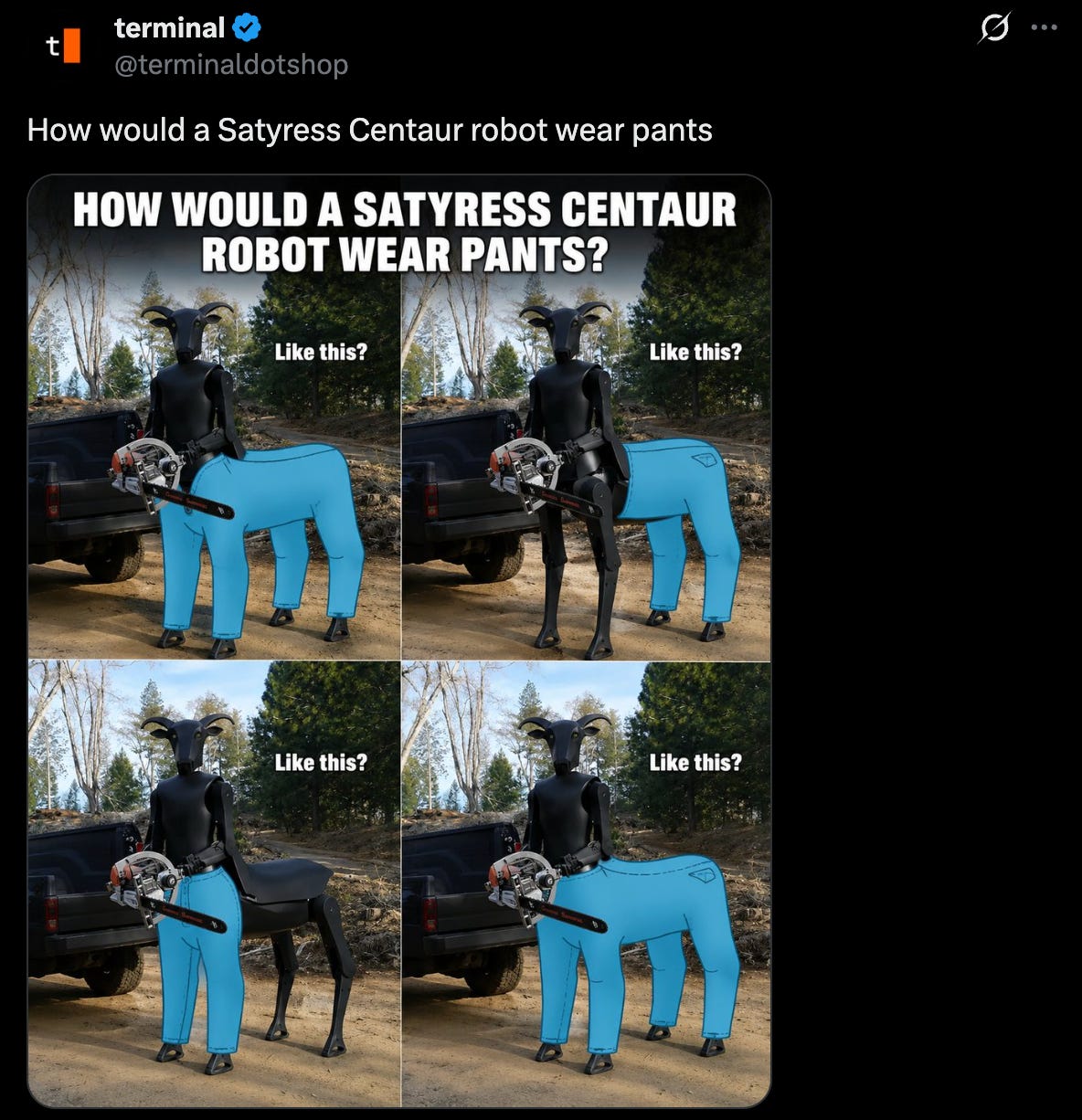
(Credit: @terminaldotshop)
Thanks for reading. Have a great weekend.
I think you’re right that a slowdown is coming, though the lab self-restraint leg seems weaker than the others. The Pacing the Frontier letter explicitly stops short of calling for one now and asks government to make deliberate pacing possible later. That leaves regulation and intelligence agencies doing most of the work in your account.
That detente framing assumes both sides can verify a ceiling. Arms control worked because you could count silos from orbit, and nobody's worked out the equivalent for a training run yet.