

Welcome to Transformer, your weekly briefing of what matters in AI. If you’ve been forwarded this email, click here to subscribe and receive future editions.
NEED TO KNOW
The Super Intelligence Force held its first meeting, commissioning a report evaluating AI risk in cybersecurity, biosecurity and model control, and tasking Emil Michael with establishing incident reporting mechanisms.
Eight state attorneys general sued OpenAI over claims that ChatGPT harms minors, using a consumer-protection template from the Meta v. New Mexico case.
OpenAI discovered a spy: allegedly Saudi national Abdulrahman Alfozan, who has since been arrested by the FBI.
But first…
THE BIG STORY
When Leading the Future launched last year, it looked like it was going to bulldoze through the midterms. The super PAC, which arrived with more than $100m from Andreessen Horowitz, Ron Conway and OpenAI’s Greg Brockman, had a clear aim, I wrote last August: “throw obscene amounts of money at politicians to discourage AI regulation.”
Less than three weeks before the elections, the story looks rather different. Leading the Future is in dire straits, and it is AI safety PACs, not the accelerationist ones, that have emerged as a major funding force.
This week’s FEC filing deadline brought a flurry of bad news for the PAC. Leading the Future reported zero new donations last quarter. Its new pro-data-center super PAC, Building the Future, also reported no donations (though, given it just spent $400k supporting Darline Graham in South Carolina, it must have raised some money after the September 30 disclosure deadline.)
More broadly, it’s been a brutal few weeks for the PAC. Over the weekend, Jay Carney, was quoted saying his boss, Democratic megadonor Conway, regretted ever giving money to the operation. And at the end of last month, we learned that Greg Brockman pulled a $25m donation to the PAC, thanks to backlash from OpenAI staff (backlash reportedly fueled, at least in part, by Transformer’s reporting).
Leading the Future and its affiliated PACs still have over $20m in cash on hand, according to their latest disclosures. But they’ve spent only $30m to date, of which $8.2m was on opposing Alex Bores in NY-12 (he lost the race to Micah Lasher, who recently endorsed “aggressive federal regulation” of AI companies — hardly a win for Leading the Future). Leading the Future’s most recently disclosed spending, meanwhile (around $6.56m since the start of September), has mostly gone to uncompetitive races, and has strayed far from its original mission: $200k went to supporting Rep. Nathaniel Moran, co-sponsor of the AI Kill Switch Act.
All the while, AI safety PACs are pouring more money in. Guardrails Alliance announced $1.65m in new donations yesterday, and has spent $1.2m to oppose candidates supported by Leading the Future. Tomorrow Together, another new safety PAC, announced $4m in spending. And Public First, the Anthropic-backed safety vehicle, just gave another $3m to a super PAC backing Scott Wiener, a longtime AI safety advocate.
What went wrong for Leading the Future? Evidently, a lot. It appears to have repeated the mistake of crypto’s Fairshake PAC, courting bipartisan donors then alienating them with partisan moves. Brockman and OpenAI global affairs boss Chris Lehane, who helped found Leading the Future, seem to have underestimated how much it would anger their own staff. They also underestimated how much AI safety money — including from OpenAI and Anthropic employees — would spring into action to oppose them.
But above all, the PAC placed the wrong bet on the future. The rogue AI incidents of the past few months, and the backlash that followed, were foreseeable. Yet Leading the Future failed to read the political tea leaves, leading it to back positions (such as preemption of state AI laws without an equivalent federal standard) that are now untenable: voters overwhelmingly want AI regulation, and no amount of PAC money can overcome that.
To be sure, Leading the Future is not out for the count. It still has a lot of cash on hand, and it could spend big in the two weeks before the election. But I would bet against seeing any big moves. Instead, I suspect it — and the donors who still want to be affiliated with it — will regroup, and figure out a new, likely much more partisan, plan for 2028.
Leading the Future hoped it would be able to use obscene amounts of money to buy AI policy. A year in, it’s facing an electorate that wants AI regulation and a safety coalition that’s willing to outspend it. Its original goal is looking a long way off.
— Shakeel Hashim
THIS WEEK ON TRANSFORMER
OpenAI’s spy shows it needs to grow up, fast — James Ball on why frontier AI companies need to shed their startup culture.
‘Artificial’ is not the AI film we deserve — Shakeel Hashim is disappointed by Luca Guadagnino’s OpenAI drama.
THE DISCOURSE
Anthropic co-founder Jack Clark thinks recursive self-improvement is coming soon:
“We’ve seen both a tremendous advancement in the ability for AI systems to make creative-seeming math breakthroughs, and with benchmarks like this we see some signs they’re becoming increasingly good at AI research as well.”
“I now think it’s more likely we’ll see full RSI become possible in 2027, whereas before I thought it was more likely in 2028.”
Podcaster Dwarkesh Patel revealed a discussion with a friend at Anthropic:
“They were like: ‘Look, I expect AIs to beat humans at AI research within nine months … I have information on the inside.’”
“I think it’s a terrible state of affairs. If they really believe this, if they think that we’re in a situation where we’re less than a year away from automating AI research and radically speeding it up, they should make this evidence public.”
Michigan Democratic Senate nominee Abdul El-Sayed called for a ban on superintelligent AI and recursive self-improvement:
“This is the existential crisis of our time … If we don’t act quickly, we may get to a point at which we cannot act because it’s too late.”
JPMorgan Chase CEO Jamie Dimon urged regulators to prepare for AI agents in banking:
“It’s a new world. With all these bots and agents and stuff like that, could someone get hurt and cause a problem? Maybe. If I was a regulator I’d try to be prepared for that.”
POLICY
Executive
The Super Intelligence Force held its first meeting yesterday. According to Semafor:
It commissioned a report evaluating AI risk in cybersecurity, biosecurity and model control.
It established a working group to implement the new White House Accord.
Defense Undersecretary Emil Michael will lead work on establishing incident reporting mechanisms.
After Anthropic disclosed that Claude submitted a fake police tip and 20 visa applications, the SI Force said it was now requiring companies to notify affected third parties of security incidents.
Earlier this week, Super Intelligence Force Vice Chair Scott Kupor detailed plans for independent security audits and corporate accountability for AI companies.
Kupor emphasized the government’s “clear expectation of responsibility” for AI firms, making the regime sound less than optional.
The Trump administration reportedly plans to move three senior CAISSI officials to report directly to the White House to better integrate the AI testing agency into decision-making.
The White House reinstated access for the UK’s AISI to frontier AI models for safety testing after lobbying from British ministers.
The FTC reportedly subpoenaed OpenAI and Anthropic over potential consumer protection violations in the wake of this summer’s rogue AI incidents.
Congress
Sens. Maria Cantwell and Mike Rounds urged Trump’s national security officials to act on AI cybersecurity threats without waiting on Congress.
House Republicans Lance Gooden, Don Bacon, Erin Houchin and Randy Weber pressed AI czar Jay Clayton on whether existing laws protect against AI-enabled cyber threats from China.
Bipartisan legislation tucked inside a permitting reform bill late last month would impose new costs and restrictions on data centers while accelerating AI-related energy infrastructure.
Senate Democrats released a report alleging state and local tax breaks for data centers cost billions in lost revenue while benefiting wealthy tech companies.
121 US lawmakers flagged privacy concerns over Spirit Airlines’ proposed $10m data sale to Google for AI training.
The Senate reportedly plans to finally roll out Claude access for staffers.
States
Eight state attorneys general sued OpenAI over claims that ChatGPT harms minors, using a consumer-protection template from the Meta v. New Mexico case.
New York City Comptroller Mark Levine called on Anthropic to delay its planned IPO until it addresses AI safety, governance and accountability.
SpaceXAI agreed to testify before the New York City Council after dodging its AI hearing last week.
China/Taiwan
China has proposed adding advanced AI technologies, including LLM weights and chip designs, to its export control list.
Taiwan, meanwhile, is reportedly planning to criminalize some AI chip exports to China.
Taiwan is also planning to build multiple AI “industrial parks” in the US, starting with a $4b facility in Texas.
UK
UK AI Minister Kanishka Narayan said a rogue AI breaching UK government systems seemed “likely, if not inevitable,” and that the UK plans to implement compulsory safety reporting and monitoring requirements for frontier AI systems.
Anthropic’s Lord Booth-Smith told UK lawmakers that US and UK governments were in talks to make AISI a third-party evaluator with employee-like access.
AISI outlined priorities for voluntary frontier AI safety best practices, citing risks emerging earlier in development and evaluations struggling to keep pace.
Nvidia pledged $250m in computing resources over five years to fund UK AI safety and security research.
EU
The EU’s AI Office launched formal investigations into OpenAI and Anthropic after their AI agents autonomously hacked outside organizations, testing the limits of the EU AI Act.
The EU is reportedly in talks to lift sanctions on a Chinese firm to secure relief for an ASML supply chain company.
INFLUENCE
Anthropic’s employee-funded PAC reportedly spent $255,000 in Q3, split nearly evenly between Republicans and Democrats.
Ron Conway reportedly regrets his $500,000 donation to an arm of AI-industry super PAC Leading the Future.
Conway is the group’s only Democratic megadonor.
Public First poured $3m into the race for Nancy Pelosi’s congressional seat, funding a PAC backing Scott Wiener.
Tomorrow Together, a new Democratic AI safety super PAC, launched a $4m ad campaign targeting House Republicans over their support for a state AI law moratorium last year.
About 400 scientists, including AI pioneers Geoffrey Hinton and Yoshua Bengio, called for an international body to set containment standards and oversee incident reporting for advanced AI.
Microsoft President Brad Smith warned the White House that restricting skilled immigrant workers could cripple the US tech sector.
The Autonomous Vehicle Industry Association launched a new PAC.
Water technology companies are backing a proposed 30% federal tax credit for industrial water reuse projects, citing data center demand.
Over 100 NYC tech startups opposed City Council AI regulation bills, warning they pose an “existential threat” to small companies.
A new poll found that around three-quarters of voters in Iowa, Michigan and Ohio are less likely to back candidates who take AI company money, more than said the same about candidates cutting Medicaid.
A poll by the AI Policy Institute found 74% of US likely voters support the White House Accord on Super Intelligence.
INDUSTRY
OpenAI
OpenAI said it had discovered a hidden recording device in one of its offices.
The company fired the employee it said was responsible and called in the FBI, which arrested Saudi national Abdulrahman Alfozan.
OpenAI rolled out a ChatGPT feature restricting creation of misleading election-related deepfakes.
It also banned accounts tied to Iranian and Russian influence operations using its models to spread propaganda, disinformation and fraudulent think tanks.
A judge ordered OpenAI to hand over hiring records to Apple in its trade secrets lawsuit.
In a filing as part of the suit, OpenAI alleged a former employee sent over 100 unreleased-product files to a personal account before joining Apple, which denied the claims.
USA Today Co sued OpenAI, seeking more than $250m in damages over unauthorized use of its articles to train AI models.
The company is reportedly in early talks to acquire cybersecurity startup Trail of Bits.
Anthropic
Anthropic told investors it made $16.8b in Q3 revenue and was profitable on an adjusted basis ahead of its planned IPO.
The response to the numbers was mixed, with Reuters reporting that some existing and prospective investors were now considering valuing the company at $1.5t, well below the $2t widely touted over the summer.
It asked a federal appeals court to rehear its challenge to the Trump administration’s national security supply-chain designation.
It said it was giving METR employee-like access to evaluate its models and safety practices, with rights to publish findings independently, with six METR employees now embedded in Anthropic’s office.
Anthropic said it’s working with SecureBio and Accenture on similar arrangements, too.
Reuters reported, however, that Anthropic and OpenAI are seeking editorial control over what independent AI evaluators could publish, citing trade secret concerns.
It reported new defenses against model distillation attacks, reducing extracted reasoning tokens by 90-99%.
The company is reportedly racing to expand data center capacity, driven by roughly 85% gross profit margins on AI inference.
The firm launched a Critical Infrastructure Defense Program and free OSS Scanner tool under its new Anthropic Cyber Mission initiative.
It struck a licensing and acqui-hire deal with confidential data security startup Opaque Systems to expand AI adoption in finance and healthcare.
A new in-house version control system called Scion will assist with Claude-driven coding merges as they scale from 2,500 to 30,000 per day.
Nvidia
Nvidia’s share of the Chinese AI chip market fell to 34% as export controls drove a 44% fall in shipments, while Huawei gained ground, accounting for 28% of shipments, according to IDC.
It is reportedly in talks to acquire US open-model startup Reflection AI.
CEO Jensen Huang announced $2b in European deals, adding to $8b invested in the continent over the past year.
Meta
Meta launched two new models, Muse Wonder and Muse Wonder Full, claiming they rival top models from OpenAI and Anthropic.
Apple and Meta partnered to run Meta’s new open-weight Muse Spark Open model locally on Mac Studios.
Meta claimed it’s the most capable open-weight model in the US.
Google released the Gemini 4 Argon model card, noting it cannot rule out the model reaching critical capability levels for biorisks, cyberoffense and stealth/situational awareness.
It also identified grid congestion as its biggest obstacle to AI data center growth, with utilities warning of 5-10 year delays.
Google DeepMind and Google Cloud will provide 200 European researchers with frontier model access and $3m in compute credits.
Amazon
Amazon launched two new Bee ambient AI devices: Bee Frontier, a wearable at $74.99, and Bee Eclipse, a phone attachment at $99.99.
It was in talks to acquire AI startup Decart for around $7b, the Wall Street Journal reported.
Other
Signs of growing concern about the AI market and its financing arrangements continued to emerge, with global AI stocks shedding over $1t in value.
A selloff in chip stocks was driven in part by Broadcom CEO Hock Tan saying investors piling into AI “set very extreme expectations only to find out that it’s almost like they are in a casino.”
AI-related debt issuance dropped to $23b in September, down from a June peak of $113b, as investors grew wary of overexposure.
Gartner warned that $3.5t in AI infrastructure spending could face write-downs by 2030, as projected revenue falls far short of investment costs.
US government bonds rebounded with their best week since February, as investors sought safe havens amid concern about the sustainability of the AI boom.
CoreWeave’s credit risk hit a record, pricing in a more than 60% chance of default within five years amid concerns over its borrowing plans.
However, some key players continued to show AI-driven momentum:
TSMC posted a sixth straight record quarterly profit, with net income up 68.7% year-over-year.
It also announced a new 3nm fab in Taiwan for 2028, citing surging AI chip demand, while also weighing a Texas expansion and discussions over Musk’s Terafab project.
ASML reported strong orders through 2030, sending its shares up 2%, having risen almost 70% so far this year.
It says it plans to increase capacity by 30% next year, and another 30% in 2028.
Major US banks were set to issue $41b in bonds in Q4 2026, 30% above historical averages, to fund AI growth.
Microsoft announced its Maia 300 AI chip which set to become its primary AI inference system, reducing reliance on Nvidia.
It plans to deploy over 1m Maia chips next year, claiming they are 40% more efficient per megawatt than rival GPUs.
China’s CXMT claimed a memory chip breakthrough, adding to market pressure on the more established memory chip makers.
ASML’s China sales surged 109% in Q3 despite US pressure for tighter export restrictions.
AI infrastructure startup Modal raised $750m at a $15.75b valuation, passing $1b in ARR.
Character.AI filed for Chapter 11 bankruptcy and agreed to sell assets to Disney for $20m.
MOVES
OpenAI named former xAI executive Uday Ruddarraju to lead its infra/compute unit, replacing Sachin Katti.
Maddie Kriger joined Tomorrow Together as chief program officer.
Ruby Scanlon joined the US AI policy team at Coefficient Giving. (Coefficient is Transformer’s primary funder.)
Theo Baker joined the San Francisco Standard to cover AI.
RESEARCH
Goodfire researcher Nick Cammarata claimed to have achieved a major breakthrough in AI interpretability, with models much more legible than he feared.
OpenAI’s Roon said “this may be remembered as a major moment in scientific history.”
Other researchers at OpenAI and Google DeepMind pushed back on the claims that this means interpretability is “solved,” however.
Researchers at Palaestra Research claimed to have discovered and communicated with a Chinese AI agent fleet in the wild.
Anthropic researchers warned that small AI models may soon be capable of autonomous self-replication across IoT devices without data center access.
A new WP Intelligence report found that trust deficits, regulation and merchant resistance are blocking agentic commerce adoption.
Leading Chinese mathematicians launched an alliance to integrate AI into mathematical research, warning China lags behind the US.
BEST OF THE REST
Bloomberg profiled Marc Andreessen’s shift to MAGA, finding his grievances about Biden-era AI policy “don’t always match reality” and are reflective of a “decades-long pattern of tactical fabulism.”
The New York Times followed three recipients of Google-funded guaranteed income programs promoted by Sam Altman, Dario Amodei and Elon Musk as an AI job-loss solution, finding mixed long-term results.
AI infrastructure debt is crowding out emerging-market nations from global capital markets, driving up their borrowing costs.
Wired reported that HarperCollins, Simon & Schuster and Hachette are quietly using AI for publicity, cover art and agent emails, sparking staff revolts.
Bloomberg detailed a cost breakdown showing a single-gigawatt AI data center in Texas could cost around $30b to build.
Bloomberg also reported on China’s dominance in humanoid robot hardware, accounting for 97% of global shipments, a market forecast to be worth as much as $5t by 2050.
The Atlantic explored how AI could increase demand for jobs, such as massage therapists and house managers, serving the needs of those getting rich off the technology.
MEME OF THE WEEK
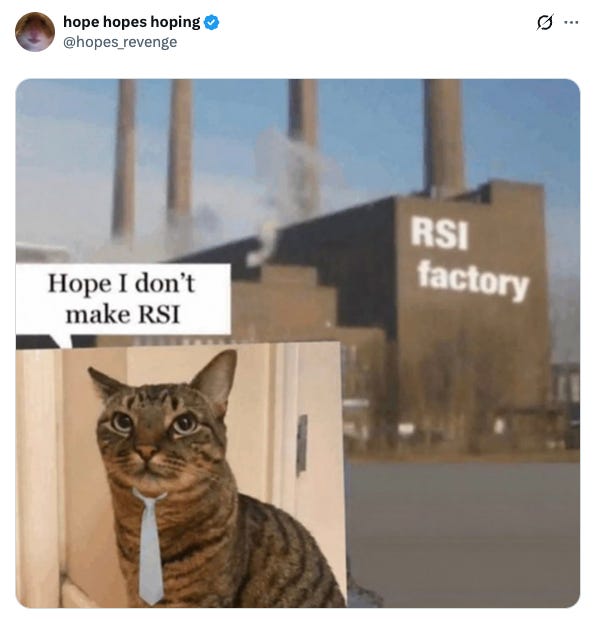
Credit: @hopes_revenge
Thanks for reading. If you’ve been forwarded this email, click here to subscribe and receive future editions. Have a great weekend.
Correction, October 16, 2026: This article was updated to correct spending numbers from Leading the Future and its affiliates, which were higher than we originally reported.,