

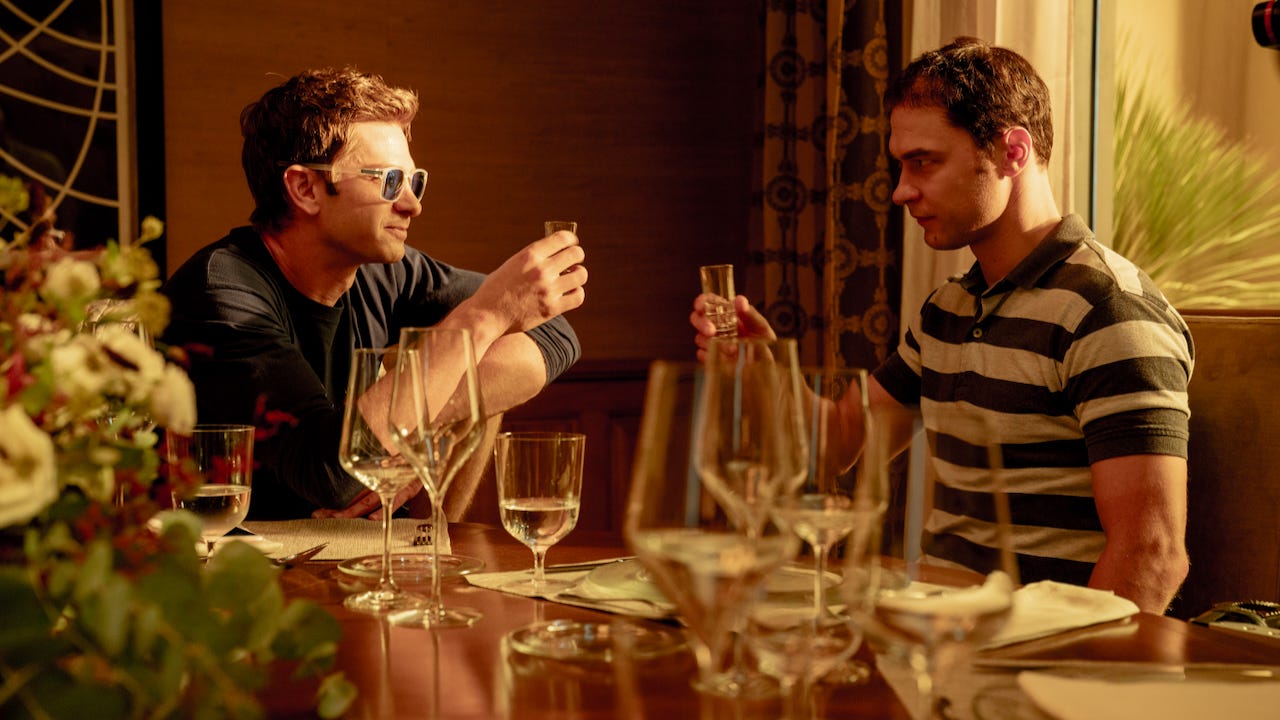

There are many problems with making a movie about the modern-day AI industry. Corporate dramas are, a few gems excepted, underwhelming. Chatbots, given their intangibility, are hard to film. But the most difficult problem of all is just how sprawling it is: how much history there already is, how many characters with all their interconnecting beefs, how many crucial milestones on the way to 2026.
On paper, Artificial deals with that challenge by paring the focus down to one moment (the OpenAI board’s firing of Sam Altman) and one character (Ilya Sutskever). But in practice, it cannot resist a maximalist approach. Like kids in a candy store determined to sample everything, director Luca Guadagnino and screenwriter Simon Rich stuff every last detail into their film. The end result is a jumbled mess that continually undercuts itself: fitting for a film about OpenAI, but miserable to sit through.
The lack of focus rears its head immediately. Artificial’s first act is a whistle-stop tour of Sutskever’s career, starting with meeting future Nobel winner Geoffrey Hinton in 2003. Disjointed scenes take us to conferences in Montreal (replete with unnecessary cameos from Meta’s Yann LeCun), the virtual auction for Hinton and Sutskever’s new company, and Google’s headquarters (with Demis Hassabis nowhere to be seen).
There is some satisfaction in seeing important AI moments documented on screen, but the overly technical details drag (do audiences really need to know what backpropagation is?). Worse, there is no dramatic purpose to these scenes: for all the ground covered, at no point do we learn where Sutskever’s fascination with AGI comes from, nor do we truly understand why Elon Musk and Altman might later be so afraid of Google controlling the technology. One is left with a sense that Rich felt an obligation to include it all because That’s How You Make a Biopic. He needn’t have.
As we whip through the founding and later success of OpenAI, things improve — but not much. The most interesting element is the relationship between Andrew Garfield’s Altman and Yura Borisov’s Sutskever, and the latter’s growing disillusionment with the former. But even this does not quite work. Garfield’s performance is striking, but neither charming nor scary enough to sell us on why Sutskever would get into bed with him, or eventually turn on him. There is no reality distortion field here, with Garfield instead choosing to amplify Altman’s awkwardness and, bizarrely, campness — choices that serve neither the story nor the mood.
Throughout, there are baffling decisions over what is and is not included. ChatGPT launches off screen. Sam Altman visits a fictional bunker. Repeated shots of waiters and cleaners suggest a focus on AI’s impact on the average person, until a crass shot of a homeless man with a VR headset punctures any sense of class consciousness. When we eventually get to Altman’s firing, there is little time left to build its tension. In a remarkably dull board meeting we are told — but never shown — that Altman is an inveterate liar and manipulator. The twists and turns of the next few days could have made a high-stakes thriller that rivaled Margin Call. Instead we are left with a by-the-numbers saga without a flicker of suspense.
If Guadagnino had brought his trademark directorial flair to the saggy screenplay, perhaps the film could have been salvaged. Unfortunately, it is as aesthetically confused as it is narratively. The cinematography is disappointingly bland: it is hard to imagine the director of the visually sumptuous Challengers and Call Me by Your Name could shoot something this indistinct. Damon Albarn’s overbearing soundtrack is sometimes embarrassingly on the nose; other times completely at odds with what’s happening on screen. And the performances veer between accurate impressions and caricatures. Ike Barinholtz’s Musk is very funny; he also feels like he’s in a different film.
Much ink has been spilled comparing Artificial to The Social Network. Yes, both are about world-changing tech giants. But the comparisons ought to end there. For all its faults and factual inaccuracies, The Social Network was a precise masterpiece: David Fincher knew what he wanted to do, and carefully sculpted the film to achieve it. By contrast, Artificial feels like the work of a director lacking a clear vision.
Bad movies are a dime a dozen. What makes Artificial sting is the missed opportunity. On net, audiences will probably walk out slightly better informed about the AI industry and its leaders. But even though Artificial goes to great lengths to spell out what the companies have planned for our future — and the potentially calamitous risks — I suspect it will not leave much of a lasting impression. The true story of OpenAI is stranger and scarier than anything in Artificial. Someone should put that on screen.
Artificial is out in theaters on December 25, 2026.