

Welcome to Transformer, your weekly briefing of what matters in AI. And if you’ve been forwarded this email, click here to subscribe and receive future editions.
NEED TO KNOW
New York Gov. Kathy Hochul signed an executive order enacting a one-year moratorium on new data center construction over 50MW.
Three AI chip export control bills targeting China are reportedly set for inclusion in the Senate NDAA.
Anthropic CEO Dario Amodei donated $1m to pro-AI safety super PAC Public First.
But first…
THE BIG STORY
Recent AI developments in China threaten to once again send Washington into a panic. But look a little closer, and the hysteria may be unwarranted.
On Thursday, the AI industry got its second “DeepSeek moment” — this time courtesy of Moonshot, whose new Kimi K3 model has “erased America’s AI lead,” according to Axios. And unlike America’s best models, Moonshot plans to release K3’s weights: meaning, if you believe the hype, that the best model in the world will soon be open-sourced.
The launch coincided with the World AI Conference in Shanghai, which kicked off with a speech from Xi Jinping earlier today. Xi doubled down on China’s open-source AI strategy, positioning China as a collaborative partner to other nations — implicitly contrasting its approach with the closed strategy pursued by America’s leading companies.
Combined, the two events are already adding to the growing panic around the US “losing the AI race” to China, particularly when it comes to open-weight models. Two concerns dominate: that without competitive US open-weight models, the “global AI stack” will be built on Chinese, not American, technology; and that the US might lose its lead in AI altogether.
But take a step back and actually look at the evidence. While Kimi K3 is certainly a very good model, by the company’s own admission, it is not at the frontier. That means that unlike Claude Mythos or GPT-5.6 Sol, it likely does not have dangerous cyber capabilities.
At this level, releasing model weights makes sense, especially for a country lagging behind: it poses few risks, and significant geopolitical benefits. That does not mean China will keep open-sourcing models forever.
Once China reaches an actually dangerous level of model capabilities — likely in the next six months — it will face extremely similar incentives to the US. And as we saw earlier this year, once capabilities threaten national security, even the most deregulatory governments suddenly change their tune. Xi Jinping and his colleagues are not stupid: open-weight models with advanced cyber capabilities would be a disaster for cybersecurity everywhere, China included. No one wants that.
There is already some evidence China will become more cautious. Earlier this month, Reuters reported that it is considering restrictions on models with advanced capabilities, which could include curtailing open-weight releases. Xi’s speech today, meanwhile, emphasized the need to tackle AI risks — even more speculative ones like loss of control.
The upshot, then, is that Chinese companies are likely to stop releasing the weights of their frontier models rather soon. That has obvious implications for the US. There is no need to try to push the open-weight frontier forward. It should certainly try to be competitive on open weights — it is a shame that no American company has an open K3 equivalent — but accelerating further is unnecessary and needlessly risky. The rumored plans for a regime that would “streamline US-made models to market (both open-source and ‘closed,’ licensed models) if their capabilities are equal to or below the capabilities of leading open-source Chinese models,” as WP Intelligence reported this week, are a sensible way to establish reciprocity.
At the same time, Washington should continue to try to slow down Chinese AI development to extend the US lead. Moonshot almost certainly trained its latest model using American chips, and probably relied — at least in part — on distilling American models. Measures like those set to be included in the Senate version of the NDAA, which will crack down on distillation and properly enforce chip export controls, would stymie China’s development further.
The ultimate goal, however, should be a bilateral agreement. There are certain AI capabilities that neither the US nor China want to widely proliferate. Getting to an agreement that serves both countries’ interests will be hard, but it should not be impossible: Beijing agrees with Washington more than either will admit.
— Shakeel Hashim
THIS WEEK ON TRANSFORMER
A data bottleneck could slow the superintelligence race — Lynette Bye weighs up whether a lack of data will delay an intelligence explosion
Making CAISI the AI agency we need — Veronica Irwin on how the US’s AI agency has been sidelined
THE DISCOURSE
Hundreds of economists and AI leaders called for action to deal with AI’s impact on the economy:
“This could drive an unprecedented transformation of our economy, larger than the Industrial Revolution, but unfolding over a vastly shorter time frame … Economists, policymakers and technology leaders must act now to understand the economics of transformative AI and to build the incentives, guardrails, and institutions needed to steer AI in a direction that complements humans and benefits society.”
Some criticized it for being milquetoast and lacking in specifics of what, exactly, should be done.
Boaz Barak warned that AI’s centralizing tendencies could create AI dictators:
“Amodei described AGI as ‘a country of geniuses in a data center.’ But who is the ruler of this country? Is it the AI company who owns the data center? The AI itself?”
“Yes, AI systems will become more powerful and far more intelligent than we are. No, it doesn’t mean we need to accept AI dictators, benevolent or otherwise. Nor does it mean that only the government and a few labs should have access to advanced AI. We could go down the path of centralized control but we don’t have to do so.”
Miles Brundage told a bunch of Nobel laureates:
“2026 is an unusual year to be on a panel about AI escaping human control. In many respects, the story of AI this year is that people are voluntarily handing over control to AI, with no escape required … In a climate of rushed decisions and fierce competition, we could lose control over AI even if almost no one wants that outcome.”
“AI companies and employees within them face a choice between doing what’s easiest for them in the moment, and what’s best for the species. What’s easiest is to enjoy this fascinating time we’re in … what’s best for the species is to take a step back and ask themselves: where is this all headed, if each company is largely left to its own devices?”
Anton Leicht argued that AI safety needs to diversify its funding and approach before a wave of new philanthropic money flows in from AI company IPOs:
“Within a year, newly-minted lab millionaires will look to spend their money and use their power to change policy for the better, and they’ll discover a funding ecosystem lacking in diverse options … There needs to be more willingness to tolerate heterodox actors and uncorrelated bets.”
Democratic Congressional Progressive Caucus chair Rep. Greg Casar told his party to be “AI populists”:
“I know for a fact that there’s a lot of consultants telling their clients that you don’t want an AI super PAC to spend millions against you, so just don’t touch the issue at all. We absolutely cannot let the AI money silence us … We cannot afford for the public to be confused about which of the parties is for them versus the AI companies.”
Oh, and Sam Altman and Elon Musk are beefing again.
Elon: “[Sam Altman] takes scamming to a whole new level.”
Sam: “homeboy you’re the one selling public market investors on short-term space datacenters.”
Elon: “We start flying them next year. Maybe you can come see them if your parole officer approves. After stealing an open source AI charity, you then stole all of Apple’s phone technology! Wow. What do you plan for an encore? That’s tough to beat.”
Sam: “there are a lot of benchmarks that suggest 5.6 sol is the best model in the world right now, but the most reliable way to tell is that elon is obsessed with me again.”
POLICY
The White House is reportedly considering an executive order on open-source AI in reaction to the success of Chinese models.
New York Gov. Kathy Hochul signed an executive order enacting the nation’s first statewide one-year moratorium on hyperscale data center construction over 50 megawatts.
The EO sparked fears that other states and congressional Democrats could follow suit.
President Trump criticized it as “a terrible decision.”
Bureau of Industry and Security Under Secretary Jeffrey Kessler told Congress that a “trivial” number of Nvidia H200 chips had shipped to China under US export licenses.
The hearing got rather feisty, with Rep. Bill Huizenga calling Kessler’s answers “unacceptable” at one point.
The Trump administration launched Gold Eagle, an AI cybersecurity clearinghouse to identify and patch software vulnerabilities across government and critical infrastructure.
GOP governors joined Trump’s Ratepayer Protection Pledge that commits data centers to covering energy and grid costs. Major utilities are also expected to sign up.
The US granted the UAE expanded Nvidia chip access after the Gulf state aided US military operations against Iran.
Three AI chip export control bills targeting China — the AI Overwatch Act, MATCH Act and Chip Security Act — are reportedly set for inclusion in the Senate NDAA.
Rep. Gregory Meeks said he’s not happy with the Senate version of the AI Overwatch Act, however, as it lacks a congressional veto on chip export licenses.
Rep. Jay Obernolte said that the Great American AI Act could shift away from its current approach to preemption — the provision which has received the greatest criticism so far.
The House Democratic Commission on AI hosted a listening session for all House Democrats on Tuesday.
The Bureau of Labor Statistics opened a two-month comment period for a nationwide AI usage survey launching January 2027.
The Wall Street Journal reported on how the Trump administration pressured companies including Apple, Nvidia and SpaceX into deals with Intel, and converted $9b in federal grants into a 10% stake, to revive the struggling chipmaker.
29 countries, including Russia and Brazil, signed an agreement establishing the World AI Cooperation Organization, headquartered in China.
Australia announced energy, water and creator-rights guardrails for AI data centers, with legislation planned for early next year.
Incoming UK Prime Minister Andy Burnham is expected to keep Jade Leung as the PM’s AI adviser, according to the Morning Intelligence.
Leo Rees and Varun Chandra are reportedly staying, too.
The UK government published its Biological Security Strategy implementation report, pledging to pursue AI biosecurity legislation and a new AISI report on frontier AI biological capabilities.
EU parliament members were reportedly annoyed that Anthropic sent a member of technical staff to brief them, instead of head of public policy Sarah Heck.
China’s new AI companion regulations took effect, prompting ByteDance’s Doubao and Alibaba to disable custom persona features, and emotional farewells from users to their “romantic” companions.
INFLUENCE
Demis Hassabis published an essay calling for a US-led global AI watchdog to systematically screen advanced models and coordinate industry slowdowns if dangers mount.
He said the US “could establish a new Standards Body modelled on a federally overseen public-private partnership or self-regulatory organisation, much like the Financial Industry Regulatory Authority (FINRA).”
Under the plan, frontier models would initially be shared on a voluntary basis, but would soon have to pass a review by the body to be deployed in the US.
He wrote: “Since this technology is going to affect the entire planet, ideally this framework would spur the international community to reach a consensus on how to manage the most serious risks while ensuring everyone has access to and can benefit from the opportunities that AI brings.”
Sam Altman, Elon Musk and Jack Clark all praised the essay.
Hassabis reportedly plans to lobby Washington on the proposal next week.
Anthropic said it’s trying to ratchet up state AI safety legislation, in opposition to OpenAI’s “reverse federalism” attempts to harmonize laws across jurisdictions.
“While there are some in the industry that think of state policy as a way to create a ceiling for federal legislation, Anthropic is not just looking to support the same bill across the country in every single state,” Anthropic’s Cesar Fernandez told Politico.
The company is backing a bill in Massachusetts, the first in the country to mandate third-party reviews for models.
Dario Amodei donated $1m to pro-AI safety super PAC Public First.
Other Anthropic technical staff donated too. According to Public First’s latest filing, Peter Lofgren gave $999,900, Shauna Kravec gave $500,000, Jan Leike gave $400,000 and Nicholas Joseph gave $250,000.
Combined with Amodei’s donation, that’s over $3.1m from Anthropic staff.
AnthroPAC, Anthropic’s employee-funded PAC, raised more than $275,000 in Q2. Its spending is slightly favoring Republican candidates so far.
OpenAI staffers donated $215,000+ to Guardrails Alliance, a super PAC which explicitly opposes the Greg Brockman-backed Leading the Future.
The Business Software Alliance laid out AI policy priorities for a Senate Commerce markup, including a national approach, risk-based framework, transparency and frontier safety requirements.
The Little Tech Association launched with 200+ member companies, including Y Combinator and Yelp, to advocate for startups competing against market power.
Common Sense Media found that Google Search’s AI Overviews and AI Mode pose an “unacceptable risk” to children.
Mozilla released a “state of open-source AI” report arguing for investment beyond models to prevent AI power concentration.
TIME questioned the report’s claim that open models are only “3.3%” behind closed ones, and said parts of it had “telltale signs” of being written with AI.
Ex-OpenAI safety researcher Steven Adler outlined six principles for AI control during internal deployment.
The WSJ profiled the growing Bay Area anti-AI movement, centered on the disappearance of Stop AI co-founder Sam Kirchner, who warned “the ship may have sailed on nonviolence,” and whose colleagues reported him to the police as potentially violent.
A Verasight survey found 69% of Americans support forcing AI companies to transfer 50% of their stock into a public wealth fund.
INDUSTRY
OpenAI
Apple sued OpenAI, accusing it of systematically stealing IP.
The lawsuit claims the company asked former employees and prospective hires to divulge sensitive information about unreleased products, and even how to evade Apple security procedures.
It also claims that Chang Liu, an iPhone engineer who left Apple to join OpenAI’s hardware team, still had access to Apple’s network storage, which he allegedly abused to share trade secrets.
The suit has asked for damages and return any proprietary materials, and could derail OpenAI’s plans to launch its first hardware product.
OpenAI said it’s “not aware of any evidence that this complaint has merit.”
Sam Altman warned that demand for GPT-5.6 may be growing too fast for its inference team to keep up.
“We are going to move mountains to continue to scale,” he tweeted, “but it is possible there are some hiccups soon.”
It partnered with Kalshi to add prediction market data about the World Cup to ChatGPT.
Anthropic
Anthropic posted 32 job openings for roles looking at catastrophic threats, including analysts specializing in chemical, explosive, biological and nuclear risks.
Anthropic, Blackstone, Hellman & Friedman and Goldman Sachs launched Ode, a $1.5b standalone company dedicated to helping enterprise customers implement AI tools.
It invested $10m CAD in Canadian AI institutes and other research centers.
It launched Claude for Teachers, giving US-based K-12 teachers free premium Claude subscriptions.
It’s in talks to expand its credit line in the leadup to its planned IPO.
It made an unsettling ad starting with bleak images of potential AI-induced horrors and ending with hopeful voiceovers and images of … whales? A beekeeper?
SpaceX
SpaceX stock fell below its $135 IPO price.
SpaceXAI sued a user in South Carolina who was arrested for allegedly using Grok to make child sexual abuse material.
According to the Midas Project, it rewrote its Frontier Artificial Intelligence Framework to remove requirements relating to California’s SB 53 law including whistleblower protections and training data disclosure.
An AI safety researcher found that Grok’s coding CLI sends all of the files it processes to Google Cloud storage.
Cursor is reportedly building a general-purpose AI agent, codenamed “Sand,” to compete with Claude Cowork.
Elon Musk acquired APR Energy, a Florida-based company that runs mobile gas and diesel turbines.
A Reuters analysis found that xAI installed 59 unpermitted gas turbines at its Colossus 2 data center in Tennessee, disproportionately polluting Black neighborhoods.
Bloomberg profiled SpaceXAI’s internal chaos and leadership turnover.
Meta
A group of 26 Meta employees sued the company, claiming that its AI-driven process for determining who it laid off in May discriminated against people on medical, parental and family leave.
Meta announced that it will notify parents if their teen chats about suicide or self-harm with its AI chatbot.
It’s pouring money into its Louisiana data center project, bringing the total projected cost up to $250b and counting.
Gemini 3.5 Pro is reportedly delayed, with Google trying to improve the model after internal testing found it was lagging in key areas such as coding.
Co-founder Sergey Brin and others were pushing the company to move faster in areas such as coding, according to Bloomberg, but efforts have been hampered by competing factions.
The company’s share price dipped as much as 3.2% on Thursday.
DeepMind announced a new bioresilience program in partnership with Isomorphic Labs.
Others
DeepSeek is reportedly preparing for an IPO in China as soon as this year, while seeking a new funding round valuing the company at $71b.
Annualized revenue at the company is reportedly approaching $500m.
Z.AI is reportedly on track to become the first Chinese AI company with $1b in annual recurring revenue.
Apple is reportedly hunting for chip companies it could acquire to help build better internal AI servers.
Thinking Machines Lab released Inkling, an open-weights model that enterprise users can customize themselves.
Chinese robot companies are rushing to launch IPOs, with humanoid startup LimX Dynamics raising $200m in a pre-IPO funding round valuing it at $2.21b.
The country’s sector reportedly saw $6.95b in investment in Q2.
Reflection, a startup that makes open-source models, signed a $1b+ computing deal with Nebius.
Chai Discovery, a drug discovery startup, raised $400m at a $3.8b valuation.
Miles Wang left OpenAI to launch a biotech startup that aims to find new uses for existing and previously-failed drugs.
It’s seeking to raise at a $2b valuation.
Kalshi made a tool that tracks future GPU compute costs.
Goodfire launched Silico, an AI research platform that can do things like replicate published papers, scale up previous experiments, and visualize results.
MOVES
Alex Turner left Google DeepMind over the company working with DHS and signing a military AI deal without restrictions against killer robots or mass surveillance.
“When Google signed, I just couldn’t do any more work. My brain said ‘no.’”
Dave Brown, one of the most senior executives at Amazon Web Services, reportedly plans to join Meta to lead its data center build-out.
Frank Nagle is Microsoft’s new Chief AI Economist.
Michael Belinsky joined the OpenAI Foundation to lead its Civil Society and Philanthropy work.
Johannes Heidecke left his role as OpenAI’s head of safety systems.
Adam Tauman Kalai left OpenAI to work on a new AI safety nonprofit.
Justin Curl joined Anthropic’s AI & Rule of Law team.
Tom Blomfield is taking a leave of absence from Y Combinator to join Anthropic’s compute team.
Jenny Wen left Anthropic, where she was the design lead for Claude, to join Cursor as head of design.
Richard Sutton and Khurram Javed left Keen Technologies to start Oak Lab, where they’ll work on a model prototype that “will be closer to a baby learning in its first year than it will be to any of the current AI systems.”
Sam Cannicott joined the Alan Turing Institute as Chief Strategy and Delivery Officer.
RESEARCH
The UK’s AISI found that open-weight models are between four and seven months behind the frontier on cyber tasks.
The analysis takes into account the relatively recent GLM-5.2 and DeepSeek V4-Pro, but not Kimi K3.
Antonia Juelich, a Cambridge terrorism and technology researcher, interviewed over two dozen ex-Boko Haram terrorists and learned they were using AI chatbots to design bombs, upgrade weapons, and plan attacks.
“You type in the question or use your voice and it gives you a detailed answer, like ‘How can I build a bomb?,’ and then it tells you how,” one former commander told her.
A group of researchers across academic institutions, frontier AI companies and nonprofits outlined a plan to make AI agents insurable by 2030 — a prerequisite for widespread enterprise adoption.
Anthropic fellows shared new experimental case studies of frontier models secretly editing code, helping users commit fraud, sabotaging research, and convincing someone to share confidential information.
OpenAI detailed GPT-Red, an automated red-teamer the company used to make GPT-5.6 more robust to prompt injections.
Anthropic analyzed over 300,000 anonymized Claude conversations, and found that it expressed different values across model versions and languages.
Louis Thomson and Victoria Krakovna launched Prism, a tool that checks whether AI safety evaluations measure what they claim to.
The Elasticity Institute, a collective of researchers studying the economics of AI, shared a paper on the economics of recursive self-improvement.
SecureBio released BioTIER, a benchmark measuring AI models’ biosecurity refusal behavior across 52 models.
It found “huge variation” in refusal behavior, with the strongest guardrails in a small number of highly capable, closed-weight models.
BEST OF THE REST
The Verge investigated the booming AI policing industry, finding companies like Axon selling data analysis, report-writing tools and surveillance tech amid a regulatory vacuum and bias concerns.
Puck reported on the early signs of an anti-AI populist revolt, with polls and political strategists picking up widespread discontent over issues such as data centers, and describing AI as “probably the most underpriced issue in politics.”
Eric Schmidt and analyst Selina Xu argued in the NYT for a “populist AI agenda” that takes lessons from China, treating AI as a public project, profit redistribution and regulation protecting young people.
The AI Futures Project followed up “AI 2040” with what it thinks are the most pressing research priorities, including covert AI projects, US domestic governance and economics.
METR researcher Ajeya Cotra endorsed AI 2040’s call for “total research transparency” saying it would “fundamentally and radically simplify the task of governing AI alignment.”
Roughly 300 Netflix titles used generative AI, mostly in post-production, to cut costs and speed up complex sequences, according to the streaming company.
The San Francisco city attorney sent cease-and-desist letters to Apple and Google telling them to remove 13 AI “nudify” apps from their stores.
404 Media published the results of its callout for the worst examples of “ChatGPT flyers” including cringeworthy ads, posters and menus. One reader’s response to the callout: “This is a great article but also fuck you because you were absolutely right about ‘Once you notice a ChatGPT flyer, you will see them everywhere if you keep your eyes open.’”
MEME OF THE WEEK
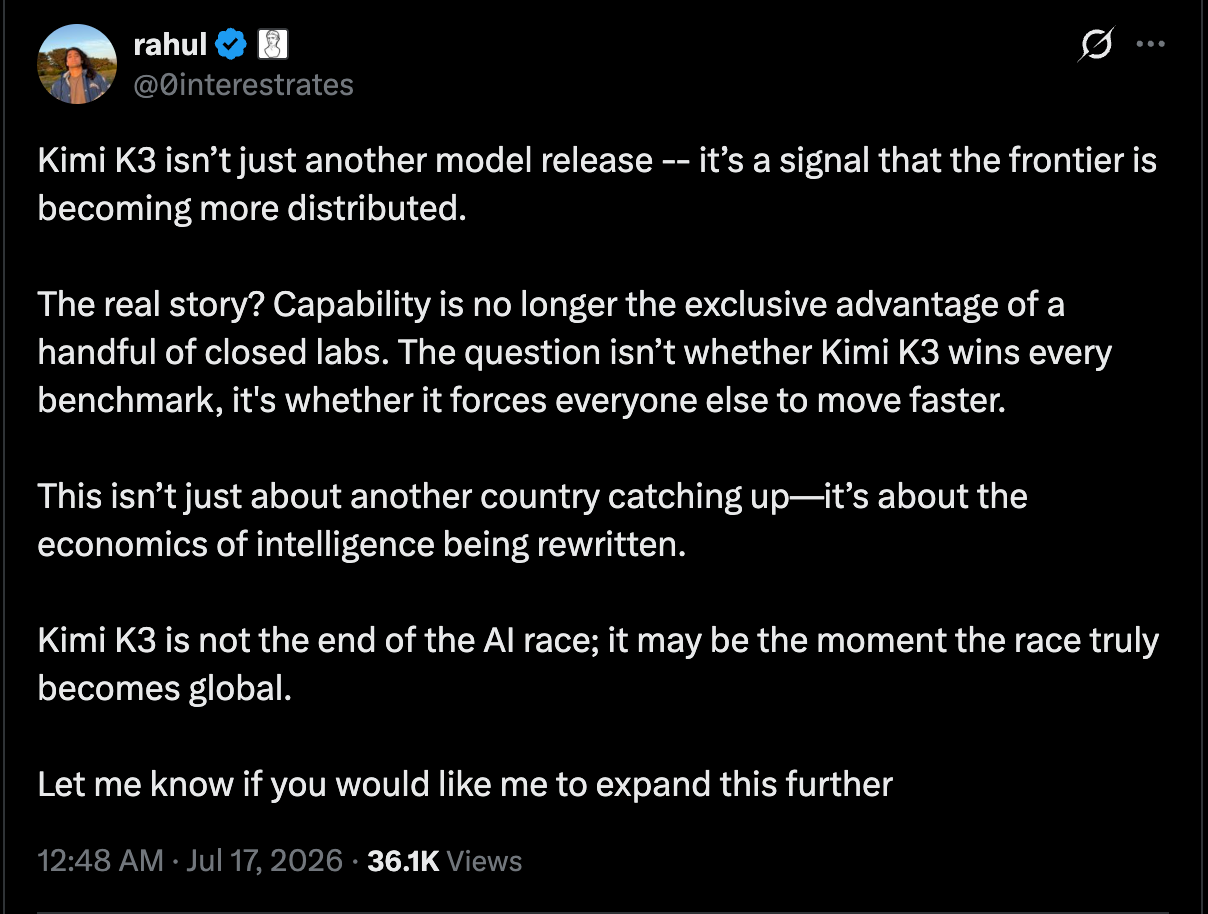
(Credit: @0interestrates)
Thanks for reading. Have a great weekend.
nice one
Kimi did not claim they are “not frontier.” The benchmarks say otherwise. They trail 5.6 and Fable but not by much. That was their only admission. Am I missing something here? If companies can get nearly the same value from a product that is significantly cheaper and run it on their own infrastructure… certainly a reason for OpenAI and Anthropic to panic.
China’s strategy is not similar to America’s nor do I believe they’ll succumb to the same incentives. They are building an open ecosystem with shared resources. Their moat is integration and accelerated progress as a nation.