

In January, Department of Homeland Security (DHS) officers killed at least two people. In both cases, federal agents grasped their guns, aimed them at a peaceful citizen, and shot them dead.
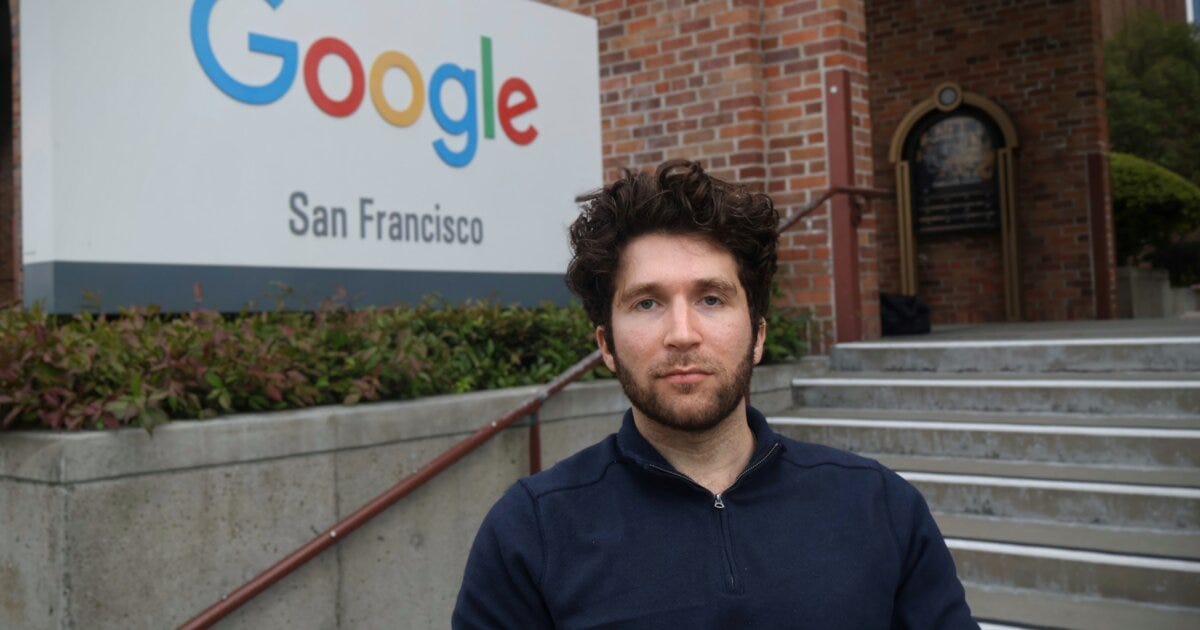
As a research scientist at Google DeepMind, I thought it was wrong that Google sold its Cloud services to the relevant parts of DHS. I set out to find the most effective way to push my company to stop.
In the months following, my campaign broadened into an attempt to prevent Google from signing an unethical military deal with the Pentagon — one with no restrictions against use for killer robots or mass surveillance. I wanted Google DeepMind to stick to its commitment against supporting killer robots.
For months, I worked to stop it. I watched powerful ethicists and institutions choose silence. Then, Google signed the Pentagon deal, so I decided I could no longer remain at the company. Google DeepMind had been, among other things, an experiment in responsible corporate governance. That experiment had finally failed.
When DeepMind’s co-founders sold the company to Google in 2014, the acquisition agreement specified, according to Google DeepMind CEO Demis Hassabis, that “no technology coming out of DeepMind will be used for military or intelligence purposes.” In 2018, the company publicly pledged to “neither participate in nor support the development, manufacture, trade, or use of lethal autonomous weapons.” That same year, Google’s original AI principles said the company would not “design or deploy AI” in weapons “whose principal purpose or implementation is to cause or directly facilitate injury to people,” nor for surveillance “violating internationally accepted norms.”
On February 4, 2025, Hassabis co-authored a post announcing updates to those principles. The new principles removed the prohibitions on weapons and surveillance. Yet in an interview following that update, Hassabis claimed that “nothing’s changed about our principles.” He had announced the changes himself. Both statements cannot be true.
In an internal channel, I pointed out the discrepancy. Many of my colleagues expressed their disappointment.
In 2026, the situation escalated. The Pentagon pressured AI companies to hand over their models for “all lawful use,” which meant no restrictions against lethal autonomous weapons or domestic mass spying.
Anthropic refused. The government retaliated by labeling the company “a supply chain risk,” damaging its enterprise business. OpenAI cut a deal and claimed that it protected the same red lines against killer robots and mass surveillance that Anthropic had insisted upon. However, some analysts concluded that OpenAI’s contract language contains wide loopholes.
I knew Google was unlikely to take a stand on its own, so I drew up a 25-page proposal containing contract language and oversight mechanisms. Military- and surveillance-law experts praised the proposal, which represented a principled counteroffer Google could have stood by. I sent the proposal to Hassabis, who routed it to senior policy staff for their evaluation. After an initial review by relatively junior staff, those senior staff never got back to me.
A few weeks later, Google signed a deal with the Pentagon that reportedly has even fewer restrictions than OpenAI’s contract. I found out at 11:45 pm via a Signal group: Google never announced the deal internally.

I had worked hard to prevent this. In particular, I had tried to get Jeff Dean, Google’s chief scientist, to take a stand. Dean is considered a saint at Google. He was Google’s 30th employee, developed key algorithms, and is a co-lead of Google’s Gemini effort. His departure would be a disaster for the company. He had enormous leverage.
Dean tweeted that the DHS killing of Alex Pretti was “absolutely shameful.” Dean tweeted against using AI for lethal autonomous weapons or mass surveillance of Americans. I then got Dean to co-sign an amicus brief (where outsiders weigh in to sway a lawsuit) backing Anthropic against the Pentagon. By signing, he broke from the company line, which probably made things awkward within the C-suite. I respect that.
Dean, Hassabis, and other senior employees pledged in 2018 to “neither participate in nor support the development, manufacture, trade, or use of lethal autonomous weapons.” I had lunch with Dean. I wanted him to threaten to walk if Google signed away its AI to the Pentagon — as I think his pledge demands. Dean evidently did not walk. I think he could have stopped the deal, yet he did not.
I’m comfortable guessing that Dean did not even threaten to walk. If he had, I would expect the classified deal to contain at least some binding provisions.

Suppose Dean and Hassabis did everything in their power to stop the deal, but failed. Even then, they’ve still taken a pledge. The point of a pledge is that it binds, even when it is personally costly.
The 2025 update to company principles and the contract with the Pentagon — which signed away Google’s ability to restrict use cases — appear to violate that pledge.
What should a pledge-signer do? I see three honest options: explain how staying at the company is consistent with the pledge, explain why you no longer hold the pledge, or quit. Wearing the pledge while saying nothing isn’t one of them.
Some employees may feel they should stay at the company to keep steering it in a positive direction. But to this I say: “What steering?” This deal may have been the clearest red line Google’s Gemini project will ever face, and yet the deal came out with no concessions to ethics-concerned employees. If their influence couldn’t produce a single binding provision in that situation, then when would it?
A pledge is only worth the credibility behind it. When someone signs “I will not support the development of lethal autonomous weapons,” then stays while their company sells unrestricted AI to a military that wants exactly that, they teach every counterparty a lesson: these safety people will not act, even at their own brightest line. The next commitment they make is worth less. Eventually, it’s worth nothing.

Even outside of Google, previously fiery advocates seemed frozen silent. Stuart Russell is a famous AI researcher who spent over a decade crusading against autonomous weapons. I worked at his lab for years. At a conference, onstage, he agreed to push his organization, the International Association for Safe and Ethical AI, to make a statement supporting AI providers against government coercion and promised a poll of the organization’s members. The statement and poll never materialized.
AI luminaries like Yoshua Bengio and Geoffrey Hinton had signed the Global Call for AI Red Lines months earlier, specifically naming lethal autonomous weapons as an example. However, when standing up for red lines meant standing against a specific powerful entity (the US government), the luminaries stayed publicly silent.
Google DeepMind was, not least of all, an important experiment in governance. I used to think of Hassabis as a quiet, thoughtful guy doing the best he can in a demanding corporate structure. When he sold DeepMind to Google, he tried to get safety guarantees. He told his biographer that while he initially “wanted to ensure safety in a way that would be trustless,” he instead decided to put energy “into creating real trust — trust that was actually useful.” He wanted a seat “at the table,” “so when a safety issue comes up, [he] can help to decide it.”
But what has his seat produced? Hassabis has been at the table for every contract in this essay. The classified deal made zero binding concessions to the employees raising ethical concerns. Maybe his presence averted something worse, but Google’s terms were near the floor of what I imagined possible. If his seat were worth what he says, you’d expect more to show for it.
I have not joined another AI company. I’m unemployed right now. But that was not a hard decision. Once Google signed the Pentagon deal, I just couldn’t do any more work. My brain said “no.”
Google DeepMind’s governance experiment has failed. Google DeepMind broke its founding promise, and its 2018 pledge appears broken along with it. Ethics-minded Google executives did not score any binding safeguards in the final deal. Sadly, even external crusaders and academics vanished.
The lesson I draw: society cannot rely on ethics-motivated people standing firm. They just don’t do it reliably. We need structures: binding contracts, independent auditors, and review bodies that cannot be quietly dissolved. Eventually, we need legislation.
I know hoping for a law is a painful endeavor. But we should at least stop telling ourselves that a seat at the table works.
Alex Turner is an independent AI alignment researcher. He left Google DeepMind, where he worked as a research scientist, on June 9, 2026.
bravo, thank you for taking a stand
Alex, I'm a science journalist who teaches at a tech school. I cite you in (of all places) a review of "The Odyssey": https://johnhorgan.org/cross-check/odysseus-and-oppenheimer-arent-heroes
John Horgan