

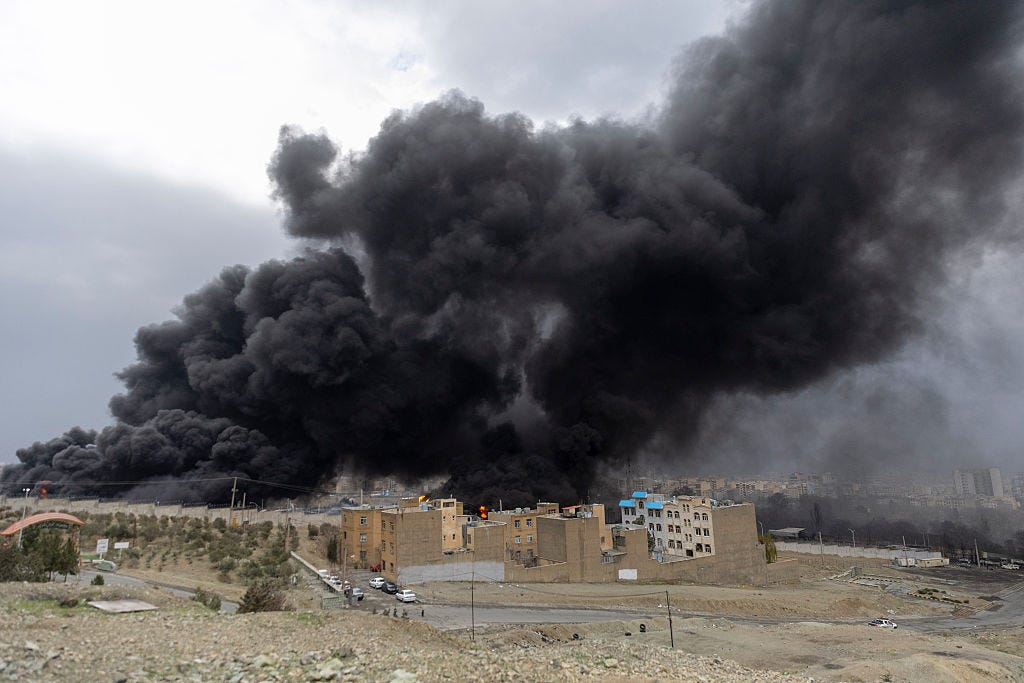
It is unclear how — or when — the war in Iran will end. And while Donald Trump sends out conflicting signals, the impacts of the war grow ever larger. The US and Israel have killed thousands across the region, injuring tens of thousands more. Oil prices have skyrocketed, with countries around the world beginning to plan fuel-saving measures. Food security is under threat. And many fear a global recession if the war drags on.
The potential effects on the AI industry are much less bleak — but no less real. Here are some of the ways in which the Iran war could affect AI.
Chip availability
You can’t train or run AI models without huge numbers of GPUs — and the Iran war could make it harder to get hold of them. That’s because countries in the Gulf are major suppliers of helium and bromine, two key components in semiconductor manufacturing. Qatar alone produces around a third of global helium, as a byproduct of natural gas production. But attacks on Qatari infrastructure and the closure of the Strait of Hormuz are making it harder to produce or ship the gas — potentially constraining chip production, and in particular worsening the current memory chip shortage.
For now, things will likely be okay: South Korea, the world’s largest supplier of memory chips, reportedly has enough helium stocks to get to June, and Taiwan has said it has enough for now too. But if the disruption in the Middle East continues beyond those stockpiles running out, things could get worse. “A prolonged regional conflict could potentially disrupt chipmakers’ manufacturing operations,” SemiAnalysis’s Ray Wang told CNBC.
Energy costs
Even if chipmaking components remain available, the sharp rise in energy costs could make AI chips significantly more expensive. South Korea and Taiwan are heavily reliant on Middle Eastern fossil fuels, and chipmaking is a very energy intensive industry.
Data centers, too, have significant energy demands — though with energy consumption accounting for an estimated 2-6% of model development costs, the impact is less likely to be felt there.

The Middle East data center buildout
As Iranian strikes on AWS facilities in Bahrain and the UAE showed, data centers are now a potential wartime target — “large, juicy targets,” in the words of the Center for a New American Security’s Janet Egan. That “will significantly change how companies think about data center security,” Center for Strategic and International Studies director Aalok Mehta told CNBC.
American hyperscalers probably won’t abandon the Gulf altogether: the combination of huge sovereign wealth funds and cheap energy is likely too tempting to ignore. But one analyst told CNBC that “if geopolitical risk continues to rise in the Gulf, companies may accelerate projects in places like Northern Europe, India or Southeast Asia.”
Gulf investment in American AI companies
Gulf investment funds including Abu Dhabi’s MGX and the Qatar Investment Authority have likely invested billions into American AI companies. But with those countries and their leaders now facing a significant economic hit from the war, it’s possible that future investments won’t be as forthcoming.
According to Reuters, “three Gulf states are reviewing how they deploy trillions of dollars invested by their sovereign wealth funds in anticipation of offsetting the losses triggered by the US-Israeli war on Iran,” though both Saudi Arabia and the UAE said long-term investment plans have not changed.
If the conflict drags on, however, they may be forced to pull back: analyst Stephen Minton told The Information that if the war “turns into months, or even longer, there could certainly be a disruptive pause to some of that investment.”
The financing squeeze
Above all, it is the wider economic fallout of the war that could most affect the AI industry. AI companies have benefited from an abundance of cheap capital, particularly from private credit firms. But that era might be coming to an end.

Energy-driven inflation could force central banks to raise interest rates, tightening the overall financing environment. Private credit companies are already seeing investors flee to safer assets — reducing the pool available for AI companies. Tech stocks, meanwhile, are tanking, making it harder for companies to justify the continued spending. For AI companies which require ever more cash to keep scaling, that’s a potentially huge problem.
Economists were already worried that AI’s growing importance to the markets made it yet another vulnerability for the global economy. And as the Bank of England warned this week, the Iran war “increases the likelihood of these vulnerabilities crystallising at the same time, potentially amplifying their combined impact.”
To many, the AI bubble is already teetering on the edge. A wider downturn could be the straw that breaks the camel’s back.
I guess there's a silver lining in every horrible situation.
Sounds good to me. I’ll lose money on my AI investments, but I’d rather lose my hedge against AI-induced unemployment than lose my job to AI.