

From former President Barack Obama to 2028 gubernatorial hopefuls, the Democratic Party is scrambling to make artificial intelligence one of the central planks of its campaign to retake Washington as it becomes an ever more mobilizing topic for voters. The problem is, it’s still far from clear what they will collectively argue for under the AI regulatory rubric.
The Democrats’ overarching argument is that there needs to be strong government oversight as artificial intelligence advances. But the party is not unified around a core set of proposals. On Capitol Hill, Democratic lawmakers are pushing proposals to keep AI companies from developing the technology in harmful ways, such as creating deepfakes or allowing AI to advance to a point where it could topple governments. Other proposals go as far as banning AI development until some kind of muscular federal regulator is established. In the past few weeks, courtesy of Anthropic researcher Jacob Coxon’s resignation, the ideological splintering around AI’s risks and capabilities — and what to do about them — has only grown.
“They’re figuring it out,” Cooper Teboe, a Democratic strategist, said. “They’re playing smart politics in that there’s a clear political opening on this.”
It comes as the Republican Party grapples with whether to support a more limited approach to regulating AI or eschew regulation entirely, in order to surpass China and other rivals’ AI development. Paradoxically, public adoption of AI is high, but attitudes toward it are largely hostile. Over half of all Gen Z Americans use generative AI, according to the New York Times, but less than 20% of them say that they are optimistic about the technology. Voters largely believe advanced artificial intelligence poses at least some danger to humanity. Polling shows neither party is trusted by a majority to handle AI appropriately, and there’s barely any difference between the public’s faith in either. Data centers, in particular, remain broadly unpopular, making regulating AI a powerful campaign cudgel during the 2026 midterm elections — and beyond.
“These are the AI midterms. 2028 is going to be the AI presidential election,” said Sacha Haworth, the executive director of The Tech Oversight Project and a longtime adviser to multiple Democratic committees, lawmakers and candidates. “Every single candidate is going to have to talk about AI. They better get started now figuring out where they stand.”

Regulating AI is a sincere effort by Democrats to answer concerns about what the party actually stands for now. The hope is soon voters will say the Democratic Party is the AI regulation party, and the one to actually prevent the worst fears about artificial intelligence from becoming a reality. Ultimately, the core principles Democrats land on for artificial intelligence will depend on what the party agrees are the most urgent dangers and what remedies it can most easily rally around.
“The question is ‘what’s our take going to be?’” said former congressman Brad Carson, the co-founder of Public First Action, a nonprofit advocating strong safeguards and transparency for artificial intelligence. (Anthropic has poured $40m into Public First Action.) “I think both parties are going to have AI as a major part of their platform and how you deal with it. The public demands it. That’s coming. Are we going to be smart about it? Or are we just going to do what Silicon Valley says?”
Why are Democrats so disjointed?
In theory, Democrats are aligned in that AI poses an exceptionally immediate danger on multiple fronts — usually on the environment, employment and education. But then there are broader concerns on national security, bioweapons, AI-enabled warfare, and even potential extinction of humanity. Where one falls on the spectrum of risk tends to color the regulatory solutions that are proposed.
There are roughly four emerging strands of thought for what the biggest problems to solve are. There are the Dems who are worried about existential risk; those who believe that talk of existential risk is marketing for AI companies, and that the real focus should be humans who use AI poorly; those who are worried about AI’s societal effects; and then those who are worried about the environmental consequences.

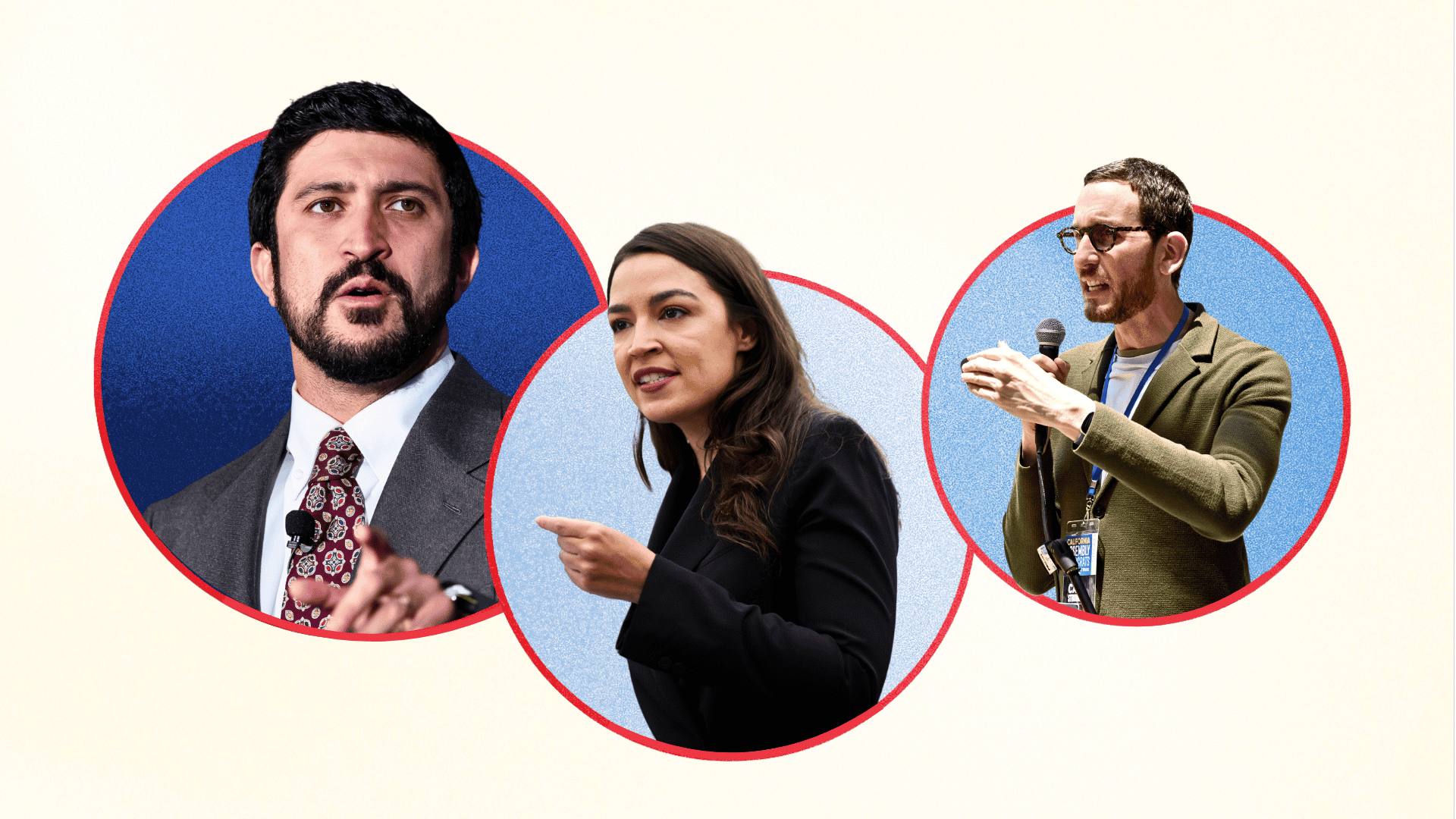
Democrats in the first camp, eager to lead on AI policy, were quick to pass state legislation or make AI a centerpiece of running for office. In his race for Congress, Alex Bores made a national framework for regulating AI a signature proposal. Similarly, in California, state Sen. Scott Wiener, another Democratic congressional candidate, has proposed instituting strict federal safety standards for AI and requiring public disclosures of important parts of the technology.
In Illinois, Gov. JB Pritzker has compared the dangers of artificial intelligence to nuclear weapons and has previously signed into law requirements for third-party audits of AI companies. Sen. Bernie Sanders and Rep. Greg Casar introduced a bill in September to permanently ban superintelligent AI and pause advanced AI development until a powerful regulatory body is established to enforce safety regulations.
Democrats also see an economic populist angle in focusing on AI. The logic here is that Silicon Valley is using language around existential risk to distract people from the lavish profits reaped by Big Tech companies like Alphabet, Amazon, Microsoft, and major semiconductor companies like Nvidia and TSMC.
Democrats have used that argument as a favorite example of corporate greed run amok. They have also coupled those arguments with opposition to data center construction.
“Silicon Valley billionaires have rigged the game and are attempting to shift their financial risk to working people: If they’re right about AI’s potential, they reap the profits,” Rep. Alexandria Ocasio-Cortez wrote in an email to supporters. “If they’re wrong and the bubble bursts, they are setting up the American people to pick up the tab. Heads, they win; tails, we lose.”
Then there are those who are taking action on AI use cases that have an immediate impact on daily life, and are looking for wins most people can agree on, such as child safety or education. New York City Mayor Zohran Mamdani’s administration issued a moratorium on generative AI use in schools for students through 8th grade. That move has served as one of the better examples of how pro-AI regulation officials can move quickly in easy-to-understand ways to limit the damaging effects of AI usage for children and young people.
The larger Democratic umbrella campaign organizations have also been encouraging candidates to oppose data centers. It’s an easy argument. Data centers are boxy, imposing buildings that are popping up in communities like weeds — and can in some cases bring excessive water and energy consumption, as well as air and noise pollution. Data centers are also inextricably linked to AI, so arguing against data centers is something that can appeal to voters who may not understand what artificial intelligence actually does.

In Michigan, Democratic nominee Abdul El-Sayed released a comprehensive set of policy positions on data centers and artificial intelligence early in his campaign, as a preferred attack strategy against his Republican opponent, former Rep. Mike Rogers.
“We need to be absolutely clear. Donald Trump is trying to forestall any meaningful limit on AI development, which even the people developing it say has a serious chance of dooming humanity, for one reason. The midterms,” El-Sayed tweeted, adding “He’s putting his short-term political interests over the huge risk AI poses. And that’s what you’ll get if his stooges like Mike Rogers wins. Short-term, self-dealing liars.”
And while you could read these schools of thought as mutually exclusive, there is some overlap — and that could be the beginning of unity. Shaunna Thomas, the co-founder of the Guardrails Alliance, framed the growing network of groups countering pro-AI efforts as well as the candidates preaching similar messages as the beginning of a more organized pushback.
“I think that we do not have a clear tip of the spear of what it looks like to intervene now in a way that protects people and helps realize an equitable distribution of values between the tech sector and new technologies,” Thomas said. “But I do think it’s emerging.”
How money complicates unity
A hallmark of the 2026 midterm cycle has been the rise, and fighting between, outside groups, nonprofits and super PACs related to AI policies and candidates.
In Republican and Democratic primary contests as well as general election matchups, AI-focused outside groups have emerged as some of the most influential and deep-pocketed super PACs and nonprofits in play. Almost $58m has been spent by AI-focused outside groups in the 2026 midterm cycle, according to Transformer’s AI campaign finance tracker, with $33m spent by “pro-safety” super PACs and $25m spent by “pro-innovation” super PACs.
The largest or most active groups have been playing in both Republican and Democratic primary races to establish their influence and shape support. The most well-funded of those groups are mostly linked to AI tech giants like OpenAI or Anthropic, or major crypto groups. Those focused on pushing back against super PACs or other types of outside organizations backing the interests of pro-AI groups are younger and smaller, but have become active in 2026 midterm elections.
In June, a pair of Democratic operatives started the Guardrails Alliance super PAC to push back against organizations and candidates opposing stronger safeguards for artificial intelligence. Last month, a set of progressive candidates signed onto an initiative backed by QuitGPT, an anti-OpenAI grassroots boycott, urging campaigns to reject money from the biggest and most influential pro-AI super PAC, Leading the Future. The populist progressive New York-based Working Families Party is recalibrating its mission to focus more on artificial intelligence and AI companies.
For Democrats, fighting AI is an alluring rallying cry. The subject has allowed the party to organize in a way it hasn’t been able to in years. But the hurdles are still significant. The AI-friendly super PACs and outside groups have tens of millions of dollars in their war chests to spend than their pro-regulation counterparts. Those groups support advancing AI technology and oppose robust AI oversight. They also say they want just one federal framework for regulating AI rather than a number of statewide frameworks.
This summer, Democrat Alex Bores ran on a strident pro-regulation AI platform in the party primary for New York’s 12th Congressional District. He became the prime target for anti-regulatory super PACs linked to AI companies like OpenAI. Super PACs opposing and supporting Bores — mostly because of his stances on AI — poured millions into the primary. Ultimately, he lost, but his candidacy became a prime example of how AI policy can trigger a waterfall of outside spending for and against a candidate.
There are also elected Republican officials trying to create a pathway for their party to address artificial intelligence. Sen. Marsha Blackburn proposed an overarching framework for artificial intelligence that tackles safety for children and deepfakes. Senate Majority Leader John Thune, a Republican, has teamed up with Sen. Amy Klobuchar, a Democrat, on an AI safety bill. Other top Republicans have voiced support for action to at least mitigate the worst fears about AI.
But for all those calls, Donald Trump has injected a strain of inconsistency in how the party should approach artificial intelligence, sometimes signaling opposition to any type of regulation and other times showing some level of openness.
Democrats see an opportunity to essentially be the adult in the room on AI. They want to be the party to quell concerns and effectively regulate it. They wouldn’t mind being the party that can claim it saved the world from AI-driven mass extinction.
But if you ask members of Congress or Democratic strategists what their core principles on AI are, or what the most urgent regulations are, answers vary dramatically. When Democrats were focused on passing a healthcare overhaul during the Obama administration, Obamacare was their core set of principles. Democrats aren’t there yet on AI.
“I think like all the other major issues it’s our job in Congress to set the terms of that debate and have real things ready to go,” Rep. Sara Jacobs, the author or cosponsor of a number of bills on AI, told Transformer. “Because I’m very worried about simplistic tagline proposals on this. It’s a complicated topic that we should have thorough, comprehensive solutions for. AI can’t be governed by catchphrases.”
