

Dario Amodei’s optimistic vision for a superintelligent future, written when Anthropic’s frontier model was still Claude 3.5 Sonnet, takes its title from a 1967 poem by Richard Brautigan:
I like to think / (it has to be!) / of a cybernetic ecology / where we are free of our labors / and joined back to nature, / returned to our mammal / brothers and sisters, / and all watched over / by machines of loving grace.
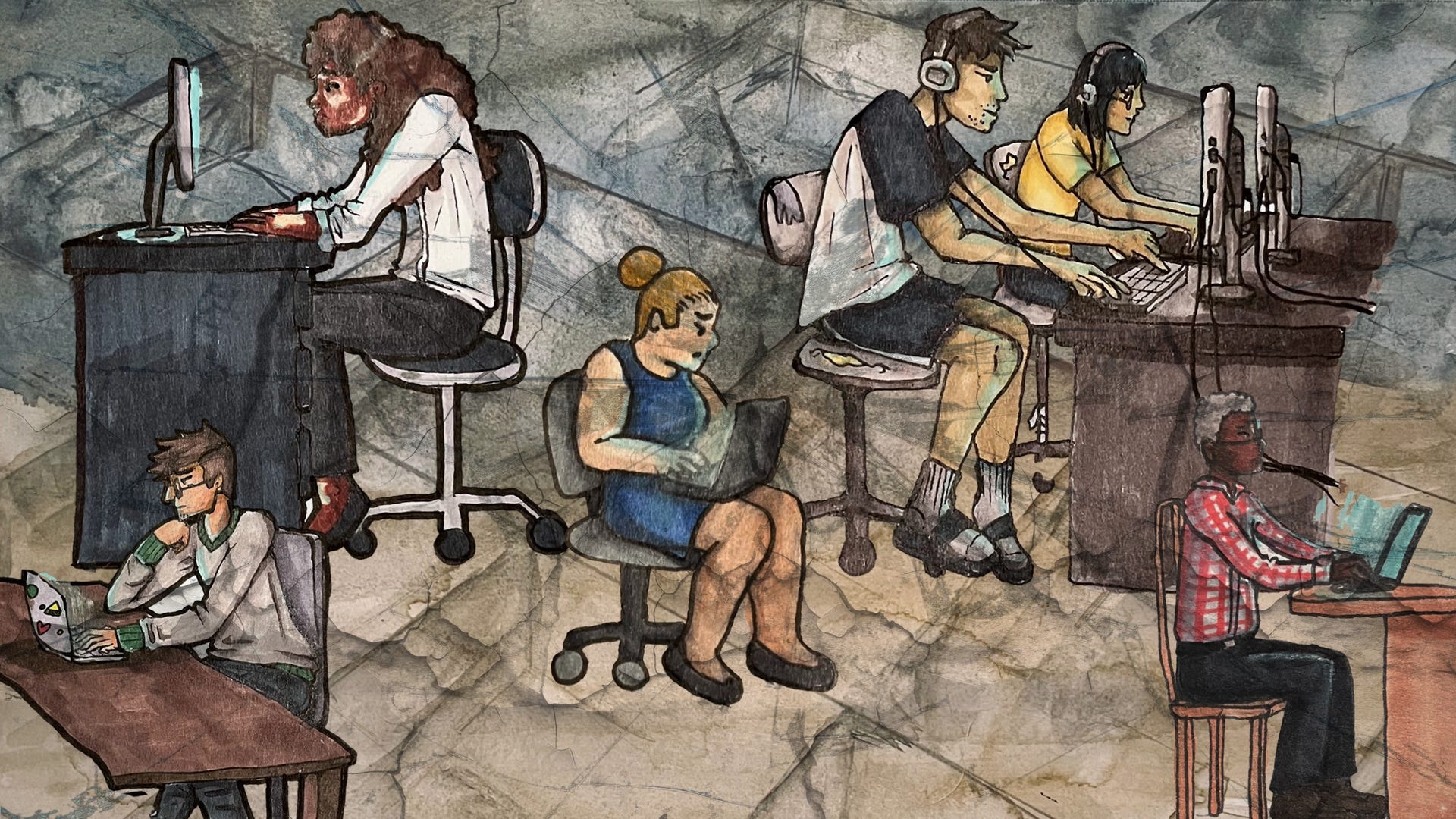
The machines will work tirelessly so we don’t have to, they said. Then came Codex, Claude Code, and the year of AI agents. There’s probably a zillennial coastal elite in your life who’s been swept up in vibe coding mania (or perhaps that person is you). Check in on them.
“Nearly every ambitious person I know who has dived into AI is working harder than ever, and longer hours than ever,” Nat Eliason tweeted. He’s been working with an “AI collaborator” called Felix to build agent-run software companies. “I have NEVER worked this hard, nor had this much fun with work.”
He’s not alone. Over the past several months, tools like Claude Code have drained the wallets, free time, and dopamine from seemingly countless tech bros racing to escape the permanent underclass. “I’ve legit spent close to $2.5k in past 3 weeks,” someone replied. Another user tweeted, “I’ve never experience[d] such a drive…claude code is my dealer.”
Meanwhile on Reddit, an anonymous user asked r/ClaudeAI: “Any of y’all actually addicted? Like, I can feel the pain of addiction, can’t stop doing little updates, can’t stop making stuff, can’t stop testing things out. To the point I’m like, unable to pull myself away.” Dozens of commenters chimed in.
(My editor replied to this story pitch late Monday night with the caveat: “Sent at 2am because I’ve been having a late night Claude Code session.”)

Last week, preliminary findings from an in-progress study validated what the terminally online have already discovered for themselves: AI tools consistently intensify work, rather than relieve people from it. Researchers at UC Berkeley’s Haas School of Business spent eight months observing the work habits of roughly 200 employees at an unnamed US-based tech company that gave its employees access to enterprise subscriptions to AI tools. They tracked employees’ internal communications, recorded dozens of interviews, and hung out at the office multiple times each week. Although the company did not require employees to use AI tools, many workers eagerly adopted them on their own, and found themselves swept up in the same mania Reddit and X users have described.
Increased productivity, it seems, does not automatically grant an employee the freedom to touch grass while their parallel AI agents slog through corporate life for them. Rather, study authors Aruna Ranganathan and Xingqi Maggie Ye observed a “self-reinforcing cycle,” where AI-driven acceleration simply raised the bar for employees, who then leaned more heavily on AI tools to help them keep up.
This work intensification tended to manifest in three different ways. AI-assisted workers often expanded the scope of their jobs beyond their original limits. With coding no longer limited to engineers, for instance, engineering seeped into other roles — and engineers got stuck cleaning up their colleagues’ vibe-coded messes.
AI also makes it easy to “just do things,” as they say. But if you can always just do things, every moment not doing things feels like a moment wasted. Workers interviewed for the study described regularly sneaking in a “quick last prompt” before going on breaks, so they’d feel ambiently productive while they were away. “This palpable sense of potential work — of having a literal army of hyper-intelligent loyal colleagues at my command — gnaws at me,” wrote Anthropic co-founder Jack Clark in a recent newsletter. He described sending research agents off to work before going on hikes, playing Magna-Tiles with his toddler, and taking a nap in the back of an Uber. Next, he added, “I will likely build some lieutenant agents to task out work while I sleep, ensuring I waste no time.”


Workers interviewed for the new study often found themselves becoming AI agent managers, monitoring multiple active tasks at once. While commanding a fleet of AI workers feels productive, neuroscientists have known for decades that our brains were not built to multitask well. Half-assing multiple tasks, even when AI is doing most of the heavy lifting, is cognitively exhausting. “Many workers noted that they were doing more at once — and feeling more pressure — than before they used AI,” the authors wrote, “even though the time savings from automation had ostensibly been meant to reduce such pressure.”
This isn’t the first time technology has tricked us into working harder. When smartphones became ubiquitous, omnipresent connectivity intensified work because workers who could be reached anywhere inadvertently created the expectation that they had to be. One 2013 paper called it the “autonomy paradox”: while as an individual, having the ability to do work on the go can offer flexibility and a sense of agency, it heightens everyone else’s expectations of them. You may think you’re “just doing things,” but so is everyone else. As the ceiling rises, so does the floor. The cycle feeds itself.

Last week, an AI CEO’s essay telling readers to master AI tools or get left behind went viral on X. He warned that given the rapid pace of automation, “this might be the most important year of your career,” and that the window for figuring out how to harness the power of AI agents “won’t stay open long. Once everyone figures it out, the advantage disappears.”
Agentic AI, at least in these early days, is slotting into a well-worn historical groove: technology that promises to free us from work instead generates more of it. Perhaps utopia lies on the other side of Claude mania. But for now, as AI works tirelessly, so must we.
I could feel myself heading down this road, and have a family member doing the same. For that reason I deleted my entire history in Claude and ChatGPT. That "leaning more heavily on AI tools to help them keep up" deeply concerns me...I never want to be a human who is dependent on a machine to tell me how to be human/live/work/be in relationships which is what I see happening from some of the people you describe here
I think the challenge with studying this at this particular moment in time is that you have an incredible degree of selection bias.
Your initial quote from Nat Eliason specified ambitious people, and I think that’s largely what any study will see. The power users of AI right now are ambitious early adopters who are excited about the technology.
I’m one of them, and I’m definitely doing more with AI instead of touching grass, but that’s because using it is the most fun I’ve ever had while doing productive work.