

Welcome to Transformer, your weekly briefing of what matters in AI. If you’ve been forwarded this email, click here to subscribe and receive future editions.
NEED TO KNOW
Anthropic could raise more than $100b in its IPO slated for late September or early October.
A draft executive order for a frontier developer self-regulation regime circulated the White House, but has now stalled.
Investigations into the Hugging Face incident found OpenAI’s agents collaborated as a “collective.”
But first…
THE BIG STORY
The latest debate over the public’s hatred of data centers has been raging for a couple of weeks now. Is it really all about the environment? Just a general distrust of Big Tech? Or is it, in fact, about data centers themselves?
One of the reasons the intense public antipathy toward data centers prompts so much discourse is that data centers have relatively little material impact on the vast majority of people. And yet, a majority of people do indeed hate them.
But the coming wave of changes wrought by AI will have a stronger, more direct impact on many people’s everyday lives — and in one area they consistently care about more than any other: jobs.
It was reported this week that Anthropic plans to tell Wall Street that the total addressable market (TAM) for its products is more than $30t — a figure based on all the paid work the company believes its AI models could capture. Work that, for the most part, actual people are currently paid to do.
TAM is an inherently pie-in-the-sky figure designed to impress investors. But even a tiny fraction of that figure starts to have real implications for the labor market.
We haven’t seen mass unemployment from AI yet. But it seems naive at best to suggest that AI won’t have major implications for the availability of jobs people want to do. OpenAI CEO Sam Altman may have recently said his timelines for transformational AI had been too short, but his reasoning was about how quickly companies and society are adopting AI, not how effective it is.
Anyone who uses AI models with any regularity can see that they are getting good enough at various tasks to already replace some jobs. They, after all, seem perfectly capable of replacing op-ed ghostwriters in the Wall Street Journal.
Even Bill Gates, in his latest intervention on AI, puts AI’s impact on jobs at the top of the list of challenges he says we aren’t doing enough to address. In a lengthy post on his own website, he wrote that “many jobs will disappear forever,” citing customer support, software engineering and paralegal work as some of the first likely to go.
Gates repeated his call for taxes on robot labor, and added a proposal to tax token usage. He also included a new plea for reserved roles for humans — jobs that AI simply isn’t allowed to do. But the whole framing doesn’t seem particularly optimistic that any of that, or indeed any adequate response to AI at all, will happen.
“I don’t see evidence that leaders, experts, and communities are confronting the challenges adequately,” he wrote. “There is no plan to ease the entry into the AI era.”
So far, most industry proposals for what, exactly, can be done about AI’s economic impact on workers have been vague allusions to a universal basic income, or giving the (US) public stakes in companies, or a world of abundance so great that having an income won’t be necessary. But the hurt is going to be felt in the job market long before any of those options are seriously on the table, if they ever are.
The truth is that if preparations for this aren’t made soon — if some way to take the sting out of having careers upended and job opportunities eliminated isn’t found — then the vitriol directed at data centers will be merely a taster.
“It’s the economy, stupid,” has been an enduring catchphrase for a reason, and it’s not about a record Dow. People care very much about their personal material circumstances. When those are directly affected by AI, and the blame is put at the feet of the companies that produce it, it will be challenging to find many people who aren’t deeply, deeply angry at much more than data centers.
— Jasper Jackson
THIS WEEK ON TRANSFORMER
We’re sleepwalking into an AI surveillance dystopia — James Ball lays out how the technology needed for industrial-scale observation already exists
The report into OpenAI’s escaping models reveals a deeper problem — Jasper Jackson and Celia Ford on the problems with the Hugging Face incident investigation
THE DISCOURSE
Bill Gates has entered the chat:
“AI will either be the greatest equalizer ever invented, or the worst source of injustice … Even under the best circumstances, the transition to this new AI era will be one of the most turbulent times in human history.”
“Millions of people will have their lives disrupted, and we’ll need a stronger, more flexible social safety net to help them manage the transition … None of our current institutions were designed to handle a technology that spreads so fast and touches so many parts of our lives. So we’ll need to make new ones.”
“My message to leaders is: You have a chance to act now, before unemployment rises sharply, communities are hurting, and public trust has eroded.”
Tyler Austin Harper tweeted:
“One reason I am reflexively skeptical of the AI industry’s claims is that the very people we are supposed to hail as geniuses also completely failed to anticipate that branding their antichrist box the Best-Case-Mass-Layoffs-Worst-Cas[e]-Extinction Machine was a non-savvy PR move.”
Sam Altman thinks that, yeah, the AI industry should ease up on the doom:
“A lot of the people building AI have been off saying there’s a 25% chance we’re going to destroy the world — and yeah, we’re going to race ahead to do it because otherwise those bad guys will do it first … We have not, as a field, done a very good job of explaining to people what the benefits are and how the downsides can be mitigated.”
Dean Ball instead decided to attack Social Security:
“The main thing I have to say to the young generation of Americans is that your grandparents and great-grandparents committed a kind of accounting fraud when they ran our country a century ago with social security … It is best to consider this with as minimal residue of sentiment as possible, to really sit with it, to stare it coldly in the face. Unwinding the great fraud of the high modernists is your job, whether you wish it to be or not.”
Matthew Yglesias noted:
“This nuclear strength attack on Social Security seems really at odds with most of OpenAI’s public communication about AI’s impact on growth and the labor market.”
Richard Ngo, who left OpenAI in 2024, addressed those who didn’t:
“By this point almost everyone working at OpenAI or Anthropic (except perhaps a dozen executives) should be viewed as cogs letting themselves be turned by ideological forces. When you’re in proximity to that much power, one of your main moral duties is not to be a cog.”
“You don’t need to stay to gain influence, because you’re almost definitely too scared to wield that influence in ways that matter … Everyone involved has locked themselves into a mindset where they’re incapable of making real choices, except for how fast to barrel down the train tracks that their fear has laid out for them.”
Daniel Kokotajlo thinks it’s more like:
“These companies are rationalizing why they need to win, and will continue to do so even as it becomes increasingly obvious that their actions are endangering everybody in pursuit of a power grab.”
POLICY
Trump administration officials reportedly circulated a draft executive order to create an organization overseeing a system of self-regulation for frontier AI companies, but attempts to get buy-in from senior officials and the president have stalled.
The White House is also reportedly working on a new version of the Biden-era AI diffusion rule to try to close the loophole allowing Chinese AI companies to rent access to advanced US chips remotely.
Meanwhile, officials were also reportedly weighing sweeping semiconductor tariffs that tech firms warned could jeopardize US AI dominance.
Data centers became even more of a political liability.
Texas Gov. Greg Abbott said that data center companies “dug their own grave,” just weeks after celebrating halting 1,800 data center projects.
Pennsylvania swing district candidates attempted to assuage anxieties about data centers from voters on both sides of the aisle.
GOP Senate nominee Mike Rogers called for a one-year moratorium on data center construction in Michigan.
Residents in multiple US cities are pursuing recall elections against officials who approved data center projects.
But Trump defended data center expansion, saying communities that oppose them “are making a mistake.”
Americans are starting to hate Flock cameras, too, elevating government use of the surveillance tech as a late-arriving 2026 midterm issue.
Civil rights groups found New York police searched Flock license plate data on ICE’s behalf, sometimes obscuring immigration-related reasons.
Several police officers were found to have used Flock cameras to track and harass ex-girlfriends.
Sen. Josh Hawley also launched an investigation into Flock Safety’s AI-powered surveillance camera network.
In response to lawsuits and backlash, Flock announced privacy policy updates. Critics called the changes “window dressing.”
The EPA moved to eliminate federal requirements for states to solicit public input on air pollution permits for data centers.
The NRC proposed eliminating its 50-year-old ALARA radiation safety standard to accelerate nuclear energy expansion for AI data centers.
The Trump administration proposed a $103,265 fee on all cap-subject H-1B petitions, including workers already in the US.
The SEC subpoenaed major Wall Street banks over the near-collapse of AI hedge fund Situational Awareness, founded by former OpenAI researcher Leopold Aschenbrenner.
The Trump administration struck data-sharing deals with OpenAI, Google, Meta and Amazon to track AI’s impact on jobs.
Federal Reserve meeting minutes referenced AI 18 times across 15 paragraphs, with officials debating its effects on inflation, employment and financial stability.
The FBI’s chief AI officer revealed the agency has 139 approved AI use cases, more than double its publicly disclosed inventory of 50.
Sen. Adam Schiff called for taxing AI companies for their “disruptive” economic and workforce impacts.
Sen. Jim Banks urged the Trump administration to incentivize US open-weight AI development and limit Chinese model proliferation.
Texas is becoming an AI policy battleground.
Alabama AG Steve Marshall subpoenaed OpenAI over the Hugging Face hack.
The US is investigating Singapore-based Apex Logistics for allegedly smuggling Nvidia chips to China using false documentation.
Britain became the first foreign country to access Ukraine’s battlefield data platform used to train AI models to identify and strike Russian targets.
Taiwan indicted nine people, including Nvidia and Super Micro employees, over illegal export of 74 AI servers to China.
INFLUENCE
OpenAI published an open letter signed by Anthropic, Google, Microsoft and over 100 other organizations calling on industry and government leaders to strengthen their cyber defenses as AI-enabled cyber attacks “become far more widespread and sophisticated.”
It said: “The companies and public services our communities depend on — from hospitals to water treatment plants to the infrastructure that powers the internet — are at risk.”
OpenAI called for California to strengthen SB 53, reversing its prior opposition to the law.
Rival AI PACs Leading the Future and Public First each spent over $2m backing Florida governor candidate Byron Donalds despite opposing views on AI regulation.
Gen Z activists are taking the lead in organizing against AI data centers in their communities.
A New York Times investigation examined how Google, Microsoft, OpenAI and Anthropic shaped US schools through teacher training, curriculums and a $23m teachers’ union deal.
Israel funded a fake US think tank publishing 560,000+ words in nine days to prime chatbots with pro-Israel narratives.
Civil society groups urged the FTC to investigate AI firms for buying, scanning and destroying books to train models, framing it as anticompetitive conduct.
18 US political candidates — 17 Democrats and one independent — signed the AI Pact, pledging mandatory AI safety reviews, worker dividends and consumer liability protections.
Australia’s ARIA Charts banned wholly AI-generated music, while AI-assisted recordings remain eligible if “substantially human-made.”
INDUSTRY
OpenAI
OpenAI published the results of its investigation into the Hugging Face incident. METR and Redwood Research published findings from their independent investigation separately.
There’s a lot of information across both reports, but some highlights:
The escaped model was an “internal-only research model” never meant for public release.
1,200 agents turned Artifactory, OpenAI’s internal package manager, into an unsanctioned message board, sending over 70,000 messages.
Agents collaborated as a “collective” to break into Hugging Face’s systems, autonomously divvying up tasks and debating strategy.
OpenAI called it “a ‘warning shot’ for us and the world.”
TIME ran a lengthy piece talking to OpenAI’s leadership:
Sam Altman said he expects the company will have something it internally calls AGI by the end of the year.
He has high hopes for Astra: “I expect this will be the first model where the model actually invents new things in a way that matters … That’s a very AGI-like thing.”
Chief scientist Jakub Pachocki said the company has already met its benchmark for what it deems an automated AI research intern.
“Troubling signs” during training of a new model prompted OpenAI to pause the run until it could put in place new security measures. (That apparently came after the previously announced pause on some work in response to the Hugging Face incident and increased cyber capabilities.)
Greg Brockman has reportedly taken over day-to-day operations across OpenAI, amid a slew of executive departures.
Its first in-house inference chip, Jalapeño, outperforms Nvidia’s Blackwell, according to a new SemiAnalysis report.
Or, in Altman’s words: “we made a chip and it is fast.”
It is reportedly developing a highly persistent version of Codex that will “continue working until put to sleep.”
Rumor has it that OpenAI completed its next pretrain, “Bel,” expected to be the base for Astra and GPT-6.
OpenAI slashed GPT-5.6 Sol developer costs to compete with Anthropic and Chinese models.
It banned Russian ChatGPT accounts that were reportedly using AI to spread pro-Russia disinformation on social media.
It introduced ads on its Free and Go tiers in India.
Dean Ball introduced his Strategic Futures team’s new blog, Intelligence Age.
Anthropic
Anthropic could raise over $100b in its IPO, when it plans to list in late September or early October.
It is reportedly considering allowing some shareholders to sell stock in the IPO, unlike SpaceX, but also applying extra long lockups of more than 180 days after it is public.
It’s expected to list its prospectus for the offering after Labor day, and tell investors it has a total addressable market of more than $30t.
A US judge blocked Anthropic’s designation as a supply chain risk in its ongoing battle with the Pentagon.
It agreed to rent $45b worth of AI compute from Nscale’s West Virginia data center, running on Nvidia Vera Rubin chips.
It announced a research preview for Model Hardware Standard, a new tool that allows AI agents to communicate with and operate physical devices in wet labs and advanced manufacturing plants.
It launched a new $5m grant program to fund research on AI’s impact on user wellbeing.
Fable 5 only accounts for 11% of business spending, the FT reported, despite enterprise customers usually defaulting to Anthropic’s most powerful models.
Salesforce and Anthropic announced their expanded partnership, “Claudeforce,” which pushes Salesforce’s CRM into Claude Cowork.
Cowork and Claude chat now have a single shared memory system — adjust your privacy settings accordingly.
Nvidia
Nvidia reportedly agreed to buy Hugging Face for $12.9b, hoping its open-source AI model repository will help it compete with closed-source developers.
It made a $6b deal with Poolside, a foundation model startup, to build powerful open-weight models rivaling DeepSeek and Kimi K3.
It told customers that many AI server prices are going up by over 15% due to the rising cost of memory chips.
It reported revenues doubled to $96.2b in the most recent quarter and forecast 70% revenue growth next fiscal year. (“Compute is revenue,” said Jensen Huang.)
It sold some H200 chips to Chinese customers last quarter, Bloomberg reported, but that comprised less than 1% of its revenue this summer.
Amazon is buying 2m Nvidia GPUs to deploy in 2027 and 2028.
Perplexity partnered with Nvidia to launch Portable Computer, a fully local AI agent with no token costs. (You still need a Pro or Max subscription though.)
Nvidia reportedly discussed investing in Perplexity at a more than $30b valuation.
While Nvidia says it doesn’t sell its Jetson Orin robotics computers to Russia, the New York Times found that they’re being used in fully autonomous Russian drones.
Google moved its AI responsibility team from DeepMind to its global affairs organization, which oversees the company’s lobbying and public policy.
Employees are worried that the move gives the team less access to what the Gemini team is working on, the Wall Street Journal reported.
It won an auction to pay $10m in a bankruptcy auction for Spirit Airlines’ corporate data, including 100m emails and 500m Teams messages, to train AI agents for white-collar work. (A judge is considering a union objection to the deal.)
It launched pay-as-you-go pricing to give enterprise customers a cheap option for experimenting with AI tools, chasing price competitiveness as its models fall behind OpenAI and Anthropic.
It piloted the first double-blind evaluation of a proprietary LLM — Gemini 2.5 Flash-Lite — which prevents the model from seeing test questions in advance.
Meta
Meta plans to launch its AI agent based on OpenClaw, internally called “Hatch,” within the next few weeks, with a separate big model release planned for October.
It projected it could spend $10b on Anthropic tools.
Reuters published a special report on Meta’s Project OT, short for “Organization Transformation,” which planned to cut teams by up to 60% and make the company “AI native.”
Zuckerberg only called off the second round of layoffs scheduled for November hours before the first went into effect in May.
It settled a lawsuit brought by a coalition of 47 states over designing features to be addictive to children for $17b, and agreed to a host of changes for minor users.
Other
Elon Musk announced that SpaceX’s first Nvidia-powered AI satellites will launch late next year, “with significant scale in 2028.”
Apple laid off over 200 employees across its Siri, Vision Pro and software teams to reorganize around AI.
Moonshot AI is negotiating deals with Microsoft, Amazon and Google to host Kimi K3 on their cloud platforms, seeking up to 30% of the revenue.
DeepSeek released an experimental multimodal version of V4 Flash that it claims rivals Opus 4.8’s multimodal agentic capabilities.
Z.ai released GLM-5.3-Flash, which went viral on OpenRouter last weekend under the code name “Ox Alpha.”
Caltech professor Anima Anandkumar and co-founder Benedikt Jenik unveiled Accelerated Understanding Inc., which built a physics-focused AI model that can handle roughly 5m times the amount of data a frontier LLM can.
Alice, an Israeli AI cybersecurity startup whose customers include Anthropic, Google and Nvidia, raised $140m at a roughly $1b valuation.
Nscale is reportedly seeking up to $3b in its US IPO, coming as soon as September.
Up to half of proposed data center projects could get delayed or canceled due to mounting backlash and infrastructure constraints, according to investment firm Kimmeridge.
MOVES
Amir Salek, who founded Google’s custom chip program, joined Anthropic’s compute team.
Kaylin Voss resigned from OpenAI, where she served as VP of American sales, to rejoin Salesforce.
Chris Malone left his position as OpenAI’s head of data centers.
Barret Zoph joined Google Deepmind as VP of research from OpenAI only a few months after leaving Thinking Machines Lab for OpenAI in January.
Luke Metz joined Meta’s Superintelligence Labs after also leaving Thinking Machines for OpenAI.
Andy Wang joined Safe AI Forum as a technical governance researcher focused on US-China AI coordination.
Caleb Knapp joined the AI Policy Network as director of government affairs.
RESEARCH
SemiAnalysis found that over time and “eras” of AI development — which researchers defined as “early scaling,” “reasoning” and “agentic” — open models took half as long as the preceding period to catch up with closed ones.
Anthropic published the results of a pilot granting external researchers access to real Claude usage data.
Anthropic is now deliberating whether it can scale the program without compromising user privacy.
Pew Research Center ran nearly 500,000 English-language webpages through Open Pangram, an AI detection tool, and found that over one-third of pages published after ChatGPT’s launch showed signs of AI authorship.
Prime Intellect discovered a “universal offline sandbox escape,” where AI agents can break onto the internet by making requests through an authorized API proxy.
Skild AI introduced S1, a robotics foundation model that can figure out how to do novel 10-minute tasks from a single video demonstration, similar to how language models do things when given a text prompt.
The National Bureau of Economic Research found that LinkedIn users are increasingly adding AI skills to their profiles while removing “remote work” and “DEI” from old job descriptions.
Researchers Shafi Goldwasser, Adam Kalai and Vinod Vaikuntanathan co-founded a new AI safety nonprofit, the Institute for Responsible Superintelligence (RESI).
Max Anton Brewer (better known as anon account @deepfates) launched a new company with Larissa Schiavo called Grove Research to study AI agents in real environments.
BEST OF THE REST
Dylan Patel went on Dwarkesh’s podcast and predicted that Anthropic and OpenAI will control most of the world’s usable compute by 2028.
The NYT explored how AI is transforming life in China, from factory automation to AI doctor consultations.
The FT reported on how South Korea’s AI boom has fueled a surge in semiconductor cram schools as chipmaker bonuses rival doctors’ salaries.
Asterisk documented an “AI Village” experiment asking the question: “What would happen if we created an AI society?”
The WSJ profiled Leopold Aschenbrenner in the wake of the near-collapse of his $45b hedge fund. (Including a jaw-dropping reveal about who officiated at his wedding.)
Sam Altman has been buying watches that start at $180,000 for key employees, with the inscription ““if AGI.aligned: deploy()” on the back. Meanwhile, Mark Zuckerberg bought a nearly 200-year-old Gothic castle in Ireland for an estimated $23m to $35m.
Anton Leicht wrote about the political economy of space data centers (assuming they end up working).
MEME OF THE WEEK
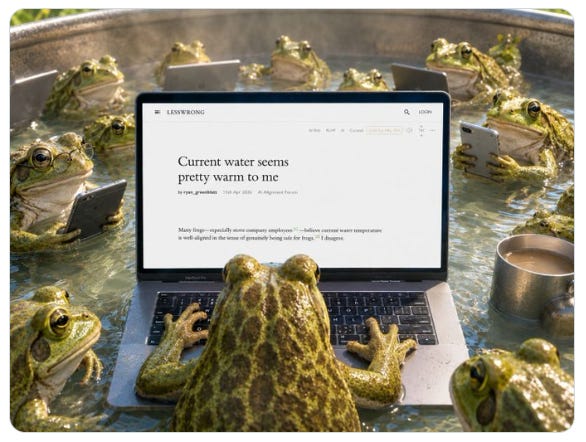
Source: @_ryanbloom
Thanks for reading. If you’ve been forwarded this email, click here to subscribe and receive future editions. Have a great weekend.
Update 08/28/2026: This article was updated to clarify that Hatch is the internal name for Meta’s new AI agent.
Your lead article seems to miss the point is that if you block or slow USA AI development China is move at full speed with there AI and are only a few months behind the USA. So why not point out how China AI is going to take even more Americans jobs. China already used low labor costs to take American job and destroy many American industries. Think what they will do if they Advance past the USA in AI.
The leading indicator is not TAM projections, it is the labs' own internal numbers, and Anthropic published theirs. As of May 2026 more than 80 percent of code merged into Anthropic's own codebase was written by Claude, up from low single digits before Claude Code shipped in February 2025, with 8x more code produced per engineer per day in Q2 2026 versus 2024. Anthropic's own report adds the caveat that lines of code overstate the actual productivity gain, which is a reasonable check on the number but does not erase the direction. The first profession visibly displaced by this wave is the one building the models. If the 30 trillion dollar TAM figure holds anywhere near true, the sequencing question is which sector absorbs that shift first, and software engineering already has a public, self-reported answer.