

“I didn’t know anything about Amy. I didn’t know she helped organize January 6 — I just learned that today from a media person. My focus is on opposing the data center.”
Renee Spaziani was shouting over the sounds of vuvuzelas and chants at a protest outside a municipal building in central New Jersey, which she had helped organize in response to an ad on Facebook. “I was like, ‘I don’t know if I want to do this.’ And I saw it a second time. I was like, ‘we need more eyes on Kenilworth. We have to do this.’”
Spaziani was one of a group of Union County residents pushing back against the construction of local data centers at borough council meetings and small demonstrations. Amid a hellish mix of Canadian wildfire smoke and flash flood-triggering showers last month, they were joining forces with another group called Humans First to stage a “National Day of Protest”.
Spaziani had earlier received an email from some prospective protesters concerned that Humans First was heavily aligned with conservative movements. They were progressives, they explained, and worried the organization also stood for things they vehemently opposed, such as white nationalism, ICE, war, and attacks on women’s rights. Spaziani brushed it off — her political allegiances lie with neither the right nor the left, she said — but the issue was coming up again as journalists asked if she knew anything about the national organization co-hosting her event.
Spaziani did her best to refocus attention on the cause at hand. The company they were protesting, CoreWeave, had “done a significantly amazing job connecting people from all different walks of life” in opposition to their data center, she said.
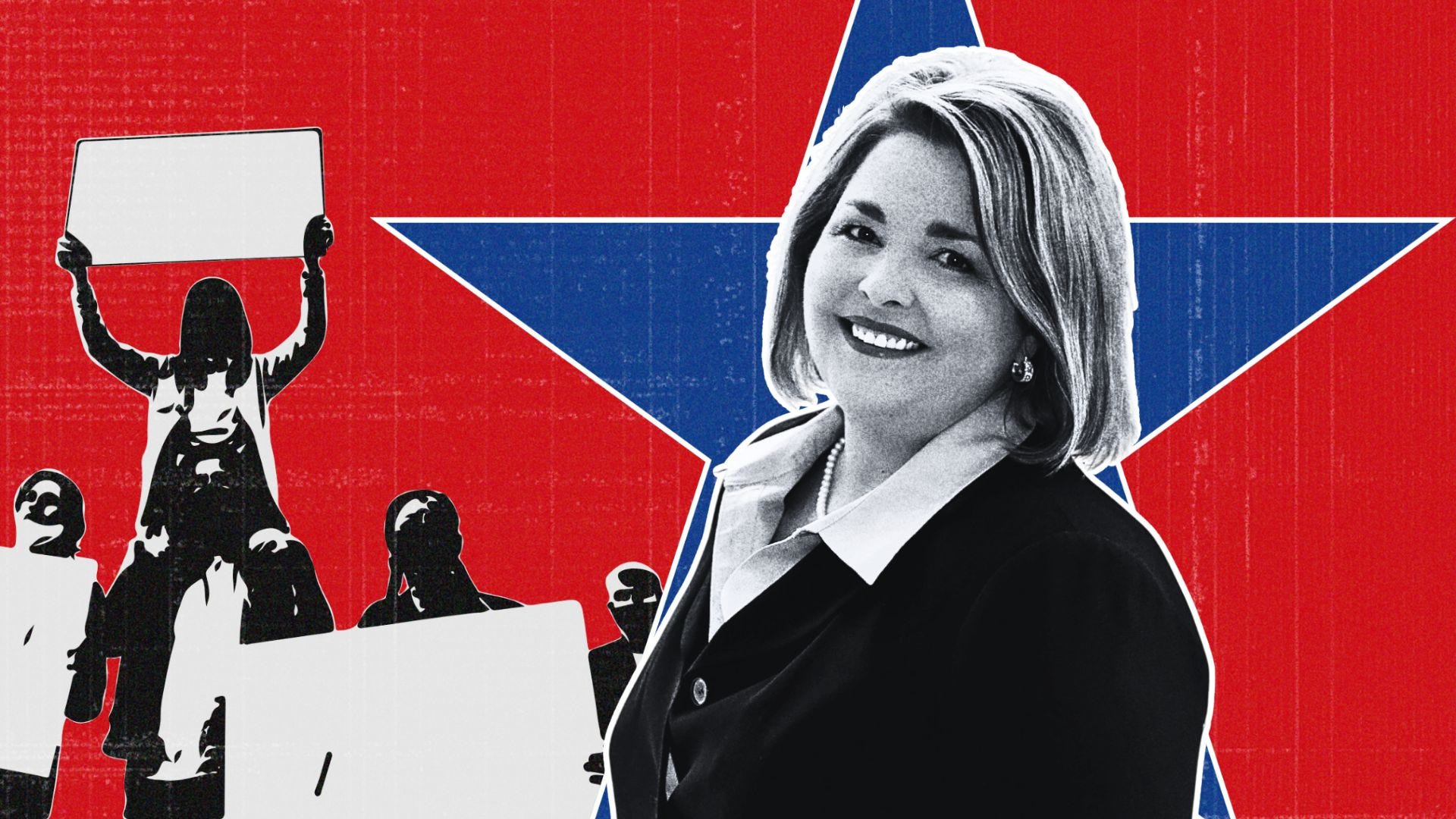
The Amy in question was Amy Kremer, chair of Humans First and a longtime conservative activist and Trump supporter — who, as Spaziani learned that day, did indeed help organize January 6. Now, though, she has a new focus: mobilizing a conservative coalition against AI companies.
“I know how to organize people,” Kremer told Transformer. “I’ve done it time and time again, and that’s why I’m a threat to their power.”

Amy Kremer helped procure the permit for the rally which preceded the January 6 riots, though she did not participate in the attacks on the Capitol. Self-described as the “founder of the modern day Tea Party,” she was a leading denier of the 2020 election results, and has been a prominent figure in right-coded conspiracy theory movements around issues such as COVID and President Obama’s citizenship. She was recruited this year to to Humans First, then a nonpartisan organization aiming to mobilize a grassroots movement on AI safety, to help reach conservatives. In April she became its chair.
As a group, conservatives are only slightly less concerned about AI than Democrats. A 2025 Pew Research poll found that 51% of Democrats and 50% of Republicans were more concerned than excited about the increased use of AI in daily life. Another recent poll from the AI Policy Institute cited by Kremer showed that 77% of Republicans said they wanted to see regulatory guardrails on the technology, compared to 82% of Democrats. The conclusion for many in the AI safety movement has been that conservatives are primed to get behind the issue, and just need the right leader to organize them.
Yet a class of investors and entrepreneurs who want to see as few guardrails as possible have pushed Republican policy in the opposite direction. Many of these “accelerationists” hold or have held roles in the Trump administration, including venture capitalists Marc Andreessen, Sriram Krishnan and David Sacks. There are signs their influence is waning — Sacks and Krishnan have stepped back in recent months, Sacks to an “advisory” position, Krishnan altogether — and the administration has shifted towards a more hands-on approach, such as implementing export controls on what it sees as dangerous models. But still, their proximity to the president has yielded a generally pro-industry platform that prioritizes innovation over caution, making it difficult for more wary conservatives to take a stand against AI.
Kremer’s resume makes her loyalty to the president difficult to question, and she says she believes she’s figured out an approach that works: “I know the president can be moved on issues.” Big AI firms have bought a lot of influence, she says, but politicians are meant to represent people and grassroots activism can tip the scales.
“Big Tech has all the money. They bought off everybody in Washington DC — I mean, they built a moat around the White House. They bought off people at the state level. Now it’s down to the county commission level. They have bought off everybody they possibly can,” says Kremer. “We will never be able to compete with their money. But what they cannot buy off is the people.”

Conversations about what it would take to organize conservatives around AI safety have been happening for years, says Joe Allen. A concert rigger-turned-conservative ideologue, Allen was working as a technology writer, then as an editor on Steve Bannon’s War Room, when AI became his primary focus. He is particularly concerned with “transhumanism,” a belief that technological innovation can transcend the travails of the human condition. Transhumanism is all too common among the Silicon Valley leaders driving the AI boom, Allen says, and a threat to society. That should particularly concern Christians, he says, because it asserts that human invention can supersede God’s creation. He summarized his beliefs about AI as early as May 2025 as “Humans First.”
It was around that same time, according to Allen, that he began thinking about ways to bring people like him — the MAGA crowd who tuned into his segments on War Room, but also disaffected liberals and others eager to reject establishment narratives — into the fold. Researchers and AI advocacy groups were talking about how to regulate AI, but those conversations were primarily driven by AI pessimists Allen collectively refers to as “doomers.” He was never convinced AI would lead to collective ruin as they do, he says, but found some overlap between their concerns and his own. He also found their warnings about AI compelling enough to be the basis for a social movement, even if exaggerated. Conservatives could be turned, if only someone explained it to them, Allen and the doomers agreed.
“It’s not getting people to wake up about AI at this point — that’s long since passed. It’s getting them to wake up to the false narratives, exaggerated narratives, manipulative narratives,” Allen says.

In 2025 Allen met Oliver Zhang and Dan Hendrycks, managing director and executive director at the Center for AI Safety (CAIS), and Allen says talks about creating Humans First with them started last summer. The non-profit does technical and policy-minded AI safety research, and also has a 501(c)(4) lobbying arm and a PAC (which is now inactive). In January this year, Zhang and CAIS special project associate Arunim Agarwal incorporated in California what would become Humans First. According to NBC, Humans First was “incubated” by CAIS, which also gave the group an “initial loan that would be paid back after the group raised donations from individuals who cared about fostering safe and beneficial AI.”
At that time, Humans First was pitched as nonpartisan, with left and right “coalitions.” Kremer led the right wing; the left was run by progressive organizer Alexander McCoy. It was launched publicly in March.
CAIS did not respond to requests for comment. However, CAIS policy lead Jason Hausenloy, speaking earlier in a personal capacity, said that Humans First was aligned with CAIS’ mission. “We don’t want the elite to go and make all these decisions,” Hausenloy said. “The focus on everyday Americans, I think, is one that both we and Humans First can get behind.”
While Allen’s critiques of the tech elite are primarily intellectual, the populist approach described by Hausenloy is Kremer’s specialty. Kremer’s political start in the Tea Party in 2009 involved organizing some of the movement’s earliest protests and eventually chairing a PAC-affiliated group which led national bus tours called the Tea Party Express. She was also an active blogger, elevating her as an unfiltered representative of conservative America’s abrupt late-2000s turn towards populist politics. She was invited to the Oval Office the night before the State of the Union Address in 2019.

Kremer created a series of organizations supporting Trump during his first presidential run and term: a super PAC called Great America PAC, Women for Trump, and Women for America First, often with the help of other former Tea Party compatriots. It was with the last group, which had been swept up in stopping “the steal” of Trump’s 2020 election win, that she organized a bus tour that led to a protest at the Capitol on January 6. Speaking to onlookers on the green expanse of the Ellipse in front of the White House, Kremer said, “I come from the Tea Party movement, and I’m asked all the time: What happened to the Tea Party? ... Well, we’re still here. We just grew and morphed into something bigger and better — the MAGA movement,” according to the New York Times.
Brendan Steinhauser, a former Tea Party organizer who now leads the Alliance for Secure AI, said members of CAIS had asked him and others in AI safety for ideas on who could lead the conservative half of Humans First. At the start of the year he recommended Kremer, who had already met Allen in December, and she was brought on board. Humans First said in an email that advisor Tom Gaitens also played a role in recruiting Kremer.
Conspiracy theories have always been part of Kremer’s political repertoire — she was one of the first to promote the theory that Obama was not born in the United States — but she also has a knack for gathering everyday people, in large numbers, to rally around grievances against the wealthy and elite. It’s for the latter talent, oft overlooked, that Steinhauser recruited her. “She’s a woman of action, she inspires others to take action,” Steinhauser says. “It’s rare to find folks that have all that together, and then of course also media savvy and the ability to really deliver a message.”
“I’m the kind of person that if you were to give me the option of being at a cocktail reception with all the famous people and power brokers and whatnot, or gave me the opportunity to be in a field with all my people at a rally, I’d much rather be at a rally,” Kremer says. “I’m a movement girl. I’m about the people.”
In a statement, Humans First spokesperson Chris Barron said “If your characterization of having questions about the origins of COVID and voting irregularities in 2020 is ‘pushing conspiracy theories’ I highly recommend you talk to someone outside of your bubble — even the most ardent Fauci cultists admit it was likely a lab leak, but by all means continue to gaslight people with the phrase ‘conspiracy theory’.”

Some conservatives are more animated by what they see as Humans First’s ties to effective altruism and Big Tech than Kremer’s role in January 6. For example, Parker Thayer, investigative researcher for right wing nonprofit watchdog Capital Research Center, took issue in June with the fact that Humans First’s uses a progressive fundraising platform. According to Andreessen, the finding was “concerning.”
Though CAIS is not an officially left-wing organization, it has ties to effective altruism, a philosophy which attempts to find, analyze and act on the “most effective” ways to do good, and which many accelerationists have concluded is inherently left-coded. The nonprofit Open Philanthropy, now called Coefficient Giving, which is rooted in effective altruism, had, as of early 2024 donated more than $10.5m to CAIS since November 2022. Coefficient Giving is itself backed by Meta co-founder Dustin Moskovitz, who also invested in Anthropic. (Disclosure: Coefficient Giving is the primary funder of Transformer).
It is unclear whether Humans First has other funders. Humans First did not respond to this question in a request for comment. Kremer did say, however, that Humans First has not yet repaid its loan to CAIS and plans to accelerate fundraising efforts to repay it over the next several months. She declined to state how much the loan is for.
These funding questions have led accelerationists to label Humans First as an effective altruist astroturfing operation. Targeted Victory’s Logan Dobson claimed that zooming in on photos of protesters from a Humans First X post showed they were AI-generated, apparently incorrectly. Innovation Council Action policy advisor Jordan Schachtel has also claimed that Humans First’s complaints about “Big AI” are hypocritical because the group is indirectly funded by Moskovitz and Kremer has complained about alleged censorship by companies like Meta.
“I didn’t even know what [effective altruism] was until a couple months ago,” says Kremer. “Honestly, there are probably people on my team now that probably don’t know what it is. I mean, there’s nothing further from the truth.”
“I will stand against anybody with my conservative credentials — anybody in the political world — and I am not for sale. If I were for sale, I would have sold out a long time ago, and I wouldn’t have lived in the hell that I’ve been through in the past five years after J6.”
This criticism isn’t widespread, mostly found on X and in backroom conversations in Washington. But it seems to have played a significant role in leading Humans First to rebrand in April as a purely conservative organization chaired by Kremer. Many of the conservative voices who are critical of Humans First have the ear of the president, including Andreessen and Sacks, and Trump has a record of distrusting political groups which are friendly with Democrats.
Kremer and others involved paint the split as a practical decision. Conservatives and liberals talk to their bases differently, she says, and official ties between two partisan groups can make it difficult to build trust.

“They don’t like Donald Trump, and there’s no way I wanted Kamala Harris. We disagree on that, and our people would disagree on that, right?” Kremer says. “When you are in a movement, you have to be respected and trusted by the people in the movement. Because you can’t accomplish anything if the people that you’re working with don’t trust you.”
In terms of how they operate there may be little difference between Humans First’s previous set up with separate partisan sub-organizations operating under one nonpartisan umbrella, and the new formally separated structure. The process of spinning out the left group as its own organization is still ongoing. According to one source and a job posting online, both Humans First and the left coalition will have their own executive directors, neither of which have been announced. McCoy, who had led the left coalition, was involved in the spin out but has since departed.
The new, conservative-focused Humans First has been the first to spring into action, hiring a set of six new advisers and staff. Many have worked in MAGA politics or played active roles in the MAGA movement. Its new Texas State Director Cathy Latham, for example, signed alternate ballots certifying that Trump won the 2020 election in Georgia, while comms advisor Chris Barron was a media surrogate for the Trump campaign in 2016. Coalitions contractor Ken Mayo served as director of field operations for Trump’s campaign in the Florida primary, while advisor Tom Gaitens was also a Trump delegate, and advisor Sarah Makin was a senior advisor to the president and vice president during the first Trump administration.
The split into right and left led Allen, aspirationally dedicated to political homelessness, to leave the group. “Even if nonpartisanship is a pipe dream, I’ve never been too shy about hitting the pipe,” he says.

Humans First’s partisan rebrand, however, didn’t quell conservative critique. If anything, it inflamed it. A pivot to data centers has heightened tensions, and a distaste for Kremer’s biography among some conservatives, who align more closely with Reaganite, free-market and pro-business leanings than the MAGA brand of class grievance, has come to the fore.
To them, Humans First is a radical group, and something to fear. In an interview in May, Nathan Leamer, who co-leads the advocacy arm of a16z and Greg Brockman-backed super PAC Leading the Future, described Kremer as “the Pierre-Augustin Hulin of America,” referring to the former French general who led the storming of the Bastille. “No one is better at storming buildings and rallying people to extreme causes than Amy Kremer, so it makes total sense.”
But as I walked up and down the line of more than 30 protesters waving to cars with signs and umbrellas, nobody was thinking about storming buildings. Aside from the emails Spaziani told me about, none of the protesters who spoke with Transformer seemed to know much about Humans First beyond its name. Their own political allegiances were diverse, ranging from Democrat, to Republican, to people who had issues with both parties. Humans First didn’t seek them out — there is no record of them paying for the Facebook ads Spaziani says she saw, just posts about the national day of protest on social media and inviting local groups to sign up themselves. Humans First was a vehicle for their activism, not the cause.
At 1pm, the protesters prepared to march from the municipal building to the site planned for the CoreWeave data center. The air quality index hovered around 170, “unhealthy” per the EPA, and rain began to pour, flooding the roads and making it treacherous for cars to leave. But the protest hardly dwindled, the protesters growing more defiant in the storm. Spaziani, speaking from a megaphone, turned the crowd’s attention to one of their comrades — a fold-down walker-using woman named Toni, dragging a tank of oxygen behind her. If Toni could be here, on a smoky, rainy day, Spaziani said, everyone should be able to power through.
Republicans and Democrats alike, the group had a united goal: stop data center development, now. Kremer is personally making that case, and the case for AI safety more broadly, on the Hill, meeting with lawmakers as recently as July 22. She says Humans First will start training grassroots organizers more deliberately in the coming months. Her group also recently announced that it will be doing an anti-data center bus tour in September, Tea Party Express style.
Protests like these will be the first of many, which Humans First believes will capture grassroots, populist enthusiasm on the right for AI safety and anger at data center builds. “My rights are being stripped away from me,” Spaziani said. “If the high elites really want a data center, put that shit on Epstein Island. That’s a better use of that space instead of what has previously gone on there, you know? If there’s a time for us to stand up, then now is it.”
Correction, September 2: Corrected the article to note that an activist was using a fold-down-walker, not a wheelchair.
Hmmm this is very interesting, how it pans out and is perceived, esp with all the findings pouring into AI centers.
What the hell is wrong with data centers?