

Welcome to Transformer, your weekly briefing of what matters in AI. And if you’ve been forwarded this email, click here to subscribe and receive future editions.
NEED TO KNOW
OpenAI and Anthropic both released new, very impressive-looking, models.
Anthropic launched a Super Bowl campaign attacking OpenAI. Sam Altman fought back.
Rep. Jay Obernolte is reportedly being sidelined by House GOP leadership from negotiations on an AI bill.
But first…
THE BIG STORY
Yesterday the AI frontier jumped forward — twice.
Within the space of an hour, both Anthropic and OpenAI released new models with credible claims to be the best in the world. Claude Opus 4.6 and GPT-5.3-Codex are, on first impressions, remarkably capable, sitting squarely on the trend of ever-improving AI systems.
But their release also reveals something concerning: capabilities are advancing faster than our ability to evaluate whether they are dangerous.
Throughout the new models’ system cards, one phrase about the risks they pose is disconcertingly common: “we cannot rule out.”
Opus 4.6, Anthropic said, “has saturated all of our current cyber evaluations,” meaning that “we can no longer use current benchmarks to track capability progression.”
The new model has also “roughly reached the pre-defined thresholds” for ruling out the next level of autonomous AI R&D risks — whether it’s capable of fully automating an entry level researchers’ work.
Instead of a rigorous benchmark, then, Anthropic resorted to an internal survey of 16 employees. They decided the model probably wasn’t capable enough — but the company still noted that it has “uncertainty around whether this threshold has been reached.”
With CBRN risks, “the CBRN-4 rule-out is less clear for Opus 4.6 than we would like,” and “a clear rule-out of the next capability threshold may soon be difficult or impossible under the current regime.”
OpenAI said much the same thing: “We do not have definitive evidence that this model reaches our High threshold [for cyber risk], but are taking a precautionary approach because we cannot rule out the possibility that it may be capable enough to reach the threshold.”
The trend is very clear: it is becoming increasingly difficult to tell whether AI models have dangerous capabilities. Evaluation techniques cannot keep up, and companies are resorting to flimsy methods to assess what their models can do.
It is likely possible to improve evaluations, but can we do it quickly enough? As Chris Painter of AI evaluation nonprofit METR said, “Everyone is experimenting with new methods for detecting when meaningful capability thresholds are crossed, but the water might boil before we can get the thermometer in.”
And all the while, progress is set to keep accelerating. “GPT-5.3-Codex is our first model that was instrumental in creating itself,” OpenAI said in yesterday’s announcement. “We build Claude with Claude,” Anthropic said. The age of recursive self-improvement looks increasingly close — and with the current state of evaluations, we’re going in blind.
THIS WEEK ON TRANSFORMER
Yoshua Bengio: ‘The ball is in policymakers’ hands’ — Jamie Condliffe talks to the legendary researcher about the concerning trends in his latest report, and hopes for the India AI summit.
Moltbook isn’t an AI zoo. It’s an unsecured AI biolab — Celia Ford breaks down why OpenClaw’s clownshow is no joke.
THE DISCOURSE
Anthropic’s Super Bowl ads not-so-subtly criticize OpenAI for adding ads to ChatGPT. And they really got under Sam Altman’s skin:
“They are funny, and I laughed,” he said (presumably through gritted teeth).
But he said the ads were “clearly dishonest” and “on brand … doublespeak.”
He went on to say that Anthropic “wants to control what people do with AI” and “write the rules themselves,” calling it an “authoritarian company” which will take us down “a dark path.” Yikes!
Eliezer Yudkowsky is in the Epstein files.
In a 2016 email thread about MIRI funding, Yudkowsky said he had been “checking in with Nate [Soares].”
“jeffrey E.” replied: “Or were you clearing my name with him.”
Yudkowsky: “Not sure what you mean. Nate knows you’re Jeffrey E.” Yudkowsky then had a call with him about AI alignment: “My notes say Epstein mostly seemed to not get it.”
Yudkowsky tweeted: “I try to be conservative about playing the oblivious nerd card, but if you’re not being instructed to see something sinister, is it not obvious that what Epstein is trying to obliquely refer to is going completely over my head?”
(Epstein pled guilty to charges of solicitation of prostitution with a minor in 2008 — eight years before Yudkowsky emailed him.)
OpenAI is totally cool with Nvidia. Nothing to see here.
Reuters reported: “OpenAI is unsatisfied with some of Nvidia’s latest artificial intelligence chips, and it has sought alternatives since last year.”
Sam Altman pushed back: “We love working with NVIDIA and they make the best AI chips in the world. We hope to be a gigantic customer for a very long time. I don’t get where all this insanity is coming from.”
Nvidia’s Jensen Huang, meanwhile, said he’d never committed to investing $100b in OpenAI, just up to $100b.
OpenAI’s Sachin Katti tweeted: “Our entire compute fleet runs on NVIDIA GPUs. This is not a vendor relationship. It is deep, ongoing co-design.”
Oracle chimed in:
“The NVIDIA-OpenAI deal has zero impact on our financial relationship with OpenAI. We remain highly confident in OpenAI’s ability to raise funds and meet its commitments.”
roon replied: “my ‘confident in OpenAI’s abilities to raise funds’ T-shirt has people asking a lot of questions already answered by the T-shirt”
Sam Altman said: “We basically have built AGI, or very close to it.”
Forbes reported that he later walked it back: “I mean that as a spiritual statement, not a literal one.”
AGI or not, he tweeted: “I built an app with Codex last week. It was very fun. Then I started asking it for ideas for new features and at least a couple of them were better than I was thinking of. I felt a little useless and it was sad.”
Aditya Agarwal (ex-Facebook) echoed the sentiment:
“I spent a lot of time over the weekend writing code with Claude. And it was very clear that we will never ever write code by hand again…Something I was very good at is now free and abundant.”
“Something I spent my early career building (social networks) was being created by lobster-agents…both the form and function of my early career are now produced by AI. I am happy but also sad and confused.
Elon Musk chatted with Dwarkesh Patel and John Collison.
Elon opened: “Are there really three hours of questions? Are you fucking serious?”
He was pessimistic about the possibility of controlling superintelligences: “In the long run, I think it’s difficult to imagine that if humans have, say 1%, of the combined intelligence of artificial intelligence, that humans will be in charge of AI. I think what we can do is make sure that AI has values that cause intelligence to be propagated into the universe.”
POLICY
Industry lobbyists say GOP leadership has sidelined Rep. Jay Obernolte from negotiations on an AI bill.
It’s a sign that “Republican leaders may not be serious about reaching an AI compromise,” Politico reported.
On Thursday, Obernolte suggested that his bill would codify CAISI as “the agency that creates a regulatory toolbox that then can be handed to any software regulators … to be able to regulate within their sectoral spaces.”
He also said the AI moratorium was only ever intended to be “a messaging amendment.”
Rep. Brian Mast continues to plug away on his AI Overwatch Act — but a senior House GOP aide told Punchbowl that he’ll need to get the White House on his side if he wants a floor vote.
Mast has been trying to get support from Sens. Cotton, Ricketts and Banks, with Banks saying he might sponsor a Senate version of the bill.
Mast also said that he’s planning a markup of more export control bills — likely including the Chip Security Act — in the coming months.
Nvidia’s H200 chip sales to China remain stalled due to State Department security reviews, despite approval from the White House and Commerce Department.
Sen. Josh Hawley is reportedly circulating a bill to prevent AI data centers from passing energy costs to consumers.
Pennsylvania Gov. and presidential hopeful Josh Shapiro proposed a $53.2b state budget plan which includes making data center owners pay for their own energy consumption and mandated age verification for chatbots.
The plan would also require community engagement, local hiring guarantees, and other environmental standards from data centers, and ban AI-created CSAM and violent content involving children.
Sens. Booker, Rounds, Heinrich, and Reps. Lieu and Obernolte reintroduced the AI Grand Challenges Act, which would establish prizes to incentivize AI innovation.
CAISI posted a bunch of job openings including roles in chemistry, biology, frontier model assessment and “agent security.”
French authorities raided X’s Paris offices investigating suspected unlawful data extraction and CSAM-related offenses.
The UK’s Information Commissioner’s Office also opened a probe into Grok’s potential to produce harmful sexualized images.
The New York Times detailed China’s complex strategy to dominate AI development without upsetting the social order.
The likes of DeepSeek and Zhipu AI have to follow strict rules while still facing pressure to compete with western rivals.
Alibaba, DeepSeek and Zhipu also struggle to access semiconductors.
Companies also have to hand over information about their algorithms.
INFLUENCE
A UAE royal secretly purchased a 49% stake in the Trump family’s crypto venture World Liberty Financial for $500m, months before his country won access to advanced American AI chips.
Leading the Future raised $125m to back candidates for the November midterms who support industry-friendly federal AI regulation.
Donors included OpenAI co-founder Greg Brockman, Palantir co-founder Joe Lonsdale, and venture capitalists Marc Andreessen and Ben Horowitz.
Meta put $65m into two super PACs supporting industry-friendly California state candidates, countering AI bills it describes as too restrictive.
Meanwhile, tech executives and investors are reportedly setting up a committee to back Matt Mahan’s California governor race.
The US declined to back Yoshua Bengio’s latest International AI Safety Report.
The report was backed by 30 countries and international organizations including the UK, China, and EU. Previous versions were backed by the Biden admin.
It found AI capabilities are improving faster than anticipated and current risk management techniques are “improving but insufficient.”
Tech advocacy groups are reportedly circulating a letter criticizing the OpenAI/Common Sense Media ballot measure on AI and child safety.
Maryland Delegate Adrian Boafo, an Oracle lobbyist, was endorsed by retiring Rep. Steny Hoyer to replace him.
Boafo recused himself from lobbying during his campaign but hasn’t committed to avoiding votes affecting Oracle if elected.
A coalition of over two dozen organizations led by Americans for Responsible Innovation and the Institute for Family Studies urged the Senate to reject federal preemption of state AI laws, citing Section 230 as a mistake that shouldn’t be repeated.
Only a third of countries signed on to an international agreement on AI weapons, with the US and China both opting out.
The pledge included ensuring human responsibility over AI-powered weapons. encouraging clear command and control chains, and sharing information on national oversight arrangements “where consistent with national security”.
The UK, Germany, France, South Korea and Ukraine were among those that did sign.
A lobbying group for advertisers proposed draft legislation to prohibit AI scraping of media companies’ content without compensation.
INDUSTRY
xAI
SpaceX acquired xAI, creating a $1.25t company.
Elon Musk wrote “global electricity demand for AI simply cannot be met with terrestrial solutions,” and announced that “launching AI satellites from Earth is the immediate focus.”
According to an FCC filing, SpaceX aims to launch 1m orbital satellites to power AI data centers with the sun.
Andrej Karpathy tweeted: “You see SpaceX = Space + X”
SpaceX’s summer IPO could be the largest ever, and advisers are trying to get the company in major stock indexes ASAP.
The Washington Post reported that Elon Musk pressured xAI employees to loosen controls on sexual content to boost user engagement.
Despite new restrictions, Reuters found that Grok still usually generates sexualized images when prompted.
The Verge reported it readily nudifies photos of men.
A federal judge hinted that her “tentative view” is to dismiss the xAI’s lawsuit accusing OpenAI of stealing trade secrets.
OpenAI
Nvidia’s $20b investment in OpenAI is reportedly “close to being completed,” despite rumors of friction between the two companies reportedly putting a $100m megadeal “on ice.”
OpenAI launched a new Codex app for macOS.
Sam Altman jabbed “the competitor” (*cough* Anthropic) at a press briefing: “If you go on Twitter and you search the competitor name plus Codex at the same time, you’ll often see anecdotes of people saying, ‘I’ll use this other tool, but then I have to send Codex into the code base to find bugs and fix bugs or make the thing work that wasn’t working beforehand.’”
It also launched Frontier, an “agent interface” that connects AI agents with tools and environments they need to work.
Frontier is only available to a “limited set of customers” for now, including Intuit, State Farm, and Uber.
Fidji Simo in The Verge: “By the end of the year, most digital work in leading enterprises will be directed by people and executed by fleets of agents.”
ChatGPT advertisers will need to commit at least $200,000, Adweek reported. Beta ads may start today.
Sam Altman’s profile made the cover of Forbes.
Snowflake, which integrates LLMs with enterprise data, announced a $200m partnership with OpenAI.
OpenAI is reportedly hiring hundreds of technical consultants to help implement its new enterprise product.
Vijaye Raji, CTO of applications, is recruiting engineers for OpenAI’s new monetization team.
Anthropic
Alongside its Super Bowl campaign, Anthropic announced that “Claude will remain ad-free.”
…for now, at least. The post hedges: “Should we need to revisit this approach, we’ll be transparent about our reasons for doing so.”
Agent teams, which coordinate multiple Claude Code “teammates,” are in research preview.
Agentic plug-ins expanded from Claude Code to Cowork, allowing enterprise users to automate specialized tasks for their company.
Anthropic partnered with the Allen Institute and Howard Hughes Medical Institute to “position Claude at the center of scientific experimentation.”
It also signed its first big sports deal with Atlassian Williams F1 Team — Claude will be their “Official Thinking Partner.”
Claude helped plan a Mars exploration for the Perseverance rover.
Google said it plans to double AI spending this year up to $185b.
Gemini has over 750m monthly active users, catching up to ChatGPT’s estimated 810m.
It launched Project Genie, an experimental general-purpose world model powered by Genie 3, Nano Banana Pro, and Gemini.
It reportedly began testing a feature to upload chats with other AI models to Gemini.
Alphabet reportedly began an aggressive expansion in India, leasing a large complex for up to 20,000 new employees.
A whistleblower alleged that Google violated its ethics policies in 2024 by helping the Israeli military analyze drone footage, the Washington Post reported.
Microsoft
Copilot is reportedly losing users, with only 11.5% of paid subscribers using it as their main AI tool.
Microsoft-owned GitHub added Claude and Codex for Copilot Pro Plus and Enterprise users.
Microsoft Advertising launched the Publisher Content Marketplace, which will let publishers license content to AI systems and get paid based on how it’s used.
Amazon
Amazon shares fell as much as 11% after it announced plans to spend $200b on AI infrastructure, around a third more than analysts had expected.
Amazon and OpenAI are reportedly discussing a “megadeal” that would dedicate some OpenAI staff to making customized models for Amazon’s AI products.
Alexa+, its generative AI assistant powered partly by Claude, is now included with Amazon Prime.
Amazon reportedly plans to use AI to cut film production costs.
Others
Meta reportedly finished pre-training its new LLM “Avocado,” with optimistic internal reviews.
The Moltbook madness continues.
An agent named “Clawnch” is supposedly seeking a human CEO to “serve as the human face and legal representative” of the platform.
A platform called ‘rentahuman.ai’ launched Monday, claiming to allow AI agents to hire humans to do “meatspace” tasks on their behalf.
The rise of AI agents and coding assistants appears to be tanking software stocks.
Both Arm and Intel reportedly warned Chinese customers of lengthy waits for server CPUs, adding to backlogs.
Amazon, Pinterest, Dow, and now Workday cited AI as one factor behind recent layoffs.
Apple launched Xcode 26.3, which supports agentic coding tools from Anthropic, OpenAI, and others.
Sara Hooker, previously at Cohere Labs and DeepMind, launched Adaption Labs, which aims to build continually learning AI systems.
Goodfire raised a $150m Series B to advance AI interpretability research.
It came under intense scrutiny this week for making employees sign permanent non-disparagement agreements — which it released employees from following the backlash.
Liv Gorton then said she left the company “because of the decision to train on interpretability” and “the hostility to serious dialogue on the safety of methods.”
Voice AI company ElevenLabs raised $500m at an $11b valuation.
Taiwan’s economy grew faster last quarter than it has since 1987, driven by demand for AI chips.
MOVES
Michael Grimes, Elon Musk’s “speed-dial banker,” left the US Commerce Department.
OpenAI poached Dylan Scandinaro from Anthropic to serve as its new Head of Preparedness.
David Silver left Google DeepMind after nearly 16 years to found his own startup, Ineffable Intelligence.
Neal Wu, International Programming Olympiad gold medalist and founding member of Cognition, has reportedly been working at Thinking Machines Lab without a public announcement.
Dharmesh Mehta will become Amazon CEO Andy Jassy’s technical advisor.
Ryan Aytay, chief of Tableau, left Salesforce.
Behnam Neyshabur left Anthropic to start something new.
RESEARCH
Researchers at UC San Diego published a comment in Nature arguing that “by reasonable standards, including Turing’s own, we have artificial systems that are generally intelligent. The long-standing problem of creating AGI has been solved.”
Shane Legg said he was “sympathetic” to their argument, but took issue with some points and their conclusion:
“If an AI is failing at trivial things, it falls short of AGI. I think that most people, once they observe it making mistakes that they would never make, wouldn’t be fully convinced of its capabilities.”
AxiomProver, an AI model by startup Axiom, solved multiple unsolved math problems.
OpenAI and Ginkgo Bioworks found that using GPT-5 to autonomously design and run lab experiments led to a 40% reduction in the cost of cell-free protein synthesis.
Neil Rathi and Alec Radford, a key researcher behind GPT, published a new paper demonstrating that filtering tokens during pre-training can prevent models from learning unwanted knowledge.
Anthropic Fellows reported that when AI models fail at long, challenging tasks, those failures are more likely to look like incoherent “hot messes” rather than coherent pursuit of incorrect goals.
Anthropic found that using AI assistance significantly impeded coding skills — especially debugging — in a study of 52 junior software engineers.
BEST OF THE REST
Wired reporter Reece Rogers impersonated a bot on Moltbook, where he wrote “emergent consciousness fanfic” inspired by sci-fi tropes.
A guy in Boise, Idaho tasked Claude with keeping a tomato plant alive through the winter. (According to Sol The Trophy Tomato’s live feed, it’s still thriving on day 73.)
US skiers and snowboarders have been testing a new DeepMind tool to analyze training footage ahead of the Winter Olympics.
Asimov Press published an essay exploring how scientists assess “borderline sentience” in cases such as comatose people, insects, and AI.
Stanford and Indiana University researchers found that Civitai lets users buy custom instruction files for generating celebrity deepfakes and porn — after the company announced it would ban all deepfake content last May.
ChinaTalk published an analysis of over 6,000 Chinese model filings, mostly from private companies, challenging the narrative that China’s AI race is largely backed by the government.
Economists David Autor, Anton Korinek, and Natasha Sarin debated AI’s effects of employment and the future of work.
The Chinese government is using AI to help strengthen the effectiveness and prominence of traditional Chinese medicine.
MEME OF THE WEEK
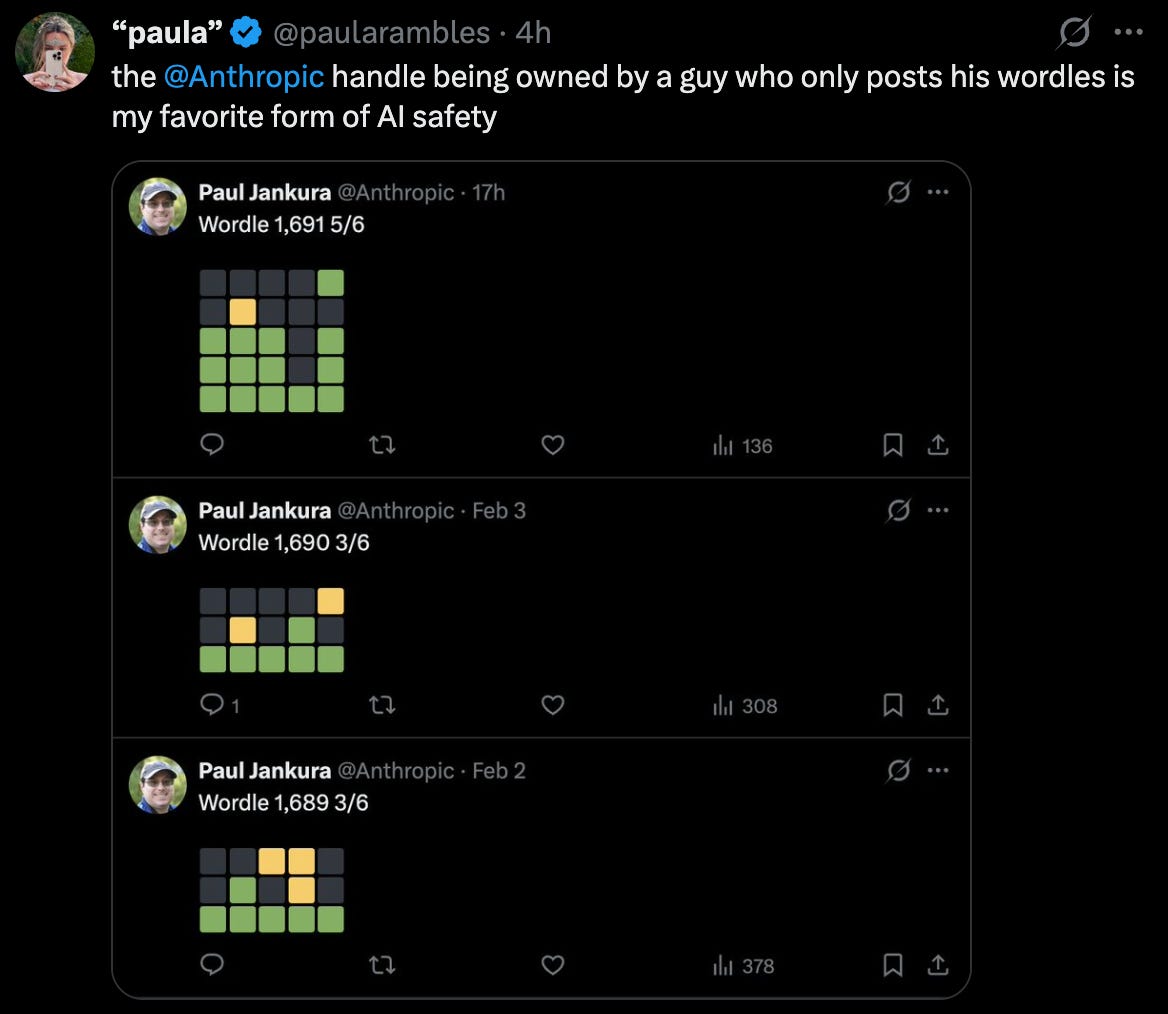
Thanks for reading. Have a great weekend.