


Transformative AI could supercharge development for the world’s poorest countries, allowing them to achieve in a decade what might otherwise take a century, according to a new report from the World Bank. But that’s only if governments act fast to lay groundwork that spreads AI’s gains, rather than concentrating them.
Crucially, the most powerful AI systems are being built in a small number of wealthy countries. And even heavyweights like the US or China haven’t quite figured out how to mitigate the economic-disparity threats that transformative AI poses within their own borders: concentrated market power, job displacement, and a shrinking tax base.
Countries outside the AI supply chain have two routes into the AI boom: adopting the technology themselves, or claiming a share of its gains through redistribution. According to current forecasts, adoption alone leaves poor countries richer but causes them to catch up with industrial countries more slowly. So far, redistribution solutions include initiatives like sovereign wealth funds, universal basic income (UBI), windfall clauses, and benefit-sharing programs.
Many of the redistribution strategies are emerging from non-governmental organizations, but a few AI companies — as well as their leaders and stakeholders — are funding studies into how those benefits might be shared, and floating proposals of their own.
In June, Anthropic committed $200m to support ambitious external research to “prepare society for the economic impacts of AI.” And OpenAI reportedly offered the US government a 5% stake in the company, worth roughly $42.6b, as part of a plan to create a sovereign wealth fund in which leading US AI companies would cede similar equity stakes to the government. Such a fund would give the American people an automatic stake in AI companies and infrastructure, OpenAI claims, even if they aren’t investing directly in financial markets. That said, it’s unclear whether the Trump administration has agreed to the offer, or whether other AI firms will follow suit.

OpenAI’s offer might be a way to buy political goodwill in an administration eager to assert its technological dominance. Still, it also signals a broader desire to spread the benefits of transformative AI across the population. Voters are apprehensive about potential AI-fueled job disruptions, data centers, and wealth inequality; a clearer sense of ownership could enable voters to participate more in AI’s gains. But if comparatively rich Americans need public ownership of AI stocks under transformative AI, how much AI equity would the global poor in Africa need?
If poor countries can’t keep up with rich, AI-fueled economies on their own, redistribution is a tough challenge. The traditional welfare state ends at the borders; rich countries have recently cut back foreign aid; and nation-states don’t incentivize politicians to take care of non-voters. If governments are unlikely to take ownership of sharing AI’s windfall worldwide, this might be an important opportunity for philanthropy to take the first steps.
Richer, but further behind?
If AI causes tremendous productivity benefits, it’s very unlikely that the global poor will be worse off.
The World Bank hopes that AI can offer a lifeline for developing countries, but this depends on them getting some basics right. “Developing countries that build the foundations now — power, connectivity, skills, and institutions — will be positioned to adopt and adapt AI for their people,” says Gaurav Nayyar, director of the World Bank’s Development Report 2026.
In fact, AI could accelerate progress against the currently non-eradicable diseases of tuberculosis, malaria and HIV/AIDS, according to the Forecasting Research Institute’s Longitudinal Expert AI Panel. Depending on the scenario, experts expect deaths to fall by about 34% relative to 2023 under slow progress (where AI serves as a digital collaborator), versus about 80% under rapid progress (where AI autonomously accelerates scientific progress) by 2050.
While AI may improve the available medicine in developing countries, its impact on local labor markets is less clear.
The job market in developing countries doesn’t contain many analytical and digital tasks, which are more exposed to AI, according to a March World Bank working paper. Furthermore, the connectivity required to harness AI fully is limited. On the other hand, AI-exposed services such as call centers, which benefited from offshoring, might be especially prone to automation.
Additionally, African and Asian economies also have advantages that are often forgotten, such as Taiwan and South Korea’s role in AI chip manufacturing. “Certain East Asian and Gulf countries have quite strong positions in the AI supply chain or due to data centers, and I would say some lower middle-income countries are better positioned to capture growth under AGI than some European countries,” says Rasmus Andersen, who has advised a range of governments on AI for the Tony Blair Institute for Global Change. How much countries gain from AI depends more on their current role in the AI supply chain and their digital readiness than their current income level.
Still, developing countries will probably struggle to reap the full gains of AI and to catch up with rich countries. The Global South lacks a highly educated workforce, digital infrastructure, and the hands-on know-how needed to put AI to work. Additionally, highly agrarian and informal economies are not as easily augmentable by AI. While most small-scale experiments in rich countries show that AI helps less productive people more, a field experiment in Kenya indicates the opposite, since they choose to implement different advice. Kenyan small-business owners gained access to an AI bot via WhatsApp, and while high-performing businesses may have benefited by over 15%, low-performing businesses performed nearly 10% worse. Even Columbia’s Daniel Björkegren, who found that AI helps teachers in Sierra Leone more effectively and more cheaply than traditional web search, conceded that AI’s benefits might mostly accrue in rich countries.
“AI is more like the Industrial Revolution and less like the mobile phone,” argues Deena Mousa, global health grantmaker at Coefficient Giving. (Disclosure: Coefficient Giving is Transformer’s primary funder.) Poor countries might not be able to leapfrog to AI as they did with online banking due to a lack of connectivity, compute, or competency, which didn’t require local bank branches and ATMs first.
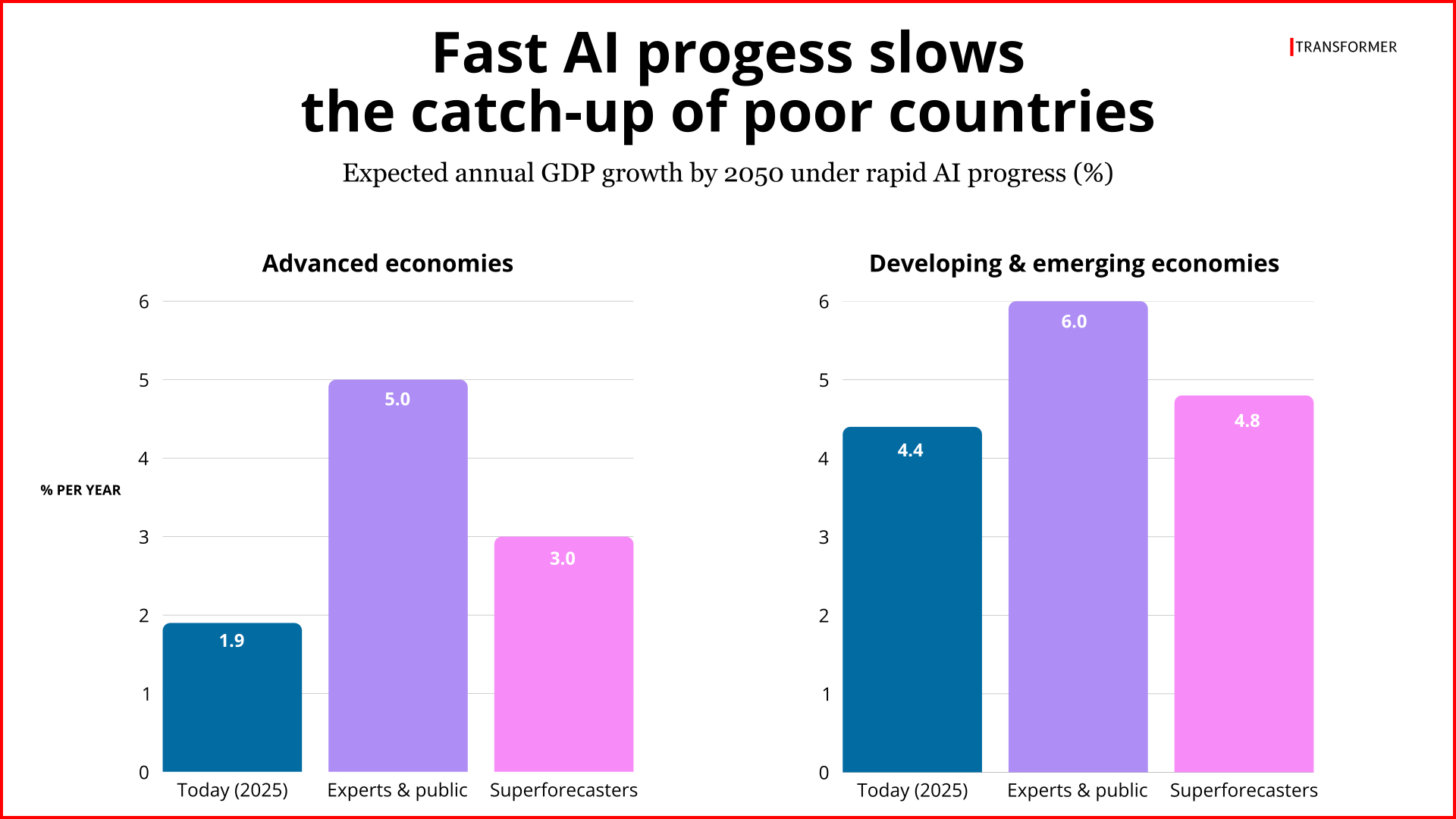
In an extreme scenario, the gap between rich and poor countries grows dramatically even if poor countries are better off.
In 2025, senior research fellow Tom Davidson at Forethought, an institute that studies explosive AI progress, modeled a scenario in which the US could outpace the rest of the world. This hypothetical becomes more likely if the US government takes further steps to curb the spread of the latest AI technology — such as when it restricted foreign access to Anthropic’s Fable model in June. (The restriction was in response to a security vulnerability concern and promptly lifted.) This is bad news for AI sovereignty worldwide and worsens the sovereignty-capability tradeoff those countries face. An alliance among the compute supply chain — such as a more potent form of the US-led AI supply chain alliance Pax Silica — that prevents the spread of AI and the wealth it generates to adversaries would be the most likely reason for this extreme divergence.
“I expect economic divergence to cause massive power concentration,” Davidson says, “especially if the leading country acts in an authoritarian way.”
How to redistribute AGI’s wealth
There are ways countries could benefit from the AI boom. Economic divergence is not their fate, but a policy choice.
Sovereign wealth funds, like the one proposed by OpenAI earlier this year, could enable governments in the Global South to take stakes in AI companies, which would be especially helpful if they could capture much of the value AI generates. But OpenAI’s proposal to the US government doesn’t currently include benefits for foreign governments. Still, these governments could appoint independent fund managers to buy public stocks themselves.
While the US government has leeway to pursue such unorthodox economic policies, such as taking stakes in Intel, the International Monetary Fund generally holds developing countries to a higher standard. In 2021 El Salvador made bitcoin legal tender and gave every citizen $30 of it via a state wallet; the IMF agreed to a $1.4b loan in December 2024 only after the government made acceptance of bitcoin voluntary for businesses.
A sovereign wealth fund would allow poor governments to prepare for transformative AI by taking equity stakes in AI companies to benefit from the upside. But the government investing only in AI companies, rather than all sectors equally, would put all its eggs in one basket and affect AI companies’ decision-making. To alleviate the latter concern, distributing the dividends from such a fund could help disentangle. Since no one that we know of has offered an African government a 5% stake in OpenAI, they’d need to gamble on the stock market.

The most popular way to distribute the generated wealth is through a universal basic income paid equally to citizens. No-strings-attached cash transfers in the US have proven to help with education and prison avoidance. To assuage AI-displacement anxiety, Sam Altman personally funded a UBI experiment in which participants were given $1,000 a month for three years, with the results released in 2024 after touting UBI’s potential as an AI wealth-disparity band-aid. Several studies funded by Altman found no large effects on health or employment, suggesting that UBI is less effective in response to AI-related economic changes, at least in a world with moderate automation. (Altman later changed his mind, concluded cash wasn’t the answer, and moved to equity and compute access as better forms of wealth redistribution.)
In contrast, 115 studies in developing countries collectively point to positive effects of cash on income, child health, employment and education. It turns out that people in the Global South are simply more cash-constrained and benefit more from cash. But the sums involved for a global UBI would be enormous and would probably require a level of multinational governance that’s not in sight. It remains unclear whether UBI would be more effective in a world with mass unemployment, where many people would rely on it and less stigma would be attached to it.
A more ambitious way to spread the benefits is universal basic capital, which would give each citizen a stake in the economy at birth rather than creating dependence on regular payments. Anthropic suggested similar universal capital accounts as a first measure against rising job displacement. Children, young adults, and exposed workers can withdraw from their accounts during career transitions and participate in AI equity. These accounts would be more targeted to AI than the newly launched Trump Accounts, which provide children with investment accounts: eligibility extends to exposed workers, withdrawals are permitted during career transitions, and the asset mix includes AI equity. These capital accounts allow the median voter to benefit from AI as a stakeholder.
Precedents are mixed: Alaska’s Permanent Fund Dividend shows citizens can durably share in capital returns without reducing work hours, but the UK’s Child Trust Fund — the closest universal capital account attempted — left 42% of matured accounts unclaimed and barely shifted savings behavior.
But there’s another actor that has grown considerably and could pick up the slack left by a lack of international coordination: philanthropy.
One proposal that crosses borders is the global dividend from the nonprofit Windfall Trust: a global fund, financed by equity stakes in AI firms or levies on AI windfalls, that pays dividends to everyone on Earth. (Disclosure: I previously wrote Windfall’s newsletter.)
Governments aren’t rushing to fund it, but Deric Cheng, Windfall Trust’s director of research, argues philanthropy needn’t wait: “Cash transfers to people living in extreme poverty are one of philanthropy’s clearest evidence-based benchmarks. The upcoming wave of philanthropy centered around the AI labs could be used to kickstart an endowment for all of humanity, starting with those who need it the most.”
Unlike the worldwide retreat in foreign aid, philanthropic orgs have been doubling down on helping the world’s poorest. The largest cash distributor for extreme poverty — GiveDirectly — wants to scale to distributing $5b by 2035, for example.
Philanthropic organizations have transcended borders ever more easily over the last few decades. They are the actors most likely to spearhead innovative solutions to global problems, but they face their own unique challenges. Distributing money quickly is a logistical nightmare and depends on the donors’ permanent goodwill.
Instead of sharing money, developing countries could also benefit from resources through other channels. Benefit-sharing might also include computing resources or other goods, in addition to cash, in return for safety commitments from the Global South regarding the prevention of misuse or chip smuggling to China. This would reframe access choices as a bargain rather than charity, since superpowers could cash in on geopolitical favors. The US deal with the United Arab Emirates on AI offers investments and security commitments in exchange for compute access. This is self-reinforcing if it works out, since the superpower gains a secure export market, while the recipient can at least run models autonomously. Many countries could view such deals as vendor lock-in and loss of sovereignty. The geopolitically weakest countries would get the worst deals, which are often the poorest.

Taxing AI usage would slow AI adoption and reduce productivity gains. Europe has tried to implement digital services taxes to prevent tax avoidance by foreign tech companies, but those collect only small amounts and are under geopolitical pressure. Similarly, international coordination on corporate taxes seems unlikely beyond the OECD’s 15% minimum rate. The economically elegant solution for slowing convergence or potential divergence would be to tax goods and services that countries massively benefiting from an AI boom have strong demand for, regardless of price. Tourism would fit the bill — think of all the Americans strolling through Paris or Rome — but such relational sectors are more pronounced in the old-money countries of Europe, where over half of international tourists go.
Overall, ensuring everybody benefits from AI is a tough political problem to solve in a richer world. Feasible solutions are hard to identify beforehand, and the extent of the issue — whether the catch-up of poor countries just slows down or even reverses — depends on how transformative you believe AI’s economic impact to be. In any case, policymakers have a wide variety of tools to address the distributional effects of AI. Still, they need to overcome adverse incentives that would spread AI’s windfall beyond borders.
What should policymakers focus on now?
Global redistribution can be seen as a “no-regret” policy regardless of AI’s impact. But given this economic outlook, all countries, especially those without strong leverage to gain access to frontier AI, should start thinking about how they can ensure they benefit from AI.
A more robust policy should focus on adapting and adopting AI tools to capture the benefits of AI in environments where additional barriers such as internet connectivity, application know-how, and language barriers exist. In the Green Revolution, which improved nutrition in the Global South by transferring agricultural know-how, local R&D centers were key to capturing the full benefits by adjusting seeds to local soil conditions.
Applying AI in low-resource contexts might be similar: making it easier and cheaper for poor people to use these services increases returns rather than relying on passive adoption. A group of development economists and practitioners from institutions such as VoxDev, the International Growth Centre, and the Center for Global Development argue that the AI revolution requires similar institutional adaptations. Evaluations, data pipelines and adaptation courses could help developing countries participate in AI’s productivity boom. As the Ford and Rockefeller foundations did in the Green Revolution, philanthropy can take the first step in building these adaptation institutions.
Education offers a hopeful example for the gains AI can unlock when adapted to the local curriculum and guided by teachers. A World Bank experiment with GPT-4 as a virtual tutor in Nigeria improved students’ knowledge by 1.5 to 2 years of schooling, which is a very large jump in educational outcomes. Teachers received instructions to administer these individual tutoring sessions.
A good way to help people in poor countries benefit from productivity gains is allowing for more migration. Such global skill partnerships become more important when migration pressures are rising. Indeed, some jobs in advanced economies — such as the care sector — require more foreign workers, partly due to AI. I experienced this firsthand, mentoring young Ugandans for the NGO Malengo as they moved to Germany to study. Early experimental results indicate that lottery winners who went to Germany more than doubled their real monthly income even during their first year of studies, compared to their compatriots who lost the lottery. In particular, the care sector in rich countries will grow and require skilled workers, such as Filipino nurses or educated health informatics graduates like my Ugandan mentee.
A whole range of policy options — such as building out compute, energy, or institutions that facilitate adaptation — are now available to not only receive charity payments from the US but also create value at home. Policymakers around the world need to take AI’s effect on the economy and, consequently, the balance of power seriously, instead of dismissing AI as the newest version of American tech hype.
Jacob Schaal researches the economic impacts of AI at King’s College London and the AI Objectives Institute.

The EU's approach offers a data point here. The AI Act's GPAI provisions apply to any provider whose model is deployed in the EU market — meaning a country can impose binding requirements on AI systems without being part of the supply chain that builds them. The September 15 filing deadline for systemic risk evaluations, which Anthropic, OpenAI, and Google face tomorrow, is the first live test of whether that leverage actually produces disclosure.
Respectfully, perhaps we should understand a) what wealth AI will create and in what timeframe and then b) how we use it to benefit/solve America's problems before we try to solve the world issues.