

Welcome to Transformer, your weekly briefing of what matters in AI. If you’ve been forwarded this email, click here to subscribe and receive future editions.
NEED TO KNOW
OpenAI fired three employees, with one saying “I believe we were fired for prioritizing safety over the near-term interests of OpenAI as a corporation.”
The White House unveiled its Super Intelligence Force, led by Director of National Intelligence Jay Clayton.
House Energy and Commerce Committee Chair Brett Guthrie said he supports a kill switch for AI models that “go rogue.”
But first…
THE BIG STORY
If Democrats retake both the House and Senate next month — as looks increasingly likely — they will be in the not-so-enviable position of having to figure out how to regulate AI. In preparation, many are planting a stake in the ground: in the past few weeks, a plethora of legislative ideas has been put forward, each making a claim to be the way forward for AI legislation.
One fear among the party is that Republicans will try to use the lame-duck session to ram through a bill of their choosing. That could be Sens. John Thune and Amy Klobuchar’s reported bill, though that appears to be a long way from a deal. It could also be Reps. Jay Obernolte and Lori Trahan’s FRONTIER Act, which was partly endorsed by House Energy and Commerce Chair Brett Guthrie this week. Many Democrats, however, view that bill as a nonstarter thanks to its preemption provisions — while party leadership takes particular umbrage with the fact Trahan went over their heads in proposing it.
Dems know that if they want to avoid momentum building behind these bills, they have to provide an alternative. So that’s what they’ve started doing. At The Curve conference last week, Reps. Don Beyer and Sara Jacobs teased a bill which would establish a standard-setting federal agency and an “emergency switch” to allow the government to shut down models. (Both said they disliked FRONTIER because of preemption.) And this week, Sen. Maria Cantwell — who will chair the Commerce Committee if Dems take the Senate — published a legislative framework calling for “constant oversight” of frontier models by both the government and independent experts. Notably, it too does not discuss preemption.
Others are taking different approaches. Trahan published a liability-focused bill this week, while Sen. Ruben Gallego put out a “jobs plan” that calls for a “New Deal-style public service jobs program” to address AI-driven unemployment. On the more extreme end, there’s Sen. Bernie Sanders and Rep. Greg Casar’s Ban Artificial Superintelligence Act — a radical position that is nevertheless gaining traction.
None of these bills are going to get passed this year, and even if Democrats control Congress, nothing will get passed at all unless they can convince some Republicans to peel off and vote with them — something much easier said than done. But for all its faults, Congress is finally seriously considering a wide range of legislative options to deal with AI.
— Shakeel Hashim
THIS WEEK ON TRANSFORMER
Bengio: ‘If you prioritize safety, leave frontier AI companies’ — Yoshua Bengio with a message for AI workers
AI is going to run out of power — Kirsten Horton on how AI could outpace America’s power grid
THE DISCOURSE
Sam Altman doesn’t seem to love Anthropic’s work with religious scholars:
“I am very uncomfortable about people trying to ascribe religious force or a surrender of human judgment to AI models, and think it is a real safety issue.”
Altman also made a surprisingly candid statement about AI risks:
“We believe that the world should accept some bad things happening for the benefits of [AI] and people having the agency.”
OpenAI safety team member David Robinson quit, lambasting the company’s culture in a resignation essay:
“My former colleagues are smart, work hard, and try to make good choices. But as the company sprints from one launch to the next, it is failing to achieve the level of care that I believe is needed.”
“Given today’s risks, frontier labs need to run like nuclear-power plants or busy airports, with layers of redundancy and careful, time-consuming planning, so that the occasional and inevitable human error does not open a door to disaster.”
Dean Ball corrected the record about alignment research:
“The “alignment *to whom*?” question IS important, but it creates the illusion that the primary questions in alignment are philosophical or political rather than scientific. The current high-order question in alignment is, “can you align a smarter-than-human intelligence *to any set of values*?” instead of “but whose values should it be aligned to?” I wish we had the luxury of having the rather more familiar political/philosophical debate of “to whom?,” but at this moment we do not.”
Adam Thierer said Sen. Cantwell’s resistance to preemption was a non-starter:
“...there will be no compromise or effective national AI governance framework unless she is willing to get serious about preemption of state AI frontier model regulation.”
Anthropic researcher Justin Curl had a theory for China’s relative opposition to AI safety:
“The CCP is less safety-pilled than the US because it has stronger control mechanisms.”
Google DeepMind’s Séb Krier offered 20 interesting takes on AI:
“[I’m] disappointed that parts of the AI policy ecosystem has felt so comfortable with populism, and happy [to] sacrifice important norms/principles to advance their aims.”
“Many critics of AI safety also fail to really engage honestly with the fact that there will, in fact, be all sorts of important risks as we decrease the barriers to entry to many activities that otherwise require some degree of expertise.”
“Too much of the AI safety community is a giant homogenous blob of correlated views, who read the same stuff and have the same groups of friends. This means you have a lot of correlated errors.”
POLICY
Executive
The White House unveiled its “Super Intelligence Force,” chaired by Director of National Intelligence Jay Clayton, with 120 days to report on AI risks and opportunities.
Under Secretary of War Emil Michael, Director of the Office of Personnel Management Scott Kupor, FTC Chairman Andrew Ferguson, former AI czar David Sacks, former Secretary of State Condoleezza Rice, and members of Trump’s cabinet are part of the task force.
The Commerce Department was conspicuously excluded, however.
Co-chair Kupor told Axios it would pursue a flexible regulatory approach, saying he wanted to avoid rules that could quickly become outdated.
Major tech firms pledged $2.4b in computing resources to the Trump administration’s Genesis Mission AI science initiative.
National Compute, Anjney Midha’s new company, is donating $100m of compute credits to the effort.
The Trump administration suspended Microsoft from the PERM visa program, alleging abuse.
A few hours later, President Trump gave Microsoft CEO Satya Nadella the National Medal of Technology and Innovation.
Elon Musk, Sergey Brin, Jensen Huang, Lisa Su and Michael Dell received awards from Trump, too.
The Pentagon finally confirmed that it has ceased use of Anthropic’s AI models.
Treasury Secretary Scott Bessent said he will propose a US-China emergency AI notification system, saying Beijing would likely agree.
Congress
Senate Majority Leader John Thune called for a “light touch framework” on AI.
Members of Congress on both sides of the aisle showed eagerness to codify the White House’s “morally binding” AI accord.
Republicans are hesitant to overstep the president, though, and Democrats expect more leverage in 2027.
Politico profiled Rep. Valerie Foushee, who House Democratic leadership is reportedly trusting to help shape their AI policy.
House Energy and Commerce Committee Chair Brett Guthrie said he supports a kill switch for AI models that “go rogue.”
He also said halting AI development “is just not an option.”
Sens. Bernie Sanders and Jeff Merkley, alongside Rep. Alexandria Ocasio-Cortez, introduced the Ban Flock Act, which would prohibit the federal government from using automatic license plate readers.
Senate Minority Leader Chuck Schumer demanded Flock delete personal data and disclose federal agency access to its AI-powered license plate database, but stopped short of backing the bill.
Sens. Elizabeth Warren and Richard Blumenthal pressed the White House over Big Tech’s influence on the unreleased AI regulatory framework.
Lawmakers from both parties rejected the idea of a government bailout if the AI boom falters, citing limited public appetite for industry handouts.
Sen. Bernie Moreno warned Dario Amodei against “alarmist” and “panic-inducing” AI commentary.
Use of AI in congressional floor speeches rose from 8.4% to 12.2% in 2026, per Originality.ai analysis.
States
At a New York City Council hearing, representatives from four frontier AI firms were grilled about safety interventions, while former frontier company employees gave evidence about the risks they believe AI poses.
Alex Bores accused OpenAI’s representatives of perjury in claiming to support his RAISE Act.
NY-12 Democratic nominee Micah Lasher argued that state AGs should launch coordinated, multistate investigations against major AI companies to enforce safety requirements.
UK
The UK Parliament’s Business, Innovation, Science and Trade Committee is hosting an AI hearing next week, featuring testimony from researchers and executives from OpenAI, Anthropic, Google and Meta.
International
Australia’s Reserve Bank warned that a 20% AI stock drop could reduce household consumption by 0.7%, or 2.4% if it spread to broader equities.
South Korea announced a $3.49b frontier AI investment plan.
INFLUENCE
Semafor reported that OpenAI employee pushback over the Leading the Future super PAC (triggered in part by Transformer’s reporting) prompted president Greg Brockman to withdraw his remaining $25m commitment.
AI accelerationists expressed frustration with OpenAI over its shifting toward more pro-regulation stances as political tides turn.
Progressives like Rep. Greg Casar celebrated the news.
Anthropic is hiring a political programs lead in Washington to run its 2028 presidential engagement program.
Tristan Harris’ Center for Humane Technology reportedly laid off half its staff and is ending its policy research work.
Guardrails Alliance announced a $1.2m ad spend opposing AI industry-backed candidates in three 2026 congressional races.
Jimmy Gomez (CA-34), Aaron Flint (MT-1) and Jay Feely (AZ-1) are its first targets. All are being supported by Leading the Future.
Democratic congressional candidates aired ads tying GOP Reps. Rob Bresnahan and Tom Barrett’s votes for the One Big Beautiful Bill Act to data center tax breaks.
AI featured in competing political ads in the race to succeed Nancy Pelosi, with those backing Scott Wiener focusing on his work to pass transparency legislation and those backing Connie Chan criticizing Wiener’s use of a chatbot which she claims mocked her accent.
Political data scientist David Shor argued that AI proponents should push for legislation ensuring AI gains are broadly shared, pointing to polls that showed voter support for AI increases when AI companies are taxed to pay for public benefit programs.
Pope Leo XIV called on the church to ally with artists to protect human creativity against AI-generated content.
A coalition of nearly 40 progressive groups laid out AI legislation demands, threatening “active, mobilized opposition” to bills crossing their red lines.
Tech trade groups representing major US tech companies warned Donald Trump that semiconductor and robotics tariffs could disrupt the AI buildout.
Foundation for American Innovation held a gala gathering Washington and Silicon Valley policy leaders to discuss advancing innovation and leveraging AI for national interests.
Demand Progress cheered the introduction of the Ban Flock Act.
The Center for Technology and Statecraft argued that restricting ASML DUVi lithography exports to China is the most decisive factor in US-China AI competition.
Common Sense Media urged OpenAI to keep teens off ChatGPT, calling teen use an “unacceptable risk” after testing found safeguard shortcomings.
The Curve convened industry leaders, lawmakers and foreign officials, this year with an added layer of pressure to pass effective policy soon before AI causes serious harm.
INDUSTRY
OpenAI
Three fired OpenAI researchers wrote a letter to OpenAI boardmembers and safety committees urging the company to preserve AI chain-of-thought monitoring and work with outside safety auditors.
The three researchers, Jasmine Wang, Tomek Korbak and Mikita Balesni, who had worked on safety and alignment teams, said in the letter that their firing was “chilling those who remain at OpenAI.”
Each offered more detail on what OpenAI told them when firing them:
Jasmine Wang: “I was given one reason: that I accessed an executive’s email … OpenAI delegated that access to me for recruiting. When I no longer needed it, I asked IT to remove it. They did not action my request, I couldn’t remove it myself … When I opened a sensitive email by mistake, I told the executive within minutes and asked IT again.”
Mikita Balesni: “In the exit call, I was told OpenAI no longer trusts me because I was speaking too much to third party safety organizations, implying I leaked company IP. I never shared company IP.”
Tomek Korbak: “I was told verbally I was fired because of the way I communicated with METR. No details on what I said or did or when. No other reasons were given and nothing was put in writing. To be clear, talking to METR was my job.”
OpenAI said they were fired for “a significant breach of trust beyond what’s outlined in the letter they published,” and that “these decisions were not about them raising safety concerns.”
OpenAI projected $70b in annualized revenue by the end of the year.
But stocks in AI-linked firms including Nvidia, Oracle, CoreWeave fell in response to reports that its current annualized revenue is $50b, instead of the $68b widely reported last month.
The company has pulled roughly level with Anthropic in the enterprise market, according to OpenRouter data, after cutting prices for access to new models.
It released 377 new math findings spanning algebra, number theory and topology.
Many mathematicians were astonished by the release, with some calling it “breathtaking” and deserving of “an instant Fields Medal.” Others are annoyed at how OpenAI’s gone about it.
Caltech professors proposed a new AI platform for math research amid growing distrust of frontier companies following the controversy.
It said it had disrupted a Russian disinformation campaign targeting schools, politicians and media in Latin America and Poland.
It published a teen usage report finding that teens spend an average of under 15 minutes a day with ChatGPT, and less than 2% of teens use the chatbot for more than three hours.
It introduced “textGrain” watermarking to comply with the EU AI Act.
Anthropic
Anthropic reported a $660m+ non-cash charitable stock-match expense in six months, expected to reach billions post-IPO.
It updated its policies to ban “sustained and needless abusive or cruel behavior” toward Claude, as well as new restrictions around uses including political manipulation, weapons development and surveillance.
It said that its Project Glasswing partners identified more than 129,000 cyber vulnerabilities, with more than 33,000 rated as high or critical severity.
It said it’s giving more people access to Mythos and reduced-safeguard models under a revamped Cyber Verification Program.
Microsoft and Meta reduced internal Claude usage, with Microsoft cutting spending by over a third and Meta halving its Claude Code users to about 30,000
Meta
Mark Zuckerberg’s Biohub partnered with Meta, Google and the US government on a $1.8b Virtual Biology Initiative to use AI to map and model cell behavior.
Meta teamed up with Walmart, Stripe and Sierra to publish an open “personal agent protocol” standard to govern how AI agents interact with businesses.
Google and Constellation Energy signed a deal for $4.3b in nuclear upgrades to power data centers.
Alphabet’s Isomorphic Labs is reportedly in talks to raise funds at a valuation of at least $40b, potentially reaching $50b.
It opened up a SynthID Detector website to let the public identify AI-generated images, videos and audio.
SpaceXAI
Elon Musk ruled out an operational role for TSMC in his Terafab chipmaking venture, saying any discussions only concern a potential site lease.
Other
Nvidia director Mark Stevens topped Q3 insider stock sales at $946m, with Jeff Bezos also among AI-linked top sellers.
A coalition of AI startups, cloud providers and investors launched the National Compute Grid to pool idle AI computing capacity and address the chip supply crunch.
Silicon Valley is reportedly bracing for legal battles after OpenAI’s agents hacked Hugging Face and other sites, exposing gaps in existing law.
AI-driven tech stocks defied soaring Treasury yields, with 10-year rates topping 5.3% and tech sector EPS expected to jump 65%.
Samsung posted a record quarterly operating profit driven by AI infrastructure spending.
AI gear drove nearly 76% of global merchandise trade growth in Q1 2026, boosting the full-year forecast to 4.6%.
Nvidia-backed Reflection AI unveiled open-weight model Beam, targeting coding and AI agent tasks.
Reflection claims the model performs on par with Chinese open-weight models.
Only 11% of businesses could accurately forecast AI spending, as unpredictable token usage makes budgeting difficult.
Healthcare startup Nolla Health launched an AI system in Utah that autonomously issues acne prescriptions.
Ex-Trump AI adviser Sriram Krishnan is seeking $500m for a new AI-focused venture fund.
SoftBank CEO and founder Masayoshi Son is trying to raise $100b from Gulf investors for a new fund that will buy companies and use AI to improve their operations.
Broadcom, Oracle and SpaceX are reportedly seeking tens of billions in debt financing to purchase AI chips, with Apollo, Blackstone and Goldman Sachs among those in talks to stump up the cash.
AI chip startup Etched is reportedly fielding investment offers at $40b–$50b, months after raising $700m at a $21b valuation.
Moonshot AI closed its final private fundraising round at a $50b valuation, targeting a Hong Kong IPO in early 2027 to raise up to $5b.
Mistral previewed Mistral Large 4, nicknamed “le Chonk,” a 1t-parameter open-weight model.
AI surveillance startup Flock Safety reportedly planned to cut around 270 jobs amid growing backlash over privacy concerns.
Anduril won a $2.9b Navy submarine contract days after co-founder and Republican donor Palmer Luckey joined the Pentagon’s Project Meridian.
China is reportedly racing to build data centers, with 50GW of compute under construction or announced, as it seeks to boost its existing capacity of 24GW to compete with the US’s 56GW.
It is planning 89 centers in one Inner Mongolia city alone, though chip shortages remain a key constraint.
Microsoft unveiled Nvidia-powered Windows laptops for demanding local AI workloads.
MOVES
Former OpenAI researcher Joshua Achiam is joining the Institute for Progress and the Foundation for American Innovation as a nonresident senior fellow.
American Hotel and Lodging Association’s Jason Riederer joined the National Artificial Intelligence Association as VP of government affairs.
Julie Mikuta, Lane McBride, Luis Jimenez, Ezra Kagan and Sara Shah joined Gina Raimondo’s RAISE US organization.
Chris Borges joined Americans for Responsible Innovation as director of policy.
The Alliance for Secure AI doubled its staff by announcing eight new hires across policy, communications and coalitions teams.
RESEARCH
Two experts from opposite sides of the AI culture war, Olivia Scharfman and David Bellamy, co-authored a piece agreeing that biological risk is “real, old, tractable, and not mainly an AI-policy problem.”
The US-China AI performance gap narrowed to just 3% on Bloomberg Intelligence benchmarks after DeepSeek’s V4.1 Flash release, raising doubts about the effectiveness of US export restrictions.
BEST OF THE REST
Axios reported that executives at Anthropic, OpenAI and others are privately gaming out how policymakers might react to an AI crisis, such as a cyberattack shutting down financial services, the internet or even power and water.
The general assumption seems to be that Democrats “will move fast to shut down AI but will face significant challenges.”
A man was sentenced to 18 months in prison for using AI songs and bots to steal $8m in streaming royalties.
Nathan Lambert argued that it seems like releasing Mythos as an open-weight model in April probably “would’ve been fine.”
Silver Bulletin analyzed eight 2028 Democratic presidential contenders’ positions on AI regulation and data centers.
The WSJ profiled the Treasury under Scott Bessent’s leadership, describing Bessent as having an abrasive leadership style and hot temper while the department missed key economic goals.
The IMF warned that an unbalanced AI boom, energy shocks and record debt threaten global stability.
AI investment is squeezing out non-tech stocks by drawing capital away from the broader market.
A hacker used AI tools including Claude and a Chinese AI agent called Artex to breach seven South Korean banks, stealing the data of 68,000 people.
Nieman Lab found that ChatGPT was not just generating New Yorker-style cartoons but adding the signatures of real cartoonists, too.
MEME OF THE WEEK
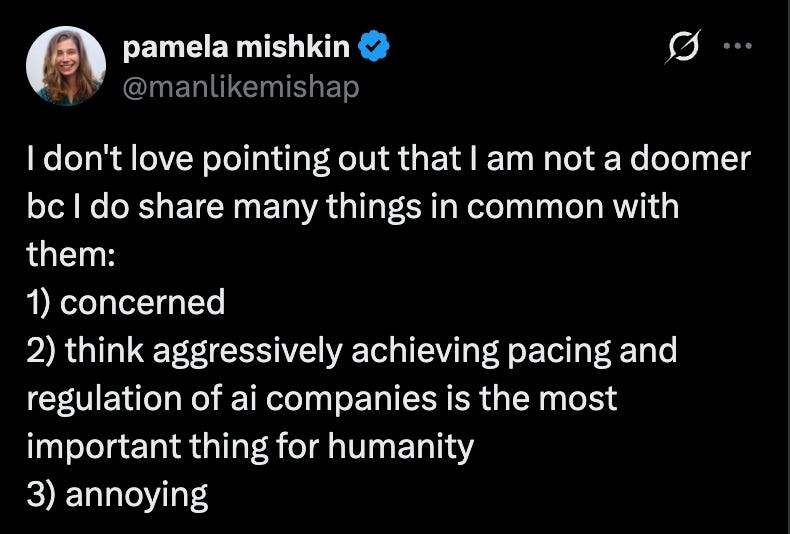
Credit: Pamela Mishkin
Thanks for reading. If you’ve been forwarded this email, click here to subscribe and receive future editions. Have a great weekend.